• Fri frakt över 249 kr
  • •
  • Snabba leveranser
  • •
  • Billiga böcker
Kundservice

Du är på sajten för privatpersoner.

Företag, bibliotek eller offentlig verksamhet?

Du handlar på classic.bokus.com, där alla dina funktioner finns intakta.
Till classic.bokus.com
Bokus logotyp. Gå till startsidan.
  • Erbjudanden
  • Nyheter
  • Student
  • Topplistor
  • Barn & ungdom
  • Bokus Play
  • E-böcker
  • Pocketböcker
  • Spel & pussel

10% studentrabatt med kod TERM26

Sidfot

Mina sidor

    Hjälp

    • Kundservice
    • Vanliga frågor och svar
    • Frakt och leverans
    • Retur vid ångerrätt
    • Reklamera vara
    • Betalning
    • Köpvillkor
    • Allmänna villkor
    • Information om webbplatsens tillgänglighet

    Om Bokus

    • Om oss
    • Pressrum
    • För studenter
    • För företag
    • För bibliotek och offentlig verksamhet
    • För leverantörer
    • Hållbarhet

    Populärt

    • Aktuella erbjudanden
    • Presentkort
    • Studentlitteratur
    • Nya böcker
    • Topplistor
    • Signerade böcker
    • Engelska böcker

    Inspiration

    • Boktips
    • BookTok
    • Populära bokserier
    • Barnbokskaraktärer
    • Populära författare
    Logotyp för Bokus
    Följ oss på Facebook (extern länk)Följ oss på Instagram (extern länk)Följ oss på YouTube (extern länk)Följ oss på TikTok (extern länk)
    bokus @ CookiesAnpassa cookiesIntegritetspolicyKöpvillkor
    Till Citymail hemsida (extern länk)Till Budbee hemsida (extern länk)Till Postnord hemsida (extern länk)Till Schenker hemsida (extern länk)Till Early Bird hemsida (extern länk)Till Walleys hemsida (extern länk)
    1. Skönlitteratur
    2. Litteraturvetenskap
    3. Litteraturvetenskap

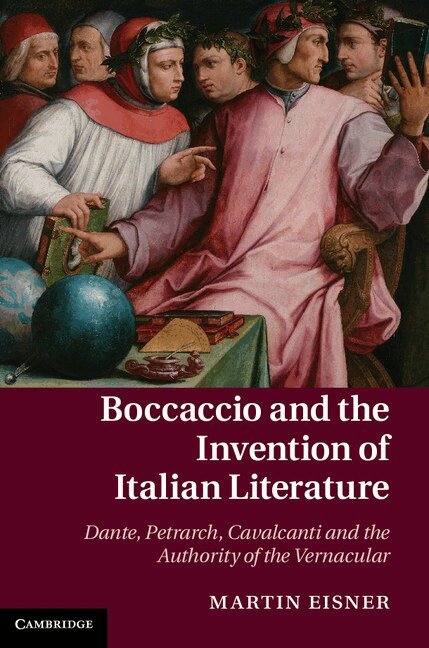
    Boccaccio and the Invention of Italian Literature

    Dante, Petrarch, Cavalcanti, and the Authority of the Vernacular

    AvMartin Eisner

    Häftad, Engelska, 2016

    Del 87 i serien Cambridge Studies in Medieval Literature

    533 kr

    Beställningsvara. Skickas inom 10-15 vardagar. Fri frakt över 249 kr.

    Fler format och utgåvor

    Inbunden

    Tillf. slut

    Beskrivning

    Giovanni Boccaccio played a pivotal role in the extraordinary emergence of the Italian literary tradition in the fourteenth century, not only as author of the Decameron, but also as scribe of Dante, Petrarch and Cavalcanti. Using a single codex written entirely in Boccaccio's hand, Martin Eisner brings together material philology and literary history to reveal the multiple ways Boccaccio authorizes this vernacular literary tradition. Each chapter offers a novel interpretation of Boccaccio as a biographer, storyteller, editor and scribe, who constructs arguments, composes narratives, compiles texts and manipulates material forms to legitimize and advance a vernacular literary canon. Situating these philological activities in the context of Boccaccio's broader reflections on poetry in the Decameron and the Genealogy of the Gentile Gods, the book produces a new portrait of Boccaccio that integrates his vernacular and Latin works, while also providing a new context for understanding his fictions.

    Produktinformation

    • Utgivningsdatum:2016-09-01
    • Mått:153 x 230 x 15 mm
    • Vikt:400 g
    • Format:Häftad
    • Språk:Engelska
    • Serie:Cambridge Studies in Medieval Literature
    • Antal sidor:262
    • Förlag:Cambridge University Press
    • ISBN:9781316619698

    Utforska kategorier

    • Litteraturvetenskap inom Skönlitteratur

    Mer om författaren

    Martin Eisner is Assistant Professor of Italian Studies at Duke University, North Carolina.

    Recensioner i media

    'Eisner's book is a welcome addition to studies on the self‐authorizing project of the Italian poets at a key moment in the rise of European vernaculars. It is also a particularly fine specimen of the 'material' turn in medieval literary studies. A reliable guide to this intricate web of interconnectedness, Eisner shows how productive the combination of philology and interpretation can be, tracing convincingly the impact of paleographical features on reception, the significance of making a book, the significance of page layout, of juxtaposition, of inclusion and exclusion, of editorial choices, of contamination in transcription - and Boccaccio's unique role in all of this.' Alison Cornish, Modern Philology

    Innehållsförteckning

    • Introduction: Boccaccio between Dante and Petrarch: cultivating vernacular literary community in the Chigi codex; 1. Dante's dirty feet and the limping republic: Boccaccio's defense of literature in the Vita di Dante; 2. Dante's shame and Boccaccio's paratextual praise: editing the Vita nuova, Commedia, and canzoni distese; 3. The making of Petrarch's vernacular Book of Fragments (Fragmentorum liber); 4. The inventive scribe: glossing Cavalcanti in the Chigi and Decameron 6.9; Epilogue: the allegory of the vernacular: Boccaccio's Esposizioni and Petrarch's Griselda.