• Fri frakt över 249 kr
  • •
  • Snabba leveranser
  • •
  • Billiga böcker
Kundservice

Du är på sajten för privatpersoner.

Företag, bibliotek eller offentlig verksamhet?

Du handlar på classic.bokus.com, där alla dina funktioner finns intakta.
Till classic.bokus.com
Bokus logotyp. Gå till startsidan.
  • Erbjudanden
  • Nyheter
  • Student
  • Topplistor
  • Barn & ungdom
  • Bokus Play
  • E-böcker
  • Pocketböcker
  • Spel & pussel

10% rabatt på allt med kod: NYSTART10 →

Sidfot

Mina sidor

    Hjälp

    • Kundservice
    • Vanliga frågor och svar
    • Frakt och leverans
    • Retur vid ångerrätt
    • Reklamera vara
    • Betalning
    • Köpvillkor
    • Allmänna villkor
    • Information om webbplatsens tillgänglighet

    Om Bokus

    • Om oss
    • Pressrum
    • För studenter
    • För företag
    • För bibliotek och offentlig verksamhet
    • För leverantörer
    • Hållbarhet

    Populärt

    • Aktuella erbjudanden
    • Presentkort
    • Studentlitteratur
    • Nya böcker
    • Topplistor
    • Signerade böcker
    • Engelska böcker

    Inspiration

    • Boktips
    • BookTok
    • Populära bokserier
    • Barnbokskaraktärer
    • Populära författare
    Logotyp för Bokus
    Följ oss på Facebook (extern länk)Följ oss på Instagram (extern länk)Följ oss på YouTube (extern länk)Följ oss på TikTok (extern länk)
    bokus @ CookiesAnpassa cookiesIntegritetspolicyKöpvillkor
    Till Citymail hemsida (extern länk)Till Budbee hemsida (extern länk)Till Postnord hemsida (extern länk)Till Schenker hemsida (extern länk)Till Early Bird hemsida (extern länk)Till Walleys hemsida (extern länk)
    1. Naturvetenskap och teknik
    2. Matematik och naturvetenskap
    3. Matematik
    4. Matematikens filosofi

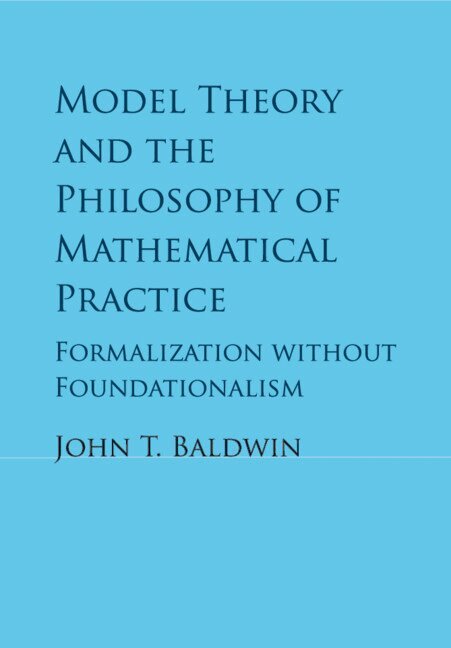
    Model Theory and the Philosophy of Mathematical Practice

    Formalization without Foundationalism

    AvJohn T. Baldwin

    Häftad, Engelska, 2020

    544 kr

    Beställningsvara. Skickas inom 10-15 vardagar. Fri frakt över 249 kr.

    Fler format och utgåvor

    Inbunden

    1 567 kr

    Beskrivning

    Major shifts in the field of model theory in the twentieth century have seen the development of new tools, methods, and motivations for mathematicians and philosophers. In this book, John T. Baldwin places the revolution in its historical context from the ancient Greeks to the last century, argues for local rather than global foundations for mathematics, and provides philosophical viewpoints on the importance of modern model theory for both understanding and undertaking mathematical practice. The volume also addresses the impact of model theory on contemporary algebraic geometry, number theory, combinatorics, and differential equations. This comprehensive and detailed book will interest logicians and mathematicians as well as those working on the history and philosophy of mathematics.

    Produktinformation

    • Utgivningsdatum:2020-01-09
    • Mått:169 x 243 x 17 mm
    • Vikt:600 g
    • Format:Häftad
    • Språk:Engelska
    • Antal sidor:364
    • Förlag:Cambridge University Press
    • ISBN:9781316638835

    Utforska kategorier

    • Matematikens filosofi inom Naturvetenskap och teknik

    Mer om författaren

    John T. Baldwin is Professor Emeritus in the Department of Mathematics, Statistics and Computer Science at the University of Illinois, Chicago. He has published widely on mathematics and philosophy, and he is the author of books including Fundamentals of Stability Theory (1988) and Categoricity (2009).

    Recensioner i media

    'The book under review has a lot to offer at many levels. First of all, it may serve as a guide to recent advances in pure and applied model theory. Such a guide may be useful not only to novices, but also to old hands. Secondly, Baldwin summarizes several trends in contemporary philosophy of mathematics, and his insights should be of interest to philosophers as well as to mathematicians.' Roman Kossak, The Mathematical Intelligencer

    Innehållsförteckning

    • Part I. Refining the Notion of Categoricity: 1. Formalization; 2. The context of formalization; 3. Categoricity; Part II. The Paradigm Shift: 4. What was model theory about?; 5. What is contemporary model theory about?; 6. Isolating tame mathematics; 7. Infinitary logic; 8. Model theory and set theory; Part III. Geometry: 9. Axiomatization of geometry; 10. π, area, and circumference of circles; 11. Complete: the word for all seasons; Part IV. Methodology: 12. Formalization and purity in geometry; 13. On the nature of definition: model theory; 14. Formalism-freeness; 15. Summation.