• Fri frakt över 249 kr
  • •
  • Snabba leveranser
  • •
  • Billiga böcker
Kundservice

Du är på sajten för privatpersoner.

Företag, bibliotek eller offentlig verksamhet?

Du handlar på classic.bokus.com, där alla dina funktioner finns intakta.
Till classic.bokus.com
Bokus logotyp. Gå till startsidan.
  • Erbjudanden
  • Student
  • Topplistor
  • Barn & ungdom
  • Bokus Play
  • E-böcker
  • Ljudböcker
  • Pocketböcker
  • Spel och pussel

5% studentrabatt – använd koden KURSBOK27 →

Sidfot

Mina sidor

    Hjälp

    • Kundservice
    • Vanliga frågor och svar
    • Frakt och leverans
    • Retur vid ångerrätt
    • Reklamera vara
    • Betalning
    • Köpvillkor
    • Allmänna villkor
    • Information om webbplatsens tillgänglighet

    Om Bokus

    • Om oss
    • Pressrum
    • För studenter
    • För företag
    • För bibliotek och offentlig verksamhet
    • För leverantörer
    • Hållbarhet

    Populärt

    • Aktuella erbjudanden
    • Presentkort
    • Studentlitteratur
    • Nya böcker
    • Topplistor
    • Signerade böcker
    • Engelska böcker

    Inspiration

    • Boktips
    • BookTok
    • Barnbokskaraktärer
    • Populära författare
    Logotyp för Bokus
    Följ oss på Facebook (extern länk)Följ oss på Instagram (extern länk)Följ oss på YouTube (extern länk)Följ oss på TikTok (extern länk)
    bokus @ CookiesAnpassa cookiesIntegritetspolicyKöpvillkor
    Till Citymail hemsida (extern länk)Till Budbee hemsida (extern länk)Till Postnord hemsida (extern länk)Till Schenker hemsida (extern länk)Till Early Bird hemsida (extern länk)Till Walleys hemsida (extern länk)
    1. Psykologi och pedagogik
    2. Psykologi
    3. Kognitiv psykologi

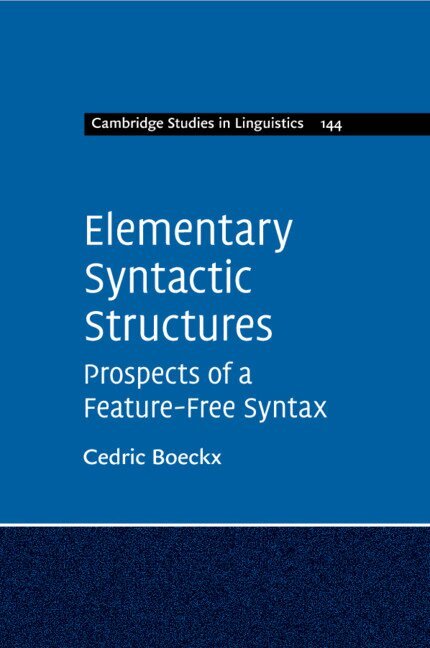
    Elementary Syntactic Structures

    Prospects of a Feature-Free Syntax

    AvCedric Boeckx

    Häftad, Engelska, 2019

    Del 144 i serien Cambridge Studies in Linguistics

    450 kr

    Beställningsvara. Skickas inom 7-10 vardagar. Fri frakt över 249 kr.

    Fler format och utgåvor

    Inbunden

    880 kr

    Beskrivning

    Most syntacticians, no matter their theoretical persuasion, agree that features (types or categories) are the most important units of analysis. Within Chomskyan generative grammar, the importance of features has grown steadily and within minimalism, it can be said that everything depends on features. They are obstacles in any interdisciplinary investigation concerning the nature of language and it is hard to imagine a syntactic description that does not explore them. For the first time, this book turns grammar upside down and proposes a new model of syntax that is better suited for interdisciplinary interactions, and shows how syntax can proceed free of lexical influence. The empirical domain examined is vast, and all the fundamental units and properties of syntax (categories, parameters, Last Resort, labelling, and hierarchies) are rethought. Opening up new avenues of investigation, this book will be invaluable to researchers and students in syntactic theory, and linguistics more broadly.

    Produktinformation

    • Utgivningsdatum:2019-08-22
    • Mått:151 x 229 x 11 mm
    • Vikt:300 g
    • Format:Häftad
    • Språk:Engelska
    • Serie:Cambridge Studies in Linguistics
    • Antal sidor:220
    • Förlag:Cambridge University Press
    • ISBN:9781316645376

    Utforska kategorier

    • Kognitiv psykologi inom Psykologi och pedagogik

    Mer om författaren

    Cedric Boeckx is Research Professor at ICREA (The Catalan Institute for Advanced Studies) and a member of the Department of Linguistics at Universitat de Barcelona.

    Recensioner i media

    'To be a good biolinguist, one needs to be a serious anti-lexicalist. Cedric Boeckx proves it by bringing together the highlights of modern syntactic theorizing and biological thinking.' Koji Fujita, Kyoto University

    Innehållsförteckning

    • Preface; Abbreviations and symbols; 1. Biolinguistic concerns; 2. Syntactic order for free: merge α; 3. Trusting in the external systems: descent with modification; 4. Elaborate grammatical structures: how (and where) to deal with variation; 5. Interdisciplinary prospects; Appendix 1. Déjà vu all over again?; Appendix 2. Switching metaphors: from clocks to sandpiles; Appendix 3. More on the loss of syntactic variation; Bibliography; Index.