• Fri frakt över 249 kr
  • •
  • Snabba leveranser
  • •
  • Billiga böcker
Kundservice

Du är på sajten för privatpersoner.

Företag, bibliotek eller offentlig verksamhet?

Du handlar på classic.bokus.com, där alla dina funktioner finns intakta.
Till classic.bokus.com
Bokus logotyp. Gå till startsidan.
  • Erbjudanden
  • Nyheter
  • Student
  • Topplistor
  • Barn & ungdom
  • Bokus Play
  • E-böcker
  • Pocketböcker
  • Spel & pussel

10% rabatt på allt med kod: NYSTART10 →

Sidfot

Mina sidor

    Hjälp

    • Kundservice
    • Vanliga frågor och svar
    • Frakt och leverans
    • Retur vid ångerrätt
    • Reklamera vara
    • Betalning
    • Köpvillkor
    • Allmänna villkor
    • Information om webbplatsens tillgänglighet

    Om Bokus

    • Om oss
    • Pressrum
    • För studenter
    • För företag
    • För bibliotek och offentlig verksamhet
    • För leverantörer
    • Hållbarhet

    Populärt

    • Aktuella erbjudanden
    • Presentkort
    • Studentlitteratur
    • Nya böcker
    • Topplistor
    • Signerade böcker
    • Engelska böcker

    Inspiration

    • Boktips
    • BookTok
    • Populära bokserier
    • Barnbokskaraktärer
    • Populära författare
    Logotyp för Bokus
    Följ oss på Facebook (extern länk)Följ oss på Instagram (extern länk)Följ oss på YouTube (extern länk)Följ oss på TikTok (extern länk)
    bokus @ CookiesAnpassa cookiesIntegritetspolicyKöpvillkor
    Till Citymail hemsida (extern länk)Till Budbee hemsida (extern länk)Till Postnord hemsida (extern länk)Till Schenker hemsida (extern länk)Till Early Bird hemsida (extern länk)Till Walleys hemsida (extern länk)
    1. Kultur
    2. Designböcker
    3. Modedesign och textilformgivning

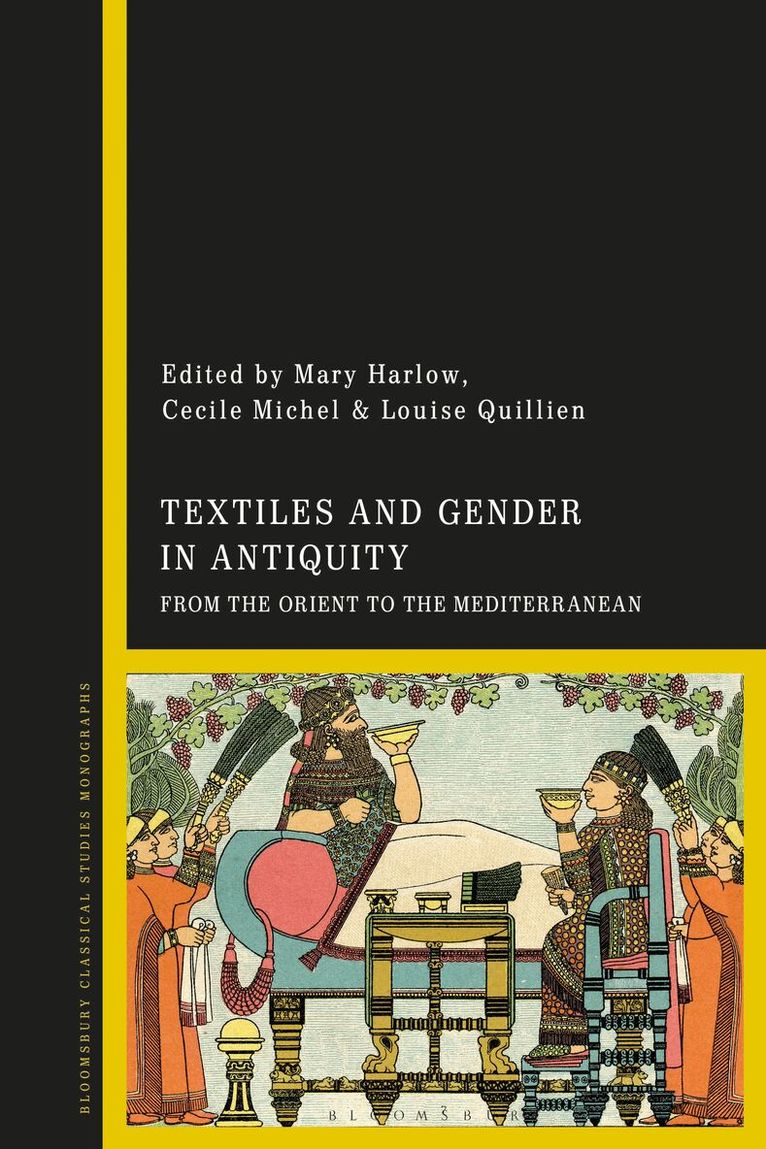
    Textiles and Gender in Antiquity

    From the Orient to the Mediterranean

    AvMary Harlow,Cecile Michel

    Häftad, Engelska, 2022

    464 kr

    Beställningsvara. Skickas inom 10-15 vardagar. Fri frakt över 249 kr.

    Beskrivning

    This volume looks at how the issues of textiles and gender intertwine across three millennia in antiquity and examines continuities and differences across time and space – with surprising resonances for the modern world. The interplay of gender, identity, textile production and use is notable on many levels, from the question of who was involved in the transformation of raw materials into fabric at one end, to the wearing of garments and the construction of identity at the other.Textile production has often been considered to follow a linear trajectory from a domestic (female) activity to a more ‘commercial’ or ‘industrial’ (male-centred) mode of production. In reality, many modes of production co-existed and the making of textiles is not so easily grafted onto the labour of one sex or the other. Similarly, textiles once transformed into garments are often of ‘unisex’ shape but worn to express the gender of the wearer. As shown by the detailed textual source material and the rich illustrations in this volume, dress and gender are intimately linked in the visual and written records of antiquity. The contributors show how it is common practice in both art and literature not only to use particular garments to characterize one sex or the other, but also to undermine characterizations by suggesting that they display features usually associated with the opposite gender.

    Produktinformation

    • Utgivningsdatum:2022-05-19
    • Mått:154 x 232 x 22 mm
    • Vikt:520 g
    • Format:Häftad
    • Språk:Engelska
    • Antal sidor:328
    • Förlag:Bloomsbury Publishing PLC
    • ISBN:9781350189737

    Utforska kategorier

    • Modedesign och textilformgivning inom Kultur
    • Konsthistoria inom Kultur
    • Forntidens historia inom Historia och arkeologi

    Mer om författaren

    Mary Harlow is an Associate Professor in Ancient History at the University of Leicester, UK. She has published extensively on Roman dress and has been an editor and contributor to several of Bloomsbury’s Cultural History series including Children and the Family (2010), Dress and Fashion (2017), Hair (2018) and Shopping (2019).Cécile Michel is a Senior Researcher at CNRS, Archéologie et Science de l’Antiquité, France and Professor of Assyriology at Hamburg University, Germany. She has published books and studies on women, gender studies and ancient textiles including Textile Terminologies (2010 and 2017) Wool Economy in the Ancient Near East and the Aegean (2014) and The Role of Women in Work and Society in the Ancient Near East (2016).Louise Quillien is a Researcher at CNRS, Archéologie et Science de l’Antiquité, France. She defended her PhD on Textiles in Mesopotamia, 1st millennium BC: manufacturing techniques, trade and uses in 2016.

    Recensioner i media

    [Textiles and Gender in Antiquity] is a great resource for in depth knowledge and studies of Antiquity, textiles, and gender.

    Innehållsförteckning

    • 1. Textiles and Gender in Antiquity: An IntroductionMary Harlow (Leicester, UK), Cécile Michel (CNRS, ArScAn, Nanterre, France) and Louise Quillien (Paris 1 Panthéon-Sorbonne, France)Gendered Textile Terminologies2. Textiles and Gender during the Middle Babylonian Period (ca. 1500-1000 BCE): Texts from Syria and BabyloniaPhilippe Abrahami (Independent Scholar, France) and Brigitte Lion (Paris 1 Panthéon-Sorbonne, France)3. The Goddess Nanaja’s New ClothesFrancis Joannès (Paris 1 Panthéon-Sorbonne, France)4. Textiles and Gender at UgaritValérie Matoïan (CNRS, Proclac, France) and Juan-Pablo Vita (Independent Scholar, Spain)5. Towards Engendering Textile Production in Middle Bronze Age CreteAgata Ulanowska (Independent Scholar, Poland)Gendered Textile Activities6. A Man’s Business? Washing the Clothes in Ancient Egypt (Second and First Millennia BCE)Damien Agut-Labordère (CNRS, France)7. Women, Men, Girls and Boys: Gendered Textile Work at Late Bronze Age KnossosHedvig Landenius Enegren (Independent Scholar, Uppsala)8. Female Dues and the Production of Textiles in Ancient Greece Beate Wagner-Hasel (Independent Scholar, Germany)9. Gender and Textile Production in Roman Society and PoliticsLena Larsson Lovén (Independent Scholar, Germany)10. Work Gendering Space? Roman Gender, Textile Work and Time in Shared Domestic SpaceMagdalena Ohrman (University of Wales, UK)Gendered Wardrobes11. Some Remarks on Textiles and Gender in the Ebla Texts of the 3rd Millennium BCEMaria Giovanna Biga (Rome, La Sapienza, Italy)12. A Visual Investigation of Feminine Garments at Mari During the Early Bronze AgeBarbara Couturaud (Institut Français du Proche-Orient, Iraq)13. Belts and Pins as Gendered Elements of Clothing in Third and Second Millennia MesopotamiaCécile Michel (CNRS, ArScAn, France)14. ‘I made you put on garments, I made you dress in linen.’ Gender Performance and Garments in Sumerian Literature Anne-Caroline Rendu Loisel (Unistra, Strasbourg, France)15. The Gender of Garments in First Millennium BCE Mesopotamia: An Inquiry Through Texts and IconographyLouise Quillien (Paris 1 Panthéon-Sorbonne, France)16. White Men and Rainbow Women: Gendered Colour Coding in Roman Dress Cecilie Brøns (Ny Carlsberg Glyptotek, Denmark) and Mary Harlow (Leicester University, UK)17. Garments for Potters? Textiles, Gender and Funerary Practices in Les Martres-de-Veyre, France (Roman Period)Catherine Breniquet (Clermont-Auvergne, France ), Marie Bèche-Wittman, Christine Bouilloc and Camille Gaumat (Musée Bargoin, Clermont-Ferrand, France)18. Fashioning the Female in the Early North African ChurchAmy Place (Leicester University, UK)19. Climate Change and Clothing Changes in Late Antique Male DressNikki K. Rollason (Leicester University, UK)Afterwords20. A Note on Gender and French ‘Haute Couture’ in 1970: ‘Les Sumériennes’ by Jacques EstérelBrigitte Lion (Paris 1 Panthéon – Sorbonne, France)21. Concluding RemarksEva Andersson Strand (Independent Scholar, Denmark)NotesBibliographyIndex