• Fri frakt över 249 kr
  • •
  • Snabba leveranser
  • •
  • Billiga böcker
Kundservice

Du är på sajten för privatpersoner.

Företag, bibliotek eller offentlig verksamhet?

Du handlar på classic.bokus.com, där alla dina funktioner finns intakta.
Till classic.bokus.com
Bokus logotyp. Gå till startsidan.
  • Erbjudanden
  • Nyheter
  • Student
  • Topplistor
  • Barn & ungdom
  • Bokus Play
  • E-böcker
  • Pocketböcker
  • Spel & pussel

10% rabatt på allt med kod NYSTART10 →

Sidfot

Mina sidor

    Hjälp

    • Kundservice
    • Vanliga frågor och svar
    • Frakt och leverans
    • Retur vid ångerrätt
    • Reklamera vara
    • Betalning
    • Köpvillkor
    • Allmänna villkor
    • Information om webbplatsens tillgänglighet

    Om Bokus

    • Om oss
    • Pressrum
    • För studenter
    • För företag
    • För bibliotek och offentlig verksamhet
    • För leverantörer
    • Hållbarhet

    Populärt

    • Aktuella erbjudanden
    • Presentkort
    • Studentlitteratur
    • Nya böcker
    • Topplistor
    • Signerade böcker
    • Engelska böcker

    Inspiration

    • Boktips
    • BookTok
    • Populära bokserier
    • Barnbokskaraktärer
    • Populära författare
    Logotyp för Bokus
    Följ oss på Facebook (extern länk)Följ oss på Instagram (extern länk)Följ oss på YouTube (extern länk)Följ oss på TikTok (extern länk)
    bokus @ CookiesAnpassa cookiesIntegritetspolicyKöpvillkor
    Till Citymail hemsida (extern länk)Till Budbee hemsida (extern länk)Till Postnord hemsida (extern länk)Till Schenker hemsida (extern länk)Till Early Bird hemsida (extern länk)Till Walleys hemsida (extern länk)
    1. Språk och ordböcker
    2. Språkundervisning och språkinlärning

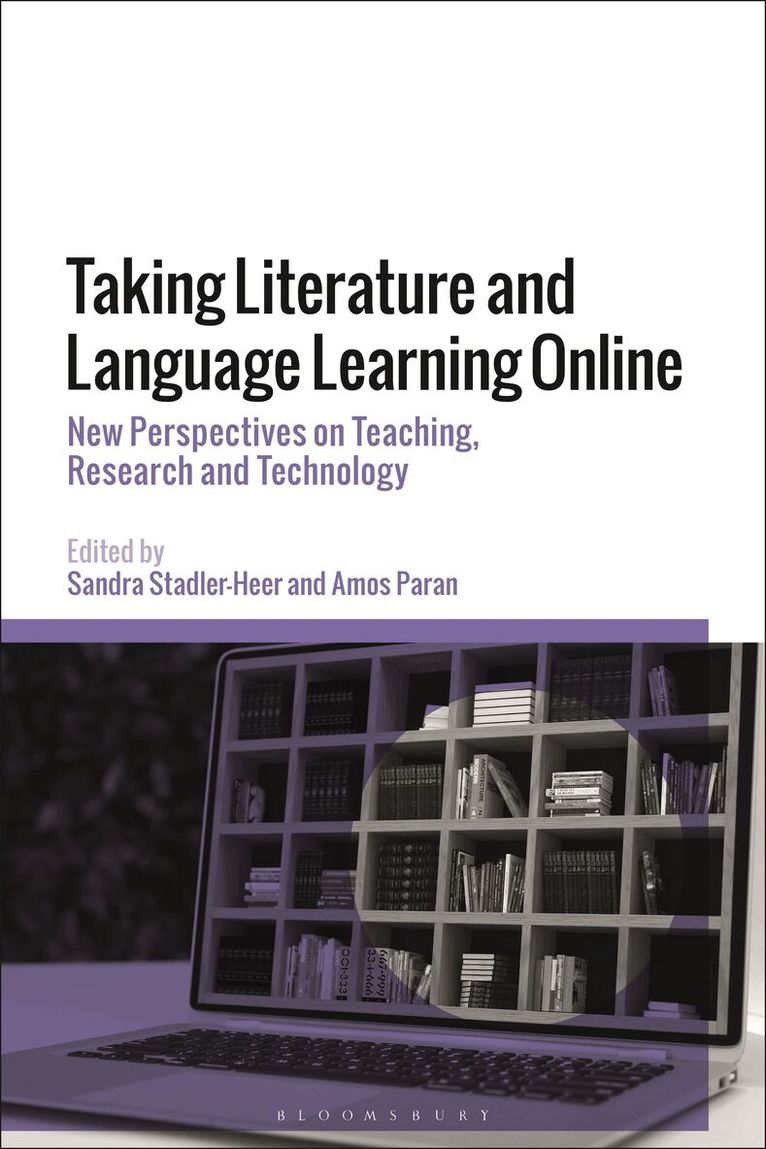
    Taking Literature and Language Learning Online

    New Perspectives on Teaching, Research and Technology

    AvSandra Stadler-Heer,Amos Paran

    Häftad, Engelska, 2024

    412 kr

    Beställningsvara. Skickas inom 10-15 vardagar. Fri frakt över 249 kr.

    Beskrivning

    The use of literary texts in language classrooms is firmly established, but new questions arise with the transfer to remote teaching and learning. How do we teach literature online? How do learners react to being taught literature online? Will new genres emerge from the COVID-19 pandemic? Is the literary canon changing?This volume celebrates the vitality of literary and pedagogic responses to the pandemic and presents research into the phenomena observed in this evolving field. One strand of the book discusses literary outputs stimulated by the pandemic as well as past pandemics. Another strand looks at the pedagogy of engaging learners with literature online, examining learners of different ages and of different proficiency levels and different educational backgrounds, including teacher education. Finally, a third strand looks at the affordances of various technologies for teaching online and the way they interact with literature and with language learning. The contributions in this volume take literature teaching online away from static lecturing strategies, present numerous options for online teaching, and provide research-based grounding for the implementation of these pedagogies.

    Produktinformation

    • Utgivningsdatum:2024-05-30
    • Mått:154 x 232 x 18 mm
    • Vikt:410 g
    • Format:Häftad
    • Språk:Engelska
    • Antal sidor:280
    • Förlag:Bloomsbury Publishing PLC
    • ISBN:9781350268562

    Utforska kategorier

    • Språkundervisning och språkinlärning inom Språk och ordböcker
    • Material och digital teknik i undervisningen inom Psykologi och pedagogik
    • Språkvetenskap och lingvistik inom Språk och ordböcker

    Mer om författaren

    Sandra Stadler-Heer is Senior Lecturer of TESOL at the Department of Linguistics and Literature, Catholic University of Eichstätt-Ingolstadt, Germany.Amos Paran is Professor of TESOL at IOE, UCL’s Faculty of Education and Society, University College London, UK.

    Recensioner i media

    This novel, timely and interesting volume explores the nexus of literature and foreign language learning, and more importantly their interconnectedness throughout the move to online publishing and teaching arising from the Covid-19 pandemic. Online interaction is at the heart of the volume, and the role literature and art more broadly have played in reminding learners and teachers alike ‘why life is worth living’ (Ben Okri, p.1) during the dark days of the pandemic. Yet although the volume is very deeply rooted in 2020 and subsequent years, the messages coming out of it have relevance beyond that period, for both language practitioners and researchers. Rather than just presenting the challenges posed for engagement with literature by online teaching, learning and publishing, the volume invites the reader to consider the many affordances of the digital world. In so doing it will be of interest to all those concerned with language education in the broadest sense, from the early years of schooling through to teacher education and publishing.

    Innehållsförteckning

    • Introduction, Amos Paran (Institute of Education, University College London, UK) and Sandra Stadler-Heer (Catholic University Eichstätt-Ingolstadt, Germany)Part I: Literary Responses in Times of Crisis1. Literary Narratives as Recordings of the Pandemic Present: The New York Times Magazine's Decameron Project, Ingrid Gessner (University College of Teacher Education Vorarlberg, Austria)2. Pandemic Literature: What It Is, Why It Should Be Taught and How, Engelbert Thaler (University of Augsburg, Germany)II. Researching and Teaching Literature for/to Young Learners 3. Identifying Quality in Asynchronous, Pre-recorded Picturebook Read-Alouds for Children Learning English as a Foreign Language, Gail Ellis (Independent Researcher, France) and Sandie Mourão (Universidade Nova de Lisboa, Portugal)4. Digital Picturebooks in Times of Crisis: From Picturebooks about the Coronavirus to Developing Critical Environmental Literacies, Theresa Summer (University of Würzburg, Germany)III. Researching and Teaching Literature in Online Teacher Education 5. Exploiting the Educational Potential of Literature in English Language Teaching: Continuity and Change in Digital Literature Teaching, Christine Gardemann (University of Bielefeld, Germany)6. Conducting Story-based Activities in Times of Social Distancing, Annett Kaminski (University of Koblenz-Landau, Germany)IV. Tools and Concepts for Teaching Literature Online7. Implementing a Collaborative Reading Project Online: Solutions for a Pedagogically Meaningful Virtual Workshop, Jennifer Schumm Fauster (University of Graz, Austria)8. Digital Storytelling as a Pedagogical Approach for Meaningful Learning: Alternative Implementations of Technology in the Libyan EFL Context, Fatma Abu-Baker (University of Edinburgh, UK) and Hana A. El-Badri (University of Benghazi, Lybia)9. Simple and Engaging Fiction for Adult Beginners, Pedro Malard Monteiro (Universidade Federal de Uberlandia, Brazil), Margaret Wilkinson (Newcastle University, UK) and Martha Young-Scholten (Newcastle University, UK)10. Annotating Literary Texts on Conceptboard: Philological Practice in the Digital Classroom, Verena Laschinger (University of Erfurt, Germany)11. Writing the Future —Collaborative Creative Science-Fiction Writing in the Virtual EFL Classroom, Christian Ludwig and Elizabeth Shipley (University of Karlsruhe, Germany)Afterword: Closing Reflections on the Brave New World of Literature and Language Education Online, Geoff Hall (University of Nottingham-Ningbo, China) References