
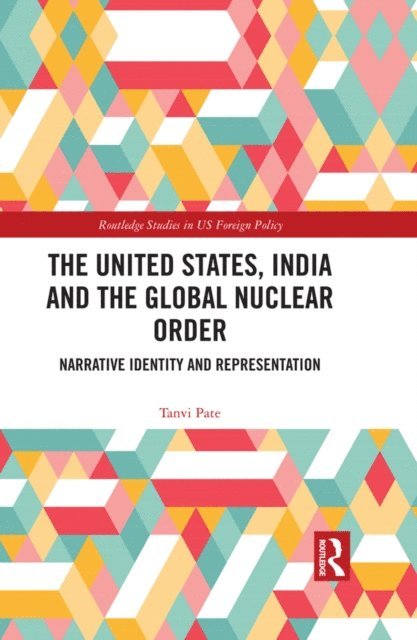
United States, India and the Global Nuclear Order
Narrative Identity and Representation
E-bok
Engelska, 2018796 kr
Läs direkt i Bokus Reader – eller ladda ned till din enhet
Fler format och utgåvor
Beskrivning
In the Post-Cold War era, US nuclear foreign policies towards India witnessed a major turnaround as a demand for ‘cap, reduce, eliminate’ under the Clinton administration was replaced by the implementation of the historic ‘civil nuclear deal’ in 2008 by Bush, a policy which continued under Obama’s administration.
This book addresses the change in US nuclear foreign policy by focusing on three core categories of identity, inequality, and great power narratives. Building upon the theoretical paradigm of critical constructivism, the concept of the ‘state’ is problematised by focusing on identity-related questions arguing that the ‘state’ becomes a constructed entity standing as valid only within relations of identity and difference. Focusing on postcolonial principles, Pate argues that imperialism as an organising principle of identity/difference enables us to understand how difference was maintained in unequal terms through US nuclear foreign policy. This manifested in five great power narratives constructed around peace and justice; India-Pakistan deterrence; democracy; economic progress; and scientific development. Identities of ‘race’, ‘political economy’, and ‘gender’, in terms of ‘radical otherness’ and ‘otherness’ were recurrently utilised through these narratives to maintain a difference enabling the respective administrations to maintain ‘US’ identity as a progressive and developed western nation, intrinsically justifying the US role as an arbiter of the global nuclear order.
A useful work for scholars researching identity construction and US foreign and security policies, US-India bilateral nuclear relations, South Asian nuclear politics, critical security, and postcolonial studies.
Produktinformation
Utforska kategorier
Hoppa över listan



Du kanske också är intresserad av
- Nyhet
Del 11
- Signerad!
Del 3
- -19%
- -19%
- Nyhet
- Nyhet
Del 11
- Nyhet