• Fri frakt över 249 kr
  • •
  • Snabba leveranser
  • •
  • Billiga böcker
Kundservice

Du är på sajten för privatpersoner.

Företag, bibliotek eller offentlig verksamhet?

Du handlar på classic.bokus.com, där alla dina funktioner finns intakta.
Till classic.bokus.com
Bokus logotyp. Gå till startsidan.
  • Erbjudanden
  • Nyheter
  • Student
  • Topplistor
  • Barn & ungdom
  • Bokus Play
  • E-böcker
  • Pocketböcker
  • Spel & pussel

10% rabatt på allt med kod: NYSTART10 →

Sidfot

Mina sidor

    Hjälp

    • Kundservice
    • Vanliga frågor och svar
    • Frakt och leverans
    • Retur vid ångerrätt
    • Reklamera vara
    • Betalning
    • Köpvillkor
    • Allmänna villkor
    • Information om webbplatsens tillgänglighet

    Om Bokus

    • Om oss
    • Pressrum
    • För studenter
    • För företag
    • För bibliotek och offentlig verksamhet
    • För leverantörer
    • Hållbarhet

    Populärt

    • Aktuella erbjudanden
    • Presentkort
    • Studentlitteratur
    • Nya böcker
    • Topplistor
    • Signerade böcker
    • Engelska böcker

    Inspiration

    • Boktips
    • BookTok
    • Populära bokserier
    • Barnbokskaraktärer
    • Populära författare
    Logotyp för Bokus
    Följ oss på Facebook (extern länk)Följ oss på Instagram (extern länk)Följ oss på YouTube (extern länk)Följ oss på TikTok (extern länk)
    bokus @ CookiesAnpassa cookiesIntegritetspolicyKöpvillkor
    Till Citymail hemsida (extern länk)Till Budbee hemsida (extern länk)Till Postnord hemsida (extern länk)Till Schenker hemsida (extern länk)Till Early Bird hemsida (extern länk)Till Walleys hemsida (extern länk)
    1. Data och IT
    2. Systemvetenskap och AI
    3. Artificiell intelligens

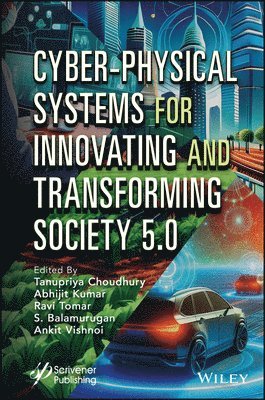
    Cyber-Physical Systems for Innovating and Transforming Society 5.0

    AvTanupriya Choudhury,Abhijit Kumar

    Inbunden, Engelska, 2025

    Del i serien Artificial Intelligence and Soft Computing for Industrial Transformation

    2 140 kr

    Beställningsvara. Skickas inom 5-8 vardagar. Fri frakt över 249 kr.

    Beskrivning

    The book presents a suite of innovative tools to reshape society into an interconnected future where technology empowers humans to efficiently resolve pressing socio-economic issues while fostering inclusive growth. This book introduces a spectrum of pioneering advancements across various sectors within Society 5.0, all underpinned by cutting-edge technological innovations. It aims to deliver an exhaustive collection of contemporary concepts, practical applications, and groundbreaking implementations that have the potential to enhance diverse areas of society. Society 5.0 signifies human advancement and is distinguished by its unique synthesis of cyberspace with physical space. This integration harnesses data gathered via environmental sensors, processed by artificial intelligence, to enhance real-world interactions. This volume encompasses an extensive array of scholarly works with detailed insights into fields such as image processing, natural language processing, computer vision, sentiment analysis, and analyses based on voice and gestures. The content presented will be beneficial to multiple disciplines, including the legal system, medical systems, intelligent societal constructs, integrated cyber-physical systems, and innovative agricultural practices. In summary, Cyber-Physical Systems for Innovating and Transforming Society 5.0 presents a suite of innovative tools to reshape society into an interconnected future where technology empowers humans to efficiently resolve pressing socio-economic issues while fostering inclusive growth. Audience The book will be beneficial to researchers, engineers, and students in multiple disciplines, including the legal system, medical systems, intelligent societal constructs, integrated cyber-physical systems, and innovative agricultural practices.

    Produktinformation

    • Utgivningsdatum:2025-04-15
    • Vikt:454 g
    • Format:Inbunden
    • Språk:Engelska
    • Serie:Artificial Intelligence and Soft Computing for Industrial Transformation
    • Antal sidor:288
    • Förlag:John Wiley & Sons Inc
    • ISBN:9781394197712

    Utforska kategorier

    • Artificiell intelligens inom Data och IT

    Mer om författaren

    Tanupriya Choudhury, PhD, is a professor and Associate Dean of Research at Graphic Era University, Dehradun, India, and a visiting professor at Daffodil International University, Bangladesh, with 15 years of research and teaching experience. He has published hundreds of papers in national and international journals and conferences, and more than 30 books and book chapters. He has also filed 25 patents and secured copyrights for 16 software programs for India’s Ministry of Human Resource Development. Abhijit Kumar, PhD, is an assistant professor in the School of Computer Science, University of Petroleum and Energy Sciences, Dehradun, India, with more than 13 years of academic and industry experience. He has published two patents and many research papers in international peer-reviewed journals and conferences. He is also a seasoned speaker and is a member of several professional bodies, including the International Association of Computer Science and Information Technology, Singapore; the International Association of Engineers, Hong Kong; and the Universal Association of Computer and Electronics Engineers. Ravi Tomar, PhD, is a Senior Architect for Persistent Systems, India, with a history as an experienced academician in the higher education industry. He has trained numerous national and international corporations, including Confluent Apache Kafka, KeyBank, Accenture, and the Union Bank of the Philippines. He is skilled in programming, computer networking, stream processing, Python, Oracle database, C++, core Java, and CorDApp. S. Balamurugan, PhD, is the Director of Research and Development, Intelligent Research Consultancy Services (iRCS), Coimbatore, Tamil Nadu, India. He is also Director of the Albert Einstein Engineering and Research Labs (AEER Labs), as well as Vice-Chairman of the Renewable Energy Society of India (RESI), India. He has published 50+ books, 200+ international journals/conferences, and 35 patents. Ankit Vishnoi, PhD, is an associate professor at Graphic Era University, Dehradun, India, with over 19 years of comprehensive experience in academia and industry. He has published 20 research articles in esteemed journals and conferences, and holds two patents. Notably, he was involved in a Department of Science and Technology project during his tenure at the University of Petroleum and Energy Sciences, Dehradun.

    Innehållsförteckning

    • Preface xvAcknowledgement xix1 Revolutionizing Legal Operations: Benefits and Best Practices of Cyber‐Physical Systems in Society5.0 1Ravi Kant, Anil Kumar Dixit and Reena Roy1.1 Introduction 21.1.1 Cyber–Physical System 21.1.2 CPS Usage in the Legal Field 31.2 Benefits of CPS in the Legal Field 41.2.1 Increased Efficiency 41.2.2 Enhanced Security 51.2.3 Improved Collaboration 61.2.4 Predictive Analytics 71.3 Applications of CPS in the Legal Field 91.3.1 Case Management 91.3.2 Contract Management 101.3.3 Document Management 111.3.4 Legal Research 121.3.5 Litigation Support 131.4 Challenges of Implementing CPS in the Legal Field 131.4.1 Resistance to Change 131.4.2 Cost of Implementation 151.4.3 Security Concerns 171.4.4 Complexity of Integration 181.5 Best Practices for Implementing CPS in the Legal Field 191.5.1 Understanding the Business Case for CPS 191.5.2 Assess the Technology Panorama 201.5.3 Develop a Comprehensive Implementation Plan 201.5.4 Ensure Statistics’ Privacy and Security 211.5.5 Provide Adequate Schooling and Support 221.6 Examples of Successful CPS Implementation within the Legal Field 231.6.1 Law Firms 231.6.2 Corporate Legal Departments 231.6.3 Legal Technology Companies 231.7 Future of CPS 241.7.1 Potential for In-Addition Integration with Different Rising Technology 241.7.2 Potential for Extra Performance and Cost Savings 241.7.3 Potential for Extended Accuracy and Effectiveness of Criminal Methods 251.8 Conclusion 251.8.1 Recap of Benefits and Challenges of CPS in the Legal Field 251.8.2 Future Outlook for CPS Inside the Legal Subject 261.8.3 Way Forward 26References 272 Integrating Predictive Capabilities and Voice Biometric Authentication in Voice Assistants 29Sonali Behura, Ashima Narang, Priyanka Vashisht and Aman Jatain2.1 Introduction 302.2 Literature Review 312.3 Methodology 342.4 Discussion and Result 352.4.1 Limitations 392.5 Conclusion and Future Scope 39References 403 Leveraging Cloud Computing in Cyber‐Physical Systems for Innovative Society 5.0 43Avinash Kumar Saxena and Priyanka Vashisht3.1 Introduction 443.2 Scope and Objective 443.3 Overview 453.4 Layers of Metaverse 463.5 Social and Technological Challenges 483.6 Evolution 503.7 Social and Cultural Implications 523.8 Limitation 533.9 Conclusion 55References 564 Drone Management System to Detect Fire and Potholes on the Road Towards Smart City 59Shubham Adhikary, Agniswari Guha and Sayan Majumder4.1 Introduction 594.1.1 Management Mechanism 604.1.2 Pothole Detection 614.1.3 Fire Detection 624.2 Proposed Methodology 624.2.1 Acquisition of the Dataset 624.2.1.1 Deep Learning Model for Pothole and Fire Detection 644.2.2 Family YOLO 644.2.3 Yolo V5 654.2.3.1 Framework Used 654.2.3.2 Benefits of YOLOv5 664.3 Experimentation and Results 664.3.1 Data Annotations 664.3.2 Test Systems 674.3.3 Performance Metrics 674.3.3.1 Performance with Pothole Dataset Using YOLOv5 674.3.3.2 Performance with Fire Dataset Using YOLOv5x 714.4 Conclusion 74References 755 A Comprehensive Approach to Cybersecurity and Healthcare Systems Using Artificial Intelligence and Robotics 77Harshvardhan P. Ghongade and Anjali A. Bhadre5.1 Introduction 785.1.1 Hypothesis 815.1.1.1 What are the General Problems in Cybersecurity? 815.1.1.2 What are the General Problems in Healthcare? 825.1.1.3 What is the Significance of AI and the Field of Robotics? 835.1.1.4 What are the Challenges of AI in Cybersecurity and Healthcare and How can these be Overcome?845.1.1.5 What is the Current State of Research in AI in Terms of Cybersecurity and Healthcare? 855.1.1.6 What is the Future of AI from a Cybersecurity and Healthcare Perspective? 855.2 Methodology 865.2.1 Applications of AI in Cybersecurity Defense 865.2.2 Applications of AI in Healthcare 885.2.3 Data Source 905.2.4 Exploration Criteria 905.2.5 Artificial Intelligence and Robotics 1005.2.5.1 Characteristics of Artificial Intelligence 1045.2.5.2 The Robotics Field 1075.3 Conclusion 1115.4 Future Direction 111References 1126 Nonlinear Power Law Modeling for Test Vehicle Structural Response 121Harshvardhan P. Ghongade and Anjali A. Bhadre6.1 Introduction 1226.2 Theory 1276.2.1 Linear Closure Phase Force-Deflection Model 1306.2.2 Power Law Closure Phase Force-Deflection Model 1326.2.3 Linear Separation Phase Force-Deflection Model 1356.2.4 Power Separation Phase Force-Deflection Model 1386.2.5 Power Law Kinematic Response 1436.3 Methods and Materials 1466.4 Results 1486.5 Discussion 156References 1597 Key Matrix Generation Techniques for Hill Cipher Cryptosystem – A Comparative Study 161Maharshi S. Pandya, Vrajesh S. Brahmbhatt, Arvik J. Shah, Rajeev Kumar Gupta and Abhijit Kumar7.1 Introduction 1627.2 Literature Review 1627.3 Hill Cipher 1657.4 Key Generation Methods for Hill Cipher 1677.4.1 Magic Rectangle Method for the Generation of Key Matrix for Hill Cipher 1677.4.2 A Generation of Self-Invertible Matrix for Hill Cipher Algorithm 1687.4.3 A Generation of Self-Invertible Matrix Using Generic Approach 1697.4.4 Alternate Approach for a Generation of Self-Invertible Matrix 1697.5 Methodology for Comparative Study 1697.5.1 Background and Overview 1707.5.2 Security Aspect 1707.5.3 Quality of the Techniques 1707.5.4 Implementation Ease 1717.5.5 Limitations 1717.6 Conclusion and Future Prospects 171References 1728 Machine Learning-Based Spotify Song Prediction 175Meenakshi Jha, Devansh Vyas, Dhruv Mehta, Jai Maru, Abhijit Kumar and Rajeev Kumar Gupta8.1 Introduction 1768.2 Literature Review 1788.3 Methodology 1798.4 Experimental Results 1848.4.1 Task 1: Time Series Analysis 1848.4.2 Task 2: Recommended Artists 1858.4.3 Task 3: Popularity Rating 1868.4.4 Task 4: Differentiate Genres 1898.5 Conclusion 190References 1919 Artificial Intelligence and Sentiment Analysis in Political Campaigns 193Amit Das and Sanjeev Malaviya9.1 Introduction 1939.2 Artificial Intelligence and Sentiment Analysis in Modern Politics 1949.3 Artificial Intelligence: A Catalyst for Political Transformation 1959.4 Sentiment Analysis: Deciphering the Public Pulse 1959.5 Applications AI and Sentiment Analysis in Modern Politics 1959.6 Ethical Considerations 1979.7 Artificial Intelligence in Political Campaigns 1979.8 Use of Sentiment Analysis in Political Campaigns 1989.9 Interrelated Variable Matrix for AI and Sentiment Analysis in Modern Politics 2009.10 Cambridge Analytica: Data Scandal of Digital Politics 2039.11 Digital Politics 2049.12 Conclusion 207References 20710 Digital Platforms and Leveraging Technologies to Enhance Learner Engagement 211Amit Das and Sanjeev Malaviya10.1 Introduction 21110.2 Personalized Instruction and Adaptive Learning 21410.3 Interactive Learning Experiences 21710.4 Leveraging Technology: Inclusivity and Access to Education 22210.5 Seamless Learning 22410.6 Ethical Considerations and Digital Citizenship 22510.7 Conclusion 227References 22911 Disruptive Technologies in Cyber-Physical Systems in War 233Ayan Sar, Tanupriya Choudhury, Rahul Kumar Singh, Abhijit Kumar, Hussain Falih Mahdi and Ankit Vishnoi11.1 Introduction 23411.2 Cyber-Physical Systems in Modern Warfare 23511.2.1 Exploring Cyber-Physical Systems: Definition and Key Characteristics 23511.2.2 Integration of CPS in Military Operations 23711.2.3 Cyber-Physical Systems in Achieving Operational Objectives 23811.3 Artificial Intelligence in Cyber-Physical Systems 23911.3.1 Autonomous Weapon Systems and AI-Driven Decision-Making 23911.3.2 Artificial Intelligence for Predictive Analysis and Situational Awareness 24011.3.3 Ethical and Legal Implications of AI in Warfare 24111.4 Autonomous Systems and Robotics 24111.4.1 Drones and Unmanned Aerial Vehicles (UAVs) 24111.4.2 Ground and Sea-Based Autonomous Systems 24311.4.3 Challenges Faced in Deploying Autonomous Systems 24411.5 Fifth Generation (5G) Technology and Network-Centric Warfare 24511.5.1 High-Speed Data Transmission for Military Applications 24511.5.2 Enhanced Connectivity and Communication in the Battlefield 24611.5.3 Security Implications and Countermeasures in 5G Networks 24611.6 Regulatory Frameworks for CPS Warfare 24711.6.1 International Agreements on the Use of Disruptive Technologies 24711.6.2 Establishing Norms and Standards for CPS in Warfare 24811.6.3 Balancing the New Innovations with Ethical and Legal Considerations 249References 249Index 251