• Fri frakt över 249 kr
  • •
  • Snabba leveranser
  • •
  • Billiga böcker
Kundservice

Du är på sajten för privatpersoner.

Företag, bibliotek eller offentlig verksamhet?

Du handlar på classic.bokus.com, där alla dina funktioner finns intakta.
Till classic.bokus.com
Bokus logotyp. Gå till startsidan.
  • Erbjudanden
  • Student
  • Topplistor
  • Barn & ungdom
  • Bokus Play
  • E-böcker
  • Ljudböcker
  • Pocketböcker
  • Spel och pussel

5% studentrabatt – använd koden KURSBOK27 →

Sidfot

Mina sidor

    Hjälp

    • Kundservice
    • Vanliga frågor och svar
    • Frakt och leverans
    • Retur vid ångerrätt
    • Reklamera vara
    • Betalning
    • Köpvillkor
    • Allmänna villkor
    • Information om webbplatsens tillgänglighet

    Om Bokus

    • Om oss
    • Pressrum
    • För studenter
    • För företag
    • För bibliotek och offentlig verksamhet
    • För leverantörer
    • Hållbarhet

    Populärt

    • Aktuella erbjudanden
    • Presentkort
    • Studentlitteratur
    • Nya böcker
    • Topplistor
    • Signerade böcker
    • Engelska böcker

    Inspiration

    • Boktips
    • BookTok
    • Barnbokskaraktärer
    • Populära författare
    Logotyp för Bokus
    Följ oss på Facebook (extern länk)Följ oss på Instagram (extern länk)Följ oss på YouTube (extern länk)Följ oss på TikTok (extern länk)
    bokus @ CookiesAnpassa cookiesIntegritetspolicyKöpvillkor
    Till Citymail hemsida (extern länk)Till Budbee hemsida (extern länk)Till Postnord hemsida (extern länk)Till Schenker hemsida (extern länk)Till Early Bird hemsida (extern länk)Till Walleys hemsida (extern länk)
    1. Naturvetenskap och teknik
    2. Teknik och industri
    3. Teknik: allmänt

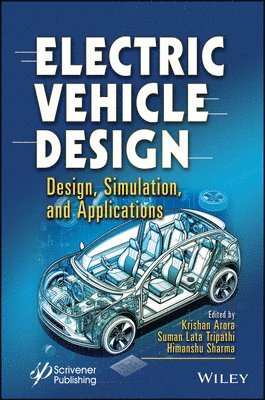
    Electric Vehicle Design

    Design, Simulation, and Applications

    AvKrishan Arora,Suman Lata Tripathi

    Inbunden, Engelska, 2024

    2 072 kr

    Beställningsvara. Skickas inom 5-8 vardagar. Fri frakt över 249 kr.

    Beskrivning

    ELECTRIC VEHICLE DESIGN This book will serve as a definitive guide to conceptual and practical knowledge about the design of hybrid electrical vehicles (HEV), battery electrical vehicles (BEV), fuel cell electrical vehicles (FCEV), plug-in hybrid electrical vehicles (PHEV), and efficient EV charging techniques with advanced tools and methodologies for students, engineers, and academics alike. This book deals with novel concepts related to fundamentals, design, and applications of conventional automobiles with internal combustion engines (ICEs), electric vehicles (EVs), hybrid electric vehicles (HEVs), and fuel cell vehicles (FCVs). It broadly covers vehicle performance, configuration, control strategy, design methodology, modeling, and simulation for different conventional and hybrid vehicles based on mathematical equations. Fundamental and practical examples of conventional electrical machines, advanced electrical machines, battery energy sources, on-board charging and off-board charging techniques, and optimization methods are presented here. This book can be useful for students, researchers, and practitioners interested in different problems and challenges associated with electric vehicles. Furthermore, in explaining the design methodology of each drive train, design examples are presented with simulation results.

    Produktinformation

    • Utgivningsdatum:2024-04-29
    • Mått:155 x 233 x 25 mm
    • Vikt:851 g
    • Format:Inbunden
    • Språk:Engelska
    • Antal sidor:368
    • Förlag:John Wiley & Sons Inc
    • ISBN:9781394204373

    Utforska kategorier

    • Teknik: allmänt inom Naturvetenskap och teknik

    Mer om författaren

    Krishan Arora, PhD, is associated with Lovely Professional University as an associate professor with more than thirteen years of experience in academics. He has been the head of the department of power systems in the School of Electronics and Electrical Engineering, Lovely Professional University since February 2017. He has published more than 55 research papers and organized several workshops, summer internships, and expert lectures for students. Suman Lata Tripathi, PhD, is working as a professor at Lovely Professional University with more than 20 years of experience in academics. She has also been a remote post-doc researcher at Nottingham Trent University, London, UK since 2022. She has published more than 74 research papers and has also published 13 Indian patents and two copyrights. She has edited and authored more than 17 books in different areas of electronics and electrical engineering. Himanshu Sharma, PhD, is associated with Lovely Professional University as an assistant professor with more than four years of experience in academics. He has published more than ten research papers and organized several workshops, summer internships, and expert lectures for students. He has supervised five postgraduate thesis and more than 15 undergraduate student projects.

    Innehållsförteckning

    • Preface xv1 Development of Braking Systems in Fuel Cell Electric Vehicles 1Harpreet Singh Bedi, Shakti Raj Chopra and Krishan Arora1.1 Introduction 11.2 Historical Background of Fuel Cell 21.3 ADVISOR 31.4 Why Hydrogen is Preferred 41.5 What is a Fuel Cell? 41.6 Working of Fuel Cells 41.7 Types of Fuel Cells 51.8 Block Diagram of Vehicle on MATLAB/Simulink 81.9 Braking System in Vehicle 81.10 Regenerative Braking System 91.11 Anti-Lock Braking System (ABS) 101.12 Conclusion 152 Design and Applications of Fuel Cells 19Pradeep Singh, Krishan Arora and Umesh C. Rathore2.1 Introduction 202.2 Types of Electric Vehicles 212.3 Design Equations of Fuel Cells 252.4 Designing of Fuel Cells 292.5 Types of Fuel Cells 302.6 Solid Oxide FCs (SOFCs) 312.7 Alkaline Fuel Cells (AFCs) 352.8 Molten Carbonate Fuel Cell (MCFC) 392.9 Phosphoric Acid Fuel Cells (PAFCs) 432.10 Polymer Electrolyte Membrane Fuel Cell (PEMFC) 462.11 Direct Methanol Fuel Cells (DMFCs) 502.12 Parameters Affecting the Performance of FCs 543 Smart Energy Management and Monitoring System for Electric Vehicles with IoT Integration 57Challa Krishna Rao, Sarat Kumar Sahoo and Franco Fernando Yanine3.1 Introduction 583.2 The Control of Electric Vehicles Using IoT 593.3 IoT Management Issues with Electric Vehicles 613.4 Monitoring and Management Benefits of IoT 623.5 Predictive Maintenance System with Fault Alerts 643.6 IoT Management and Monitoring Issues with Electric Vehicles 653.7 Microcontroller 683.8 IoT-Based Systems for Battery Management and Monitoring 713.9 Design of Battery Charge Control and Monitoring System 713.10 Results and Discussion 733.11 Conclusions 743.12 Future Scope of IoT in Electric Vehicles 754 A Review of Electric Vehicles: Technologies and Challenges 81N. Suthanthira Vanitha, L. Manivannan, K. Radhika, A. Karthikeyan and T. Meenakshi4.1 Introduction 824.2 Electric Motors 824.3 Power Electronic Converters 874.4 Battery in Electric Vehicles 924.5 Conclusion 975 Electric Vehicle and Design Using MATLAB 101Vinay Anand and Himanshu Sharma5.1 Introduction 1025.2 Motivation 1035.3 Basic Fundamentals of EVs 1045.4 Why Electric Vehicles? 1065.5 Comparison Between ICV and EV 1065.6 Classification of EVs 1075.7 Design and Structure of EV 1085.8 Mathematical Model of an Electric Vehicle 1155.9 Control Strategy of EVs 1165.10 Design Methodology for Electric Vehicles (EVs) 1175.11 Latest Emerging Technology in EV 1185.12 Performance Valuation of BLDC Motor and Induction Motor for Electric Vehicle Propulsion Application 1195.13 Conclusion 1256 Model Order Reduction of Battery for Smart Battery Management System 129Dheeraj Kumar Dhaked, Aswant Kumar Sharma, Dhanesh Kumar Sambariya and Dinesh Birla6.1 Introduction 1296.2 Problem Formulation 1316.3 Modeling of Battery 1326.4 Methodology for Model Order Reduction 1346.5 Result and Discussion 1376.6 Conclusion 1417 Power Electronic Converters for Electric Vehicle Application 147P. Swati Patro, Sarat Kumar Sahoo and Fernando Yanine7.1 Introduction 1487.2 Types of Electrical Vehicle and Role of Power Electronic Converter 1517.3 Recent Development in Power Electronic Converter 1587.4 Power Electronic Converters in Electric, Hybrid, and Fuel Cell Vehicles 1617.5 Challenges in Power Electronic Vehicular System 1627.6 Conclusion 1648 Integrating Electric Vehicles Into Smart Grids Through Data Analytics: Challenges and Opportunities 167Vikram Kulkarni, Sarat Kumar Sahoo, Ketan Shah and Prapita Thanarak8.1 Introduction 1688.2 Smart Grid and Electric Vehicle 1698.3 Impact of Electric Vehicle--Based Data Analytics for Smart Grids 1698.4 Importance of Resource Availability, Price, and Load for EV 1718.5 Electric-Tariff Design Based on Impact of Electric Vehicle Usage 1738.6 Data Analytics for Electric Vehicles 1748.7 Machine Learning for EV Analytics 1768.8 What are the Different ML Algorithms Used by Authors for EV Analytics? 1778.9 Importance of Data Analysis in the EV Industry Using an Open Source Data 1788.10 Description of the Dataset 1798.11 Features and Factors That Influence the Prices of EVs 1798.12 Price Prediction of EVs 1808.13 Random Forest--Based Price Prediction of Electric Vehicles 1858.14 Machine Learning Model 1878.15 Electric Vehicle Usage in India 1898.16 The Challenges of Adopting EV in India 1908.17 How to Increase Renewable Energy in India to Meet EV Demand 1919 Hybrid Electrical Vehicle Designs 197T. Meenakshi, K. Mahendran, N. Suthanthira Vanitha and C. Shanmugam9.1 Introduction 1979.2 Plug-In Hybrid Electric Vehicles 1989.3 Classification of HEVs 1999.4 Fuel Cell Electric Vehicles (FCEVs) 2019.5 Hybrid Electric Vehicle System Design and Analysis 2039.6 Control Strategy in Series Hybrid Drivetrain Configuration 2049.7 Design of Fuel Cell Electric Vehicles with Fuel Economy 2099.8 Conclusion 21310 EV Battery Charging System 215Balamurugan M., Narendiran S., Sarat Kumar Sahoo and Fernando Yanine10.1 Introduction 21610.2 Electric Vehicle Charging Infrastructure 21710.3 Power Electronics Converters Used for Charging System 21910.4 Control Strategies of EV Charging System 22110.5 Various Modes of Charging System 22610.6 Real-Time Challenges of EV Charging Infrastructure 22711 Optimization Algorithms and Computing Techniques for Electric Vehicles: Advancements in Computing and Algorithms 235S. Arun Mozhi, J. Nishanthy, S. Charles Raja and J. Jeslin Drusila Nesamalar11.1 Introduction 23611.2 Fundamental Optimization Techniques 23811.3 Problem Formulation of Optimal Solution 23811.4 Optimization Techniques 24111.5 Electric Vehicle 24411.6 Challenges in EV Implementation 25011.7 Optimization Techniques for Electric Vehicles 25211.8 Conclusion 26112 Economic Load Dispatch Solutions at Small, Medium, and Large Scales Utilizing Chaotic Spotted Hyena Optimization 265Tanuj Mishra, Amit Kumar Singh and Vikram Kumar Kamboj12.1 Introduction 26612.2 Unit Commitment and Economic Dispatch Process 26712.3 Optimization in Power System 26812.4 Hybrid Optimization Algorithm 27312.5 Chaotic Spotted Hyena Optimization Technique 27412.6 Economic Load Dispatch Problem 27612.7 Power Balance Equality Constraints 27712.8 Generator Power Limit Inequality Constraints 27812.9 Test Systems Results and Discussion 27812.10 Conclusion 28813 Simulation of Automatic Search of Charging Station for Electric Bikes 295Saroja S., Haseena S., Hariharan M. and Raghul Priyadharshan M.13.1 Introduction 29613.2 Related Works 29813.3 Methodology 29913.4 Load Balancing of Smart Grid 30313.5 Electric Bike Supply Equipment (EBSE) Algorithm 30413.6 Simulation 30513.7 Performance Metrics 30713.8 Method and Existing Method 30814 Self-Charging Electrical Vehicle Design and Analysis with MATLAB 313Ramchandra Sahani, Ishak Jamatia, Manas Daga, Pavan Kumar and Suman Lata Tripathi14.1 Introduction 31314.2 Natural Energy Sources for Self-Charging Electrical Vehicles 31414.2.1 Wind Energy 31514.3 Arduino-Based Control Systems in Electric Vehicles 32314.4 MATLAB-Based Simulation and Modeling for Self-Charging Electric Vehicles 32514.5 Electric Motor Model 32714.6 Results for Vehicle Performance 32914.7 Power Electronics Model 33014.8 Energy Management System 33014.9 Conclusion 333References 333Index 335