• Fri frakt över 249 kr
  • •
  • Snabba leveranser
  • •
  • Billiga böcker
Kundservice

Du är på sajten för privatpersoner.

Företag, bibliotek eller offentlig verksamhet?

Du handlar på classic.bokus.com, där alla dina funktioner finns intakta.
Till classic.bokus.com
Bokus logotyp. Gå till startsidan.
  • Erbjudanden
  • Nyheter
  • Student
  • Topplistor
  • Barn & ungdom
  • Bokus Play
  • E-böcker
  • Pocketböcker
  • Spel & pussel

10% rabatt på allt med kod NYSTART10 →

Sidfot

Mina sidor

    Hjälp

    • Kundservice
    • Vanliga frågor och svar
    • Frakt och leverans
    • Retur vid ångerrätt
    • Reklamera vara
    • Betalning
    • Köpvillkor
    • Allmänna villkor
    • Information om webbplatsens tillgänglighet

    Om Bokus

    • Om oss
    • Pressrum
    • För studenter
    • För företag
    • För bibliotek och offentlig verksamhet
    • För leverantörer
    • Hållbarhet

    Populärt

    • Aktuella erbjudanden
    • Presentkort
    • Studentlitteratur
    • Nya böcker
    • Topplistor
    • Signerade böcker
    • Engelska böcker

    Inspiration

    • Boktips
    • BookTok
    • Populära bokserier
    • Barnbokskaraktärer
    • Populära författare
    Logotyp för Bokus
    Följ oss på Facebook (extern länk)Följ oss på Instagram (extern länk)Följ oss på YouTube (extern länk)Följ oss på TikTok (extern länk)
    bokus @ CookiesAnpassa cookiesIntegritetspolicyKöpvillkor
    Till Citymail hemsida (extern länk)Till Budbee hemsida (extern länk)Till Postnord hemsida (extern länk)Till Schenker hemsida (extern länk)Till Early Bird hemsida (extern länk)Till Walleys hemsida (extern länk)
    1. Naturvetenskap och teknik
    2. Teknik och industri
    3. Elektronik och kommunikationer

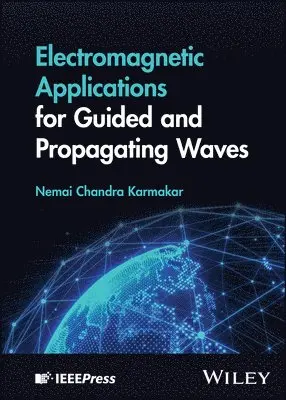
    Electromagnetic Applications for Guided and Propagating Waves

    AvNemai Chandra Karmakar

    Inbunden, Engelska, 2025

    1 568 kr

    Beställningsvara. Skickas inom 5-8 vardagar. Fri frakt över 249 kr.

    Fler format och utgåvor

    E-bok

    1 814 kr

    E-bok

    1 814 kr

    Beskrivning

    Enables readers to grasp the fundamentals of applied electromagnetics through a blended pedagogical approach Electromagnetic Applications for Guided and Propagating Waves comprehensively covers both fundamentals and advanced topics in applied electromagnetics (EM) for the professional, going above the basic static and dynamic EM field theories that are covered in most undergraduate EM textbooks. The textbook introduces complex topics with illustrations of modern technologies that use the topics, followed by a simple presentation of the basic vector analysis and Maxwell’s equations, supported by many practical examples, math essays, math puzzles, and the most modern technological developments from the websites of prominent technology companies. The textbook includes review questions at the end of each topic to enhance the students’ learning experience and outcomes. It provides the links for multimedia lecture videos and directs students to relevant open sources such as YouTube videos and lecture materials from the prestigious universities of developed and developing nations. The textbook is supported by presentation slides, a solution and instructor’s manual, and MATLAB program downloads. Written by prolific teacher Dr. Karmakar, Electromagnetic Applications for Guided and Propagating Waves discusses topics including: Fundamental theories of resonators, optical waveguides and fibers, antennas and antenna arrays, wireless systems, and electromagnetic compatibilityElectrostatic field theory and detailed derivations of electromagnetic fundamentals such as electric charges and Coulomb’s lawApplications of time-varying electromagnetic fields, covering transmission lines, impedance matching techniques, and waveguidesHow electromagnetics has impacted our day-to-day life and how we use it in our workplace and on social mediaHistorical anecdotes and evolution of EM theory from its inception to Maxwell and HertzElectromagnetic Applications for Guided and Propagating Waves is an essential reference for researchers, professionals, and policy and decision makers in the fields of electromagnetics, electrical engineering, wireless communications, and defense.

    Produktinformation

    • Utgivningsdatum:2025-10-21
    • Mått:178 x 254 x 35 mm
    • Vikt:1 479 g
    • Format:Inbunden
    • Språk:Engelska
    • Antal sidor:656
    • Förlag:John Wiley & Sons Inc
    • ISBN:9781394262823

    Utforska kategorier

    • Elektronik och kommunikationer inom Naturvetenskap och teknik
    • Elektricitet och magnetism inom Naturvetenskap och teknik
    • Maskinteknik och material inom Naturvetenskap och teknik

    Mer om författaren

    Nemai Chandra Karmakar, PhD, is the lead researcher at the Monash Microwave, Antenna, RFID and Sensor Laboratory (MMARS) at Monash University, Australia. He received his PhD in Information Technology and Electrical Engineering from the University of Queensland, Australia, in 1999. He is a pioneer in fully printable, chipless radio-frequency identification (RFID) tags and sensors, readers, signal processing, and smart antennas.

    Innehållsförteckning

    • Preface xviiAcknowledgements xxi1 Introduction 11.1 Introduction 21.2 Emerging Technologies That Use Advanced Electromagnetics 41.3 Wireless Mobile Communication Systems 91.4 Modern Pedagogy in Advanced Electromagnetics 261.5 Design Project: Wireless Energy Harvester 271.6 Conclusion 301.7 Questions 302 Vector Analyses 332.1 Introduction 342.2 Vector Analysis 352.3 Vector Operators: Gradient, Divergence and Curl 562.4 Divergence Theorem 622.5 Stokes' Theorem 642.6 Two Vector Null Identities 662.6.1 Remarks 662.7 Chapter Summary 672.8 Problems 69Part I Historical Perspective 733 Electromagnetism 753.1 Introduction to Electromagnetism 753.2 Historical Perspective of Electromagnetic Theory 793.3 Time-varying/Dynamic Electromagnetics Field 813.4 Discussion of Advanced Electromagnetic Theory 883.5 Problems 934 Electrostatics 994.1 Detailed Revision of Electromagnetic Fundamentals 994.2 Electric Field Intensity 1044.3 Gauss' Law 1194.4 Electrostatic Current and Ohm's Law 1224.5 Electric Energy and Joule's Law 1274.6 Boundary Value Problem and Electrostatic Boundary Conditions 1304.7 Electrostatic Potential Energy 1344.8 Summary of Electrostatic Theory 1374.9 Problems 1385 Magnetostatics 1495.1 Magnetostatic 1495.2 Magnetic Flux Density 1545.3 Ampere’s Circuital Law 1565.4 Magnetic Vector Potential 1635.5 Boundary Conditions of Magnetic Fields 1745.6 Boundary Conditions for Tangential Components of H 1775.7 Magnetic Energy and Inductance 1805.8 Mutual Inductance 1865.9 Duality Between Electric and Magnetic Circuit Quantities 1905.10 Summary of Chapter 1905.11 Problems 1926 Time-varying Electromagnetics 1976.1 Introduction 1986.2 The Dawn of Time-varying Electromagnetic Field 2046.3 Maxwell’s Current Continuity Equation 2096.4 Relaxation Time and Conductivity of Conductor 211.5 Displacement Current 2126.6 Example of Displacement Current 2156.7 Maxwell's Equations 2176.8 Boundary Conditions in Static Electromagnetic Fields 2206.9 Boundary Conditions of Time-varying Electromagnetic Fields 2226.10 Non-homogenous Wave Equation for Potential Functions 2266.11 Retarded Potentials 2286.12 Homogenous Electromagnetic Wave Equations 2296.13 Usefulness of Phasor Notation of Field Quantities 2326.14 Electromagnetic Spectrum 2356.15 Summary of Time-varying Electromagnetism 2376.16 Chapter Summary 2396.17 Problems 2407 Uniform Plane Wave 2457.1 Introduction to Uniform Plane Wave 2467.2 Fundamental Concept of Wave Propagation 2497.3 Plane Wave Concept 2527.4 One-dimensional Wave Equation Concept 2597.5 Wave Motion and Wave Front 2627.6 Phase Velocity of UPW 2637.7 Wave Impedance 2677.8 Time Harmonic Field Wave Equations 2697.9 Refractive Index of Medium and Dispersion 2747.10 Time Harmonic Wave Solution 2777.11 Polarisation of UPW 2797.12 Poynting Theorem 2827.13 Static Poynting Theorem 2877.14 Energy Balance Equation in the Presence of a Generator: In-flux and Out-flow of Power 2897.15 Time Harmonic Poynting Vector 2907.16 Application: Doppler Radar 2967.17 Summary of Chapter 2987.18 Questions: UPW Propagation 300Part II Boundary Value Problems 3098 Reflection and Transmission of Uniform Plane Wave 3118.1 Introduction 3118.2 Electromagnetic Waves Analysis in the Context of Boundary Value Problems 3168.3 Reflection and Refraction at Plane Surface 3198.4 Normal Incidence at Dielectric Boundary 3218.5 Concept of Standing Waves 3358.6 Problems 3519 Propagation in Emerging and Advanced Materials 3619.1 Introduction 3629.2 Applications 3649.3 Normal Incidence on Imperfect Media 3679.4 Applications of Normal Incidences on Lossy Dielectric Boundary 3779.5 Oblique Incidence in Lossy Medium 3869.6 Emerging Applications AEM in Precision Agriculture 4069.7 Summary of Chapter 4179.8 Problems 41810 Electromagnetic Passive Guiding Devices 42310.1 Introduction 42510.2 Various Transmission Lines 42710.3 Transmission Line Theory 43010.4 Calculations of Distributive Parameters of Transmission Lines 44910.5 Loaded Transmission Line 46010.6 Smith Chart 48510.7 Conclusion 50511 Electromagnetic Testing Method 50711.1 Basic Principles 50811.2 History of Electromagnetic Testing 50911.3 Who Conducted ET Method? 51211.4 Standard for ET Method 51411.5 Type of Standard 51711.6 Types of ET 52012 Simulation Tools and Artificial Intelligence 53712.1 Summary 53712.2 Key Applications of AI in EM Simulation 53712.3 History of Artificial Intelligence 53912.4 Functions of AI 53912.5 Antenna Design and Optimisation 54112.6 Electromagnetic Simulation and Modelling 54612.7 Electromagnetic Interference and Electromagnetic Compatibility 54812.8 Wireless Communication 55112.9 Non-destructive Testing 55912.10 Radar and Imaging Systems 56013 Radio Frequency Sources and Interference 56513.1 Introduction 56513.2 Fundamentals of RF Sources 56613.3 Types of RF Sources 56913.4 Design and Operation of RF Sources 57213.5 Introduction to EMI/EMC 57413.6 Sources of EMI 57613.7 Effects of EMI 57813.8 EMC Design Principles 57913.9 Testing and Measurement for EMI/EMC 58113.10 Case Studies and Applications 58313.11 Future Trends and Technologies 58313.12 Conclusion 58414 Deep Space Communications and Positioning 58914.1 Introduction 58914.2 The History of NASA's DSN 59014.3 The DSN Functional Description 59114.4 Advanced Techniques in Deep Space Navigation 59414.5 Telemetry Operations in the DSN 59714.6 DSN Capabilities and Innovations 60014.7 Data Types and Handling in the DSN 60514.8 The Role of the DSN in the Apollo Program 609References 610Index 615