• Fri frakt över 249 kr
  • •
  • Snabba leveranser
  • •
  • Billiga böcker
Kundservice

Du är på sajten för privatpersoner.

Företag, bibliotek eller offentlig verksamhet?

Du handlar på classic.bokus.com, där alla dina funktioner finns intakta.
Till classic.bokus.com
Bokus logotyp. Gå till startsidan.
  • Erbjudanden
  • Student
  • Topplistor
  • Barn & ungdom
  • Bokus Play
  • E-böcker
  • Ljudböcker
  • Pocketböcker
  • Spel och pussel

Pocketfynda! Hundratals böcker för 49 kr/st →

Sidfot

Mina sidor

    Hjälp

    • Kundservice
    • Vanliga frågor och svar
    • Frakt och leverans
    • Retur vid ångerrätt
    • Reklamera vara
    • Betalning
    • Köpvillkor
    • Allmänna villkor
    • Information om webbplatsens tillgänglighet

    Om Bokus

    • Om oss
    • Pressrum
    • För studenter
    • För företag
    • För bibliotek och offentlig verksamhet
    • För leverantörer
    • Hållbarhet

    Populärt

    • Aktuella erbjudanden
    • Presentkort
    • Studentlitteratur
    • Nya böcker
    • Topplistor
    • Signerade böcker
    • Engelska böcker

    Inspiration

    • Boktips
    • BookTok
    • Barnbokskaraktärer
    • Populära författare
    Logotyp för Bokus
    Följ oss på Facebook (extern länk)Följ oss på Instagram (extern länk)Följ oss på YouTube (extern länk)Följ oss på TikTok (extern länk)
    bokus @ CookiesAnpassa cookiesIntegritetspolicyKöpvillkor
    Till Citymail hemsida (extern länk)Till Budbee hemsida (extern länk)Till Postnord hemsida (extern länk)Till Schenker hemsida (extern länk)Till Early Bird hemsida (extern länk)Till Walleys hemsida (extern länk)
    1. Naturvetenskap och teknik
    2. Teknik och industri
    3. Maskinteknik och material

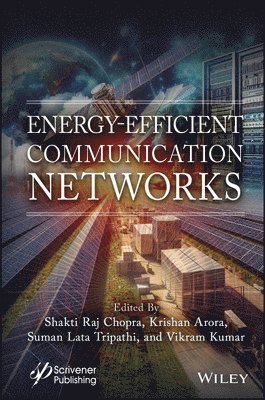
    Energy-Efficient Communication Networks

    AvShakti Raj Chopra,Krishan Arora

    Inbunden, Engelska, 2025

    2 384 kr

    Beställningsvara. Skickas inom 5-8 vardagar. Fri frakt över 249 kr.

    Beskrivning

    Energy-Efficient Communication Networks is essential for anyone looking to understand and implement cutting-edge energy optimization strategies for communication systems, ensuring they meet growing energy demands while seamlessly integrating renewable energy sources and enhancing battery life in embedded applications. Renewable energy, including solar, wind, and geothermal energy, for communication networks is a key area of exploration for meeting the demands of their increasing energy requirements. Scheduling and power cycle optimization are instrumental in deciding the effectiveness of these networks. Apart from communication, embedded systems running on batteries designed for data processing applications also face restrictions in terms of battery life—targeting low-energy consumption-based systems is particularly important here. The increased usage of sensor networks for personal and commercial applications has resulted in a surge of development to create energy-aware protocols and algorithms. This book introduces energy optimization concepts for current and future communication networks and explains how to optimize electricity for wireless sensor networks and incorporate renewable energy sources into conventional communication networks. It gives readers a better understanding of the difficulties, limitations, and possible bottlenecks that may occur while developing a communication system under power constraints, as well as insights into the traditional and recently developed communication systems from an energy optimization point of view.

    Produktinformation

    • Utgivningsdatum:2025-06-13
    • Format:Inbunden
    • Språk:Engelska
    • Antal sidor:272
    • Förlag:John Wiley & Sons Inc
    • ISBN:9781394271658

    Utforska kategorier

    • Maskinteknik och material inom Naturvetenskap och teknik

    Mer om författaren

    Shakti Raj Chopra, PhD is an associate professor at Lovely Professional University with over 18 years of academic experience. He has published over 45 research papers in international journals and conferences. Additionally, he has worked on several consultancy projects and participated in over 20 national and international webinars. His areas of interest include cognitive radio, blockchain, artificial intelligence, and machine learning. Krishan Arora, PhD is an associate professor and Head of the Department of Power Systems in the School of Electronics and Engineering at Lovely Professional University with over 16 years of academic experience. He has published over 70 research papers in international journals and conferences, organized several workshops, internships, and lectures, and participated in over 20 national and international webinars. His areas of research include electrical machines, non-conventional energy sources, load frequency control, and automatic generation control. Suman Lata Tripathi, PhD is a professor at Lovely Professional University with more than 20 years of academic experience. She has published over 74 research papers in international journals, 13 patents, two copyrights, and has authored and edited over 17 books. She also serves as a session chair, conference-steering committee member, editorial board member, and peer reviewer for international journals. Her areas of interest include microelectronics device modeling and characterization, low-power VLSI circuit design, and embedded system design. Vikram Kumar, PhD is a post-doctoral researcher and guest lecturer at the University of Calgary, Canada. He has published 82 research papers in international journals, three patents, and four copyrights. Additionally, he has presented research work in over two dozen national and international conferences and serves as an editorial board member of several journals. His areas of interest include multidisciplinary design and optimization, artificial intelligence and machine learning for numerical and engineering optimization, and information and communication technology for smart grid applications.

    Innehållsförteckning

    • Preface xvList of Contributors xvii1 Efficient Energy Management in Hyperledger Fabric Blockchain Networks: A Proposed Optimized Solution 1Kamurthi Ravi Teja and Shakti Raj Chopra1.1 Introduction 21.2 Methodology 31.3 Experimental Analysis 41.4 Results and Discussion 51.5 Conclusion 72 Framework for UAV-Based Wireless Power Harvesting 9Tanishk Singhal and Harpreet Singh Bedi2.1 Introduction 92.2 Literature Review 102.3 Results and Discussion 152.4 Conclusion 193 Future Generation Technology and Feasibility Assessment 23Pradeep Singh, Krishan Arora and Umesh C. Rathore3.1 Introduction 243.2 Next-Generation Electrical Technologies 263.3 Artificial Intelligence 373.4 Machine Learning 413.5 Conclusion 464 IoT-Enabled Weather Forecasting Systems in Future Networks: Constraints and Solutions 51Yogesh Kumar Verma, Archana Kanwar and Manoj Kumar Shukla4.1 Introduction 524.2 Need of IoT-Based Weather Forecasting System 534.3 Methodology and Results 584.4 Conclusion 615 Cognitive Radio-Based NOMA Communication Networks 65Indu Bala5.1 Introduction to Cognitive Radio and NOMA Networks 665.2 Fundamentals of Cognitive Radio Technology 675.3 Principles of Non-Orthogonal Multiple Access (NOMA) 705.4 Integration of Cognitive Radio with NOMA 735.5 Performance Evaluation and Analysis 775.6 Applications and Use Cases 785.7 Challenges and Future Directions 805.8 Conclusion 826 Cognitive Radio (CR) Based Non-Orthogonal Multiple Access (NOMA) Network 87Raja Gunasekaran, Ragavi Boopathi, Gobinath Velu Kaliyannan, Dinesh Dhanabalan and Kesavan Duraisamy6.1 Introduction 886.2 Fundamentals of CR 906.3 Spectrum Management System 966.4 Noma Networks 986.5 Enabling Technologies 1046.6 Conclusion 1077 Artificial Intelligence and Machine Learning-Based Network Power Optimization Schemes 115Jyoti, Aarti Shar, Ramandeep Sandhu, Manish Kumar Sharma and Deepika Ghai7.1 Introduction 1167.2 Network 1177.3 Decentralized Connection 1207.4 Communication Network 1217.5 Internet of Things (IoT) 1237.6 5G and Future Technologies 1237.7 Network Power and Unstable Power Supply of Computer Networks 1237.8 Adaption of Optimization Schemes to Enhance Network Power 1247.9 Related Work 1277.10 Traditional Evaluation AI and ML-Based Network Energy Optimization Techniques 1297.11 AI- and ML-Based Systems for Network Energy Optimization Techniques 1327.12 Conclusion 1358 Integration of PV Solar Rooftop Technology for Enhanced Performance and Sustainability of Electric Vehicles: A Techno-Analytical Approach 139Vinay Anand and Himanshu Sharma8.1 Introduction 1408.2 Literature Review 1428.3 Methods and Methodology 1448.4 Result and Discussion 1478.5 Conclusion 1539 The Viability of Advanced Technology for Future Generations 157Manjushree Nayak and Ashutosh Pattnaik9.1 Introduction 1589.2 Communication Systems 1599.3 Conclusion 17110 Power Optimization and Scheduling for Multi-Layer, Multi-Dimensional 6G Communication Networks 175Harpreet Kaur Channi, Pulkit Kumar and Ramandeep Sandhu10.1 Introduction 17610.2 Literature Review 17710.3 Multi-Layer, Multi-Dimensional 6G Communication Networks 18010.4 Power Optimization in MLMD 6G Networks 18310.5 Scheduling Strategies for MLMD 6G Networks 18410.6 Proposed Framework 18710.7 Challenges and Future Directions 19010.8 Conclusion 19311 Industry 4.0: Future Opportunities and Challenges 199Manoj Singh Adhikari, Raju Patel, Manoj Sindhwani, Shippu Sachdeva and Suman Lata Tripathi11.1 Introduction 20011.2 Future Opportunities of Industrial 4.0 20111.3 Increased Productivity and Efficiency 20211.4 Innovation 20311.5 Data-Driven Decision-Making 20511.6 Supply Chain Optimization 20511.7 Future Challenges of Industrial 4.0 20611.8 Data Security and Privacy 20711.9 Skills Gap and Workforce Training 20811.10 Interoperability and Standardization 21011.11 Ethical and Social Implications 21111.12 Infrastructure Investment 21111.13 Regulatory and Legal Challenges 21211.14 Dependency on Technology 21311.15 Conclusion 21312 MIMO and Its Significance 217Shahid Hamid and Shakti Raj Chopra12.1 Introduction 21812.2 MIMO 21912.3 Signal Model for MIMO 22112.4 Standard MIMO Configurations 22312.5 Why MIMO 22412.6 Results 225References 227Index 231