• Fri frakt över 249 kr
  • •
  • Snabba leveranser
  • •
  • Billiga böcker
Kundservice

Du är på sajten för privatpersoner.

Företag, bibliotek eller offentlig verksamhet?

Du handlar på classic.bokus.com, där alla dina funktioner finns intakta.
Till classic.bokus.com
Bokus logotyp. Gå till startsidan.
  • Erbjudanden
  • Nyheter
  • Student
  • Topplistor
  • Barn & ungdom
  • Bokus Play
  • E-böcker
  • Pocketböcker
  • Spel & pussel

10% rabatt på allt med kod: NYSTART10 →

Sidfot

Mina sidor

    Hjälp

    • Kundservice
    • Vanliga frågor och svar
    • Frakt och leverans
    • Retur vid ångerrätt
    • Reklamera vara
    • Betalning
    • Köpvillkor
    • Allmänna villkor
    • Information om webbplatsens tillgänglighet

    Om Bokus

    • Om oss
    • Pressrum
    • För studenter
    • För företag
    • För bibliotek och offentlig verksamhet
    • För leverantörer
    • Hållbarhet

    Populärt

    • Aktuella erbjudanden
    • Presentkort
    • Studentlitteratur
    • Nya böcker
    • Topplistor
    • Signerade böcker
    • Engelska böcker

    Inspiration

    • Boktips
    • BookTok
    • Populära bokserier
    • Barnbokskaraktärer
    • Populära författare
    Logotyp för Bokus
    Följ oss på Facebook (extern länk)Följ oss på Instagram (extern länk)Följ oss på YouTube (extern länk)Följ oss på TikTok (extern länk)
    bokus @ CookiesAnpassa cookiesIntegritetspolicyKöpvillkor
    Till Citymail hemsida (extern länk)Till Budbee hemsida (extern länk)Till Postnord hemsida (extern länk)Till Schenker hemsida (extern länk)Till Early Bird hemsida (extern länk)Till Walleys hemsida (extern länk)
    1. Samhälle och politik
    2. Samhälle och kultur
    3. Kultur och medier
    4. Referensverk och tvärvetenskap

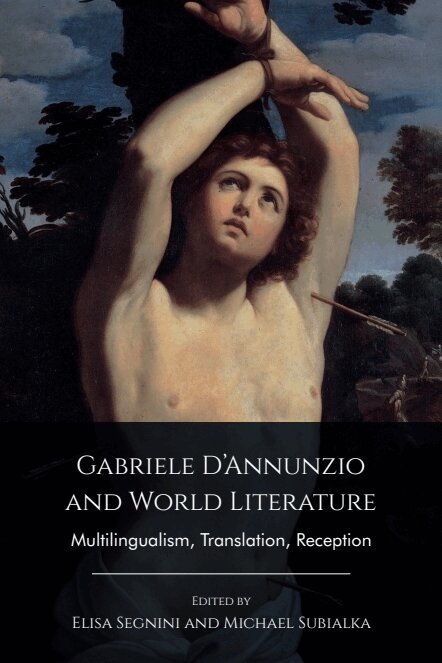
    Gabriele D’Annunzio and World Literature

    Multilingualism, Translation, Reception

    AvElisa Segnini,Michael Subialka

    Inbunden, Engelska, 2023

    2 340 kr

    Beställningsvara. Skickas inom 3-6 vardagar. Fri frakt över 249 kr.

    Beskrivning

    Examines Gabriele D'Annunzio to re-evaluate cultural exchange and the political dimensions of global decadence and modernismFirst book to examine Gabriele D'Annunzio's work from a global perspective and within World Literature paradigmsTransnational and cross-disciplinary focus: unveils D'Annunzio's investment in multilingualism, including dialect and translingual writing, as well as the influence of issues of mobility and migration, colonialism and politics on the global reception of his worksIntroduces a polycentric view of D'Annunzio by bringing together chapters written by scholars from 12 countries (Italy, France, Belgium, Austria, Spain, UK, US, Canada, Russia, Egypt, Argentina, Japan), whose work in many cases appears in English for the first time Unveils the crucial role of D'Annunzio's translators as cultural mediators and examines translations and adaptations as politically charged practicesRedefines D'Annunzio scholarship through a transnational lens, while also making a crucial contribution to studies of global decadence by demonstrating the role of Italian decadence in international networks of literary and artistic exchangeGabriele D'Annunzio was an internationally renowned artist and one of the most prominent public figures in Italy in the late nineteenth and early twentieth centuries. His novels and poetry stirred the enthusiasm of James Joyce and Henry James in the English-speaking world and his repute stretched far beyond in France, Austria-Hungary, Russia, Japan and South America, D'Annunzio became a pivotal node in the broad networks of decadent exchange. This volume offers an overview of the global dynamics of D'Annunzio's work, from his engagement with multilingualism and translingual writing to the international circulation and reception of his production. Featuring chapters by international scholars, it re-evaluates D'Annunzio with a critical eye and a transnational scope and offers a global assessment of the place that Dannunzian decadence holds in the constitution of a conflicted movement one that is profoundly cosmopolitan and yet also problematically nationalistic.

    Produktinformation

    • Utgivningsdatum:2023-07-03
    • Mått:156 x 234 x 29 mm
    • Vikt:740 g
    • Format:Inbunden
    • Språk:Engelska
    • Antal sidor:424
    • Förlag:Edinburgh University Press
    • ISBN:9781399506854

    Utforska kategorier

    • Referensverk och tvärvetenskap inom Samhälle och politik
    • Sociala och etiska frågor inom Samhälle och politik
    • Litteraturvetenskap inom Skönlitteratur

    Mer om författaren

    Elisa Segnini teaches Italian and Comparative Literature at the University of Glasgow. Her research focuses on fin-de-siècle fiction and on Italian literature in a world literature perspective. She is the author of Fragments, Genius and Madness: Masks and Mask Making in the fin-de-siècle imagination (2021) and of several articles on multilingualism in fiction. Michael Subialka teaches Comparative Literature and Italian at UC Davis, where he researches modernism focusing on literature and philosophy. He is the author of monograph Modernist Idealism: Ambivalent Legacies of German Philosophy in Italian Literature (2022). He previously co-edited a special issue of Forum Italicum on D’Annunzio (51:2, August 2017).

    Recensioner i media

    This wide-ranging and informative collection makes a strong case for seeing D'Annunzio as among the key figures in modern world literature. Persuasively demonstrating how D'Annunzio had a broad influence across Europe, East Asia, Latin America and the Middle East, the collection covers topics including D'Annunzio's wide reading in world literature, as well as the author’s relationship with his translators and his global reception. The book makes a valuable contribution to world literature studies, as well as to the burgeoning scholarly interest in the global fin de siècle.

    Innehållsförteckning

    • ‘Introduction’, Elisa Segnini and Michael SubialkaPart 1. A Poetics of Fusion: Cultural Appropriation, Multilingualism, Translingual Writing1. ‘D’Annunzio and the Classics’, Pietro Gibellini, translated by Stuart Oglethorpe 2. ‘D’Annunzio and Japanisms’, Mariko Muramatsu3. ‘Il Piacere as a Multilingual Text and its Afterlife in Translation’, Elisa Segnini4. ‘The original soul of the race": La figlia di Iorio and Italian Dialects’, Sarah Zappulla Muscarà and Enzo Zappulla, translated by Stuart Oglethorpe5.‘The "Latin sister": D’Annunzio’s Relationship to French’, Filippo FonioPart 2. Translators as Transcultural Negotiators6. ‘Gabriele D’Annunzio and Georges Hérelle: Virility, Machismo, and the Homo-erotic’, Clive Thomson7. ‘After Hérelle: André Doderet, the (In)visible Translator’, Annalisa Ciano8. ‘"An Artist in Translation": D’Annunzio, Arthur Symons, and Symbolist Drama’, Stefano Evangelista8. ‘Gabriele D’Annunzio and Karl Gustav Vollmoeller: From Classical Culture to the Attractions of Motor Power’, Adriana Vignazia, translated by Stuart OglethorpePart 3. D’Annunzio’s Global Fin-de-siècle Reception9. ‘Fin-de-Meiji as Fin-de-siècle: D’Annunzio and Japanese Literature’, Noriko Hiraishi10. ‘D’Annunzio’s Feminine Archetypes, Nationalist Ideology, and Catalan Modernism’, Assumpta Camps, translated by Alessia Zinnari11. ‘Gabriele D’Annunzio and the Austrian Reception after Italy’s Entry into the War’, Arturo Larcati, translated by Peter BrucknerPart 4. Complex Legacies12. ‘D’Annunzio and Argentina: from Elitist Snobbism to Nationalist Peronism’, Sandro Abate, translated by Alessia Zinnari and Sophie Maddison13. ‘Gabriele D’Annunzio in the United States: Politics and Stereotypes’, Guylian Nemegeer and Mara Santi14. ‘D’Annunzio’s Legacy in Post-Revolutionary Russia’, Elda Garetto and Sofia Lurie, translated by Stuart Oglethorpe15. ‘From "Great Italian Poet" to "Fascist Writer": D’Annunzio and Arabic Culture’, Hussein Mahmoud and Christine Samir Girgis16. ‘Morlach’s Blood in Fiume’s Mensa: D’Annunzio and the Intimate Adriatic’, Russell Scott Valentino17. ‘Infatuated with Il Vate: Mishima’s Transnational Mimesis of D’Annunzio as Decadent Poet, Patriot, and Celebrity’, Ikuho Amano18. ‘D’Annunzio in the Twenty-First Century’, Elisa Segnini and Michael Subialka