• Fri frakt över 249 kr
  • •
  • Snabba leveranser
  • •
  • Billiga böcker
Kundservice

Du är på sajten för privatpersoner.

Företag, bibliotek eller offentlig verksamhet?

Du handlar på classic.bokus.com, där alla dina funktioner finns intakta.
Till classic.bokus.com
Bokus logotyp. Gå till startsidan.
  • Erbjudanden
  • Nyheter
  • Student
  • Topplistor
  • Barn & ungdom
  • Bokus Play
  • E-böcker
  • Pocketböcker
  • Spel & pussel

10% rabatt på allt med kod: NYSTART10 →

Sidfot

Mina sidor

    Hjälp

    • Kundservice
    • Vanliga frågor och svar
    • Frakt och leverans
    • Retur vid ångerrätt
    • Reklamera vara
    • Betalning
    • Köpvillkor
    • Allmänna villkor
    • Information om webbplatsens tillgänglighet

    Om Bokus

    • Om oss
    • Pressrum
    • För studenter
    • För företag
    • För bibliotek och offentlig verksamhet
    • För leverantörer
    • Hållbarhet

    Populärt

    • Aktuella erbjudanden
    • Presentkort
    • Studentlitteratur
    • Nya böcker
    • Topplistor
    • Signerade böcker
    • Engelska böcker

    Inspiration

    • Boktips
    • BookTok
    • Populära bokserier
    • Barnbokskaraktärer
    • Populära författare
    Logotyp för Bokus
    Följ oss på Facebook (extern länk)Följ oss på Instagram (extern länk)Följ oss på YouTube (extern länk)Följ oss på TikTok (extern länk)
    bokus @ CookiesAnpassa cookiesIntegritetspolicyKöpvillkor
    Till Citymail hemsida (extern länk)Till Budbee hemsida (extern länk)Till Postnord hemsida (extern länk)Till Schenker hemsida (extern länk)Till Early Bird hemsida (extern länk)Till Walleys hemsida (extern länk)
    1. Historia och arkeologi
    2. Historia
    3. Mellanösterns historia

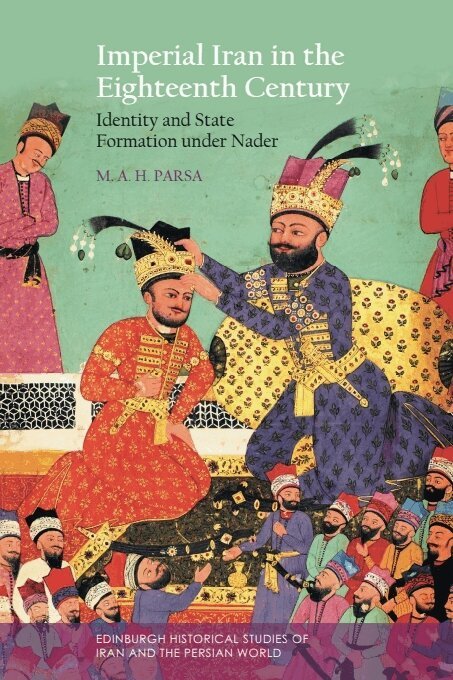
    Imperial Iran in the Eighteenth Century

    Identity and State Formation under Nader

    AvMohammad Amir Hakimi Parsa

    Inbunden, Engelska, 2026

    Del i serien Edinburgh Historical Studies of Iran and the Persian World

    1 394 kr

    Beställningsvara. Skickas inom 7-10 vardagar. Fri frakt över 249 kr.

    Fler format och utgåvor

    E-bok

    1 600 kr

    E-bok

    1 600 kr

    Beskrivning

    The 18th-century ‘interregnum’ between the Safavid and Qajar dynasties remains woefully understudied in Iranian history, regarded as a turbulent and inconsequential gap between two major dynastic periods. This book, however, argues that this period saw the emergence of the idea of Iran as the foundation for collective identity and state formation. It traces the development of a sacralised territorial identity that fused an irredentist notion of Iran-realm (Iranzamin) with Shiʿism, culminating in an unprecedented political idea: that of an ‘Iranian state’ (dowlat-e Irān), supposedly formed by the unanimous consensus of the ‘Iranian people’ (ahl-e Irān). The book then covers how this state, under Nader Shah (Nāder-e Irān), subjugated non-Iranian realms to form a new universal Islamic empire.This is the first monograph to offer an integrated understanding of state formation in post-Safavid Iran (c.1720 – 1750), demonstrating how politico-cultural, military, administrative and ecclesiastic developments related to one another. Drawing on a wide range of neglected primary sources in Arabic, Turkish (both Ajami and Ottoman) and Kurdish (Hawrami), as well as Persian and European sources, the book sheds light on Iran in its last iteration as a great power.

    Produktinformation

    • Utgivningsdatum:2026-06-30
    • Mått:156 x 234 x 25 mm
    • Vikt:682 g
    • Format:Inbunden
    • Språk:Engelska
    • Serie:Edinburgh Historical Studies of Iran and the Persian World
    • Antal sidor:384
    • Förlag:Edinburgh University Press
    • ISBN:9781399553339

    Utforska kategorier

    • Mellanösterns historia inom Historia och arkeologi

    Mer om författaren

    Dr M. A. H. Parsa is an Assistant Professor of Imperial and World History at Ashoka University in India. His primary focus is on the post-Mongol empires and the Turco-Persianate world. Currently, he’s working on the emergence of popular sovereignty in eighteenth-century Iran, rooted in the Turco-Mongol tradition of consultative rule and Perso-Islamic mystical thought. He has published several articles on Nader Shah’s imperial inscriptions in ‘Ajami/Qizilbash Turkic. He completed his PhD at SOAS University of London in 2022 on the post-Safavid and Naderid history of Iran. He was a lecturer at NYU London and the University of St Andrews in Scotland before taking up his current position at Ashoka University.

    Recensioner i media

    Parsa cuts a clear path through the chaotic thicket of post-Safavid Iran. In his reading of the period, the ruthlessly pragmatic Nader Shah, having gained legitimacy as Iran’s God-sent savior, laid the foundations of a new national identity. Henceforth the interests of the state superseded the preservation of the dynasty. Imperial Iran in the Eighteenth Century is a major contribution to the debate about the formation of the Iranian state, associated with Iran-zamin and the idea of a monarchy yet unrelated to any individual dynasty.

    Innehållsförteckning

    • AcknowledgmentsTransliteration System and Pronunciation GuideMaps and FiguresKey Personalities and SourcesIntroduction: Iran, State, and Empire in Eighteenth-Century History and Historiography1. Iranianness and Otherness 1722-17322. Nāder, the Unoriginal Saviour 1726-17363. Nāder Shāh and the ‘Iranian State’ 1736-17464. Shāh of Iran, Shāhanshāh of the World 1736-17465. Nāder as the Enemy of Iran and a Traitor to the Iranians 1740-1750Conclusions and Reflections on Eighteenth-Century Imperial IranBibliographyIndex