• Fri frakt över 249 kr
  • •
  • Snabba leveranser
  • •
  • Billiga böcker
Kundservice

Du är på sajten för privatpersoner.

Företag, bibliotek eller offentlig verksamhet?

Du handlar på classic.bokus.com, där alla dina funktioner finns intakta.
Till classic.bokus.com
Bokus logotyp. Gå till startsidan.
  • Erbjudanden
  • Nyheter
  • Student
  • Topplistor
  • Barn & ungdom
  • Bokus Play
  • E-böcker
  • Pocketböcker
  • Spel & pussel

10% rabatt på allt med kod: NYSTART10 →

Sidfot

Mina sidor

    Hjälp

    • Kundservice
    • Vanliga frågor och svar
    • Frakt och leverans
    • Retur vid ångerrätt
    • Reklamera vara
    • Betalning
    • Köpvillkor
    • Allmänna villkor
    • Information om webbplatsens tillgänglighet

    Om Bokus

    • Om oss
    • Pressrum
    • För studenter
    • För företag
    • För bibliotek och offentlig verksamhet
    • För leverantörer
    • Hållbarhet

    Populärt

    • Aktuella erbjudanden
    • Presentkort
    • Studentlitteratur
    • Nya böcker
    • Topplistor
    • Signerade böcker
    • Engelska böcker

    Inspiration

    • Boktips
    • BookTok
    • Populära bokserier
    • Barnbokskaraktärer
    • Populära författare
    Logotyp för Bokus
    Följ oss på Facebook (extern länk)Följ oss på Instagram (extern länk)Följ oss på YouTube (extern länk)Följ oss på TikTok (extern länk)
    bokus @ CookiesAnpassa cookiesIntegritetspolicyKöpvillkor
    Till Citymail hemsida (extern länk)Till Budbee hemsida (extern länk)Till Postnord hemsida (extern länk)Till Schenker hemsida (extern länk)Till Early Bird hemsida (extern länk)Till Walleys hemsida (extern länk)
    1. Naturvetenskap och teknik
    2. Teknik och industri
    3. Agronomi och lantbruk
    4. Skogsbruk

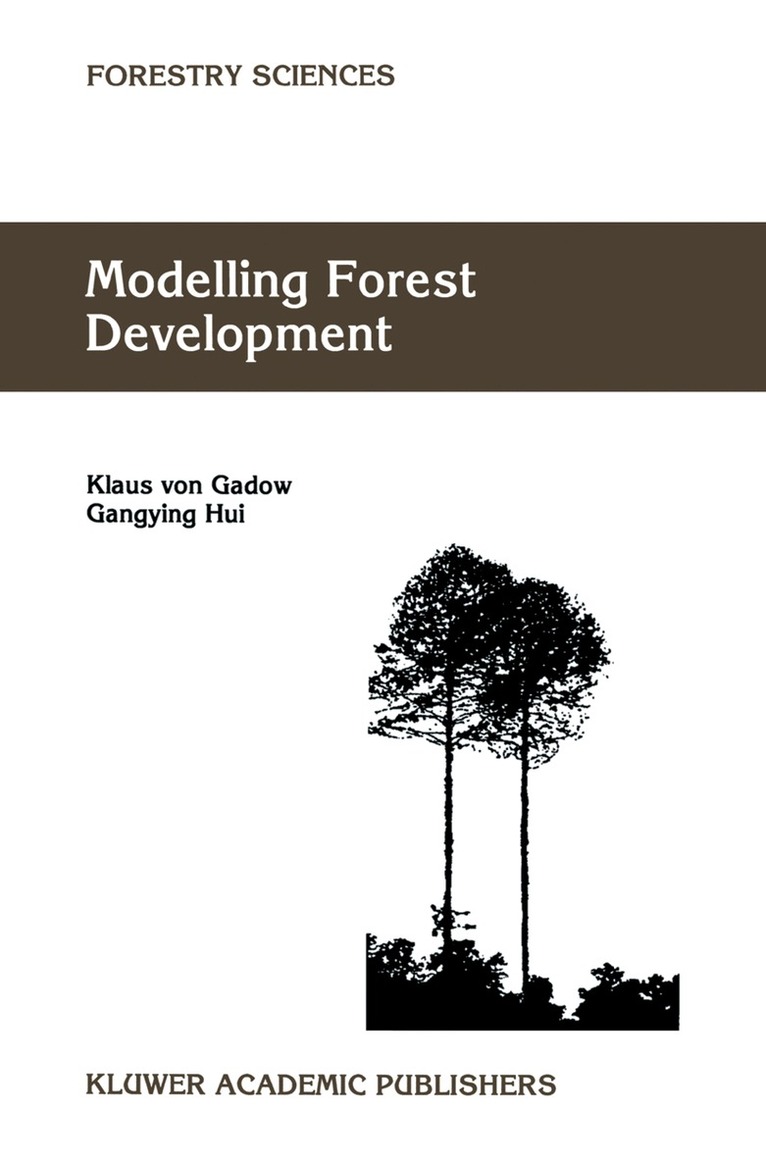
    Modelling Forest Development

    AvKlaus von Gadow,Gangying Hui

    Häftad, Engelska, 2001

    Del 57 i serien Forestry Sciences

    547 kr

    Beställningsvara. Skickas inom 10-15 vardagar. Fri frakt över 249 kr.

    Beskrivning

    In an lUlffianaged woodland, forest development follows a succession of periods of undisturbed natural growth, interrupted by intermediate loss or damage of trees caused by fire or wind or other natural hazards. In a managed woodland, the most important periodic disturbances are the thinning operations, which are often carried out at regular intervals and which usually have a significant effect on the future evolution of the resource. Thus, a realistic model of forest development includes both natural growth and thinnings. The key to successful timber management is a proper understanding of growth processes, and one of the objectives of modelling forest development is to provide the tools that enable foresters to compare alternative silvicultural treatments. Foresters need to be able to anticipate the consequences of a particular thinning operation. In most cases, total timber volume is not a very appropriate measure for quantifying growth or yields, or changes caused by thinning operations. Yield in economic terms is defined by the dimensions and quality attributes of the harvestable logs, and estimating timber products is a central issue of production-oriented growth and yield research. Introduction 2 Growth modelling is also an essential prerequisite for evaluating the consequences of a particular management action on the future development of an important natural resource, such as a woodland ecosystem.

    Produktinformation

    • Utgivningsdatum:2001-11-30
    • Mått:155 x 235 x 13 mm
    • Vikt:360 g
    • Format:Häftad
    • Språk:Engelska
    • Serie:Forestry Sciences
    • Antal sidor:213
    • Förlag:Kluwer Academic Publishers
    • ISBN:9781402002762

    Utforska kategorier

    • Skogsbruk inom Naturvetenskap och teknik

    Innehållsförteckning

    • 1 Introduction.- Types of Forest Models.- Data Requirements.- 2 Projecting Regional Timber Resources.- Empirieal Yield Functions.- Yield Functions based on MAI Estimates.- 3 Modelling Stand Development.- Height.- Basal Area.- Potential Density.- State-Space Models.- Stand Volume and Product Yields.- Thinning Models.- 4 Size Class Models.- Diameter Growth.- Diameter-Height Relations.- Estimating Product Yields.- Modelling Thinnings.- 5 Individual Tree Growth.- Generating Spatial Structures.- Competition Indices.- Spatial Growth Models.- Spatial Thinning Models.- 6 Model Evaluation.- Qualitative Evaluations.- Quantitative Evaluations.- List of Symbols.- Literature.