• Fri frakt över 249 kr
  • •
  • Snabba leveranser
  • •
  • Billiga böcker
Kundservice

Du är på sajten för privatpersoner.

Företag, bibliotek eller offentlig verksamhet?

Du handlar på classic.bokus.com, där alla dina funktioner finns intakta.
Till classic.bokus.com
Bokus logotyp. Gå till startsidan.
  • Erbjudanden
  • Nyheter
  • Student
  • Topplistor
  • Barn & ungdom
  • Bokus Play
  • E-böcker
  • Pocketböcker
  • Spel & pussel

10% rabatt på allt med kod NYSTART10 →

Sidfot

Mina sidor

    Hjälp

    • Kundservice
    • Vanliga frågor och svar
    • Frakt och leverans
    • Retur vid ångerrätt
    • Reklamera vara
    • Betalning
    • Köpvillkor
    • Allmänna villkor
    • Information om webbplatsens tillgänglighet

    Om Bokus

    • Om oss
    • Pressrum
    • För studenter
    • För företag
    • För bibliotek och offentlig verksamhet
    • För leverantörer
    • Hållbarhet

    Populärt

    • Aktuella erbjudanden
    • Presentkort
    • Studentlitteratur
    • Nya böcker
    • Topplistor
    • Signerade böcker
    • Engelska böcker

    Inspiration

    • Boktips
    • BookTok
    • Populära bokserier
    • Barnbokskaraktärer
    • Populära författare
    Logotyp för Bokus
    Följ oss på Facebook (extern länk)Följ oss på Instagram (extern länk)Följ oss på YouTube (extern länk)Följ oss på TikTok (extern länk)
    bokus @ CookiesAnpassa cookiesIntegritetspolicyKöpvillkor
    Till Citymail hemsida (extern länk)Till Budbee hemsida (extern länk)Till Postnord hemsida (extern länk)Till Schenker hemsida (extern länk)Till Early Bird hemsida (extern länk)Till Walleys hemsida (extern länk)
    1. Ekonomi och Ledarskap
    2. Företagsekonomi
    3. Affärsetik

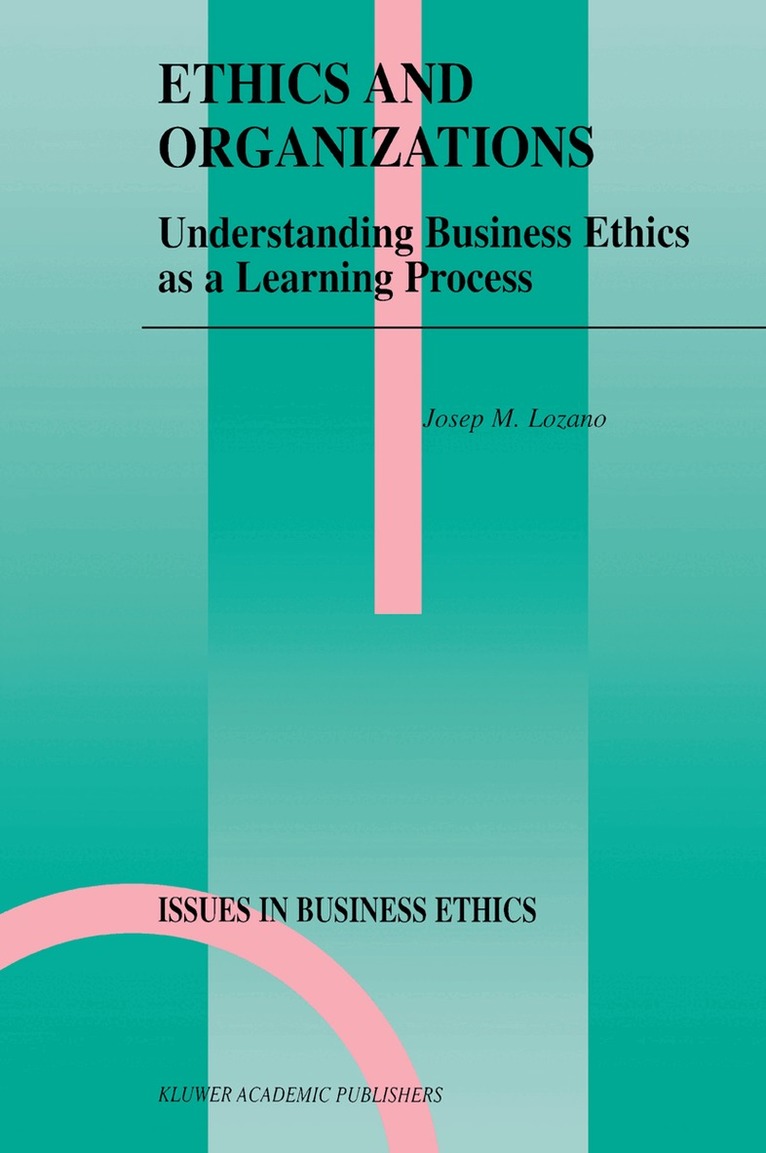
    Ethics and Organizations

    Understanding Business Ethics as a Learning Process

    AvJosep M. Lozano

    Häftad, Engelska, 2001

    Del 15 i serien Issues in Business Ethics

    1 117 kr

    Beställningsvara. Skickas inom 10-15 vardagar. Fri frakt över 249 kr.

    Fler format och utgåvor

    Inbunden

    1 117 kr

    E-bok

    1 416 kr

    Beskrivning

    This book is a study of the core issues in the field of business ethics from both an historical and a systematic standpoint. It analyzes corporate social responsibility, stakeholders, ethical codes, corporate cultures, and other issues. But the analysis takes place within a framework specially designed by the author in order to integrate the various dimensions of present-day business ethics. This integration is linked to an interpretation of business ethics as an organizational learning process in the context of the social and cultural changes caused by the emergence of a knowledge society. This approach makes it possible to adopt a focus and language, which can simultaneously take into account ethical concerns and corporate and organizational development. A previous version of the book (written in Catalan) was awarded the 1998 Joan Sardà Dexeus prize for best book on corporate economics by the Catalan Association of Economists.

    Produktinformation

    • Utgivningsdatum:2001-11-30
    • Mått:155 x 235 x 12 mm
    • Vikt:318 g
    • Format:Häftad
    • Språk:Engelska
    • Serie:Issues in Business Ethics
    • Antal sidor:192
    • Förlag:Kluwer Academic Publishers
    • ISBN:9781402003622

    Utforska kategorier

    • Affärsetik inom Ekonomi och Ledarskap

    Innehållsförteckning

    • 0. Introduction: like oil and water?.- 1. Business ethics as applied ethics.- 1.1. BE: a case of applied ethics?.- 1.2. BE as “applied” ethics: a preliminary proposal for integration.- 2. Business ethics: an on-going process.- 2.1. Introduction: a progressive Self-awareness.- 2.2. A first historical approach to BE.- 2.3. The recent development of BE in Europe.- 2.4. What issues should BE address?.- 2.5. BE: a first attempt at a systematic ordering.- 2.6. The acceptance or rejection of BE as a possible (il)legitimization of predominant practices and values.- 2.7.The impossible dissolution of BE in individual ethics.- 2.8. The ethics of organizations as the core of BE.- 3. BE’s self-awareness: unresolved tension and a call for integration.- 3.1. BE: one discipline or two?.- 3.2. Managers’ moral reasoning as a metaphor for and expression of the problem.- 3.3. Integration in the framework of BE: a demand -at least-acknowledged.- 3.4. Beyond ethics as a toolbox.- 3.5. A note about civic ethics as a possible framework for BE.- 4. An illustrative debate: corporate social responsibility.- 4.1. Introduction.- 4.2. A preliminary question: Is the corporation a moral subject?.- 4.3. Corporate social responsibility.- 4.4. Is the corporation in question?.- 4.5. Friedman: the most controversial reference.- 4.6. The diversity of arguments about corporate social responsibility.- 4.7. Corporate social responsibility: a diversity of concepts.- 4.8. The place of corporate social responsibility in the framework of BE.- 5. Stakeholders: who are they and what are their interests?.- 5.1. Power in the corporation, power of the corporation.- 5.2. Stakeholders, an understanding of the corporation.- 5.3. Stakeholders: an analytical classification.- 5.4. Stakeholders: beyond analysis.- 5.5.Stakeholders in an ethics of organizations.- 6. Corporate codes: constructing criteria and goals?.- 6.1. Professional codes as a point of reference.- 6.2. Codes and their ambivalence.- 6.3. Management as a profession: a significant absence.- 6.4. Corporate codes of ethics: a descriptive approach.- 6.5. Codes of ethics: more ethics or more control?.- 7. Corporate cultures: managing values?.- 7.1. Some questions about the concept of organizational culture.- 7.2. Corporate culture and ethics: an ambigous relationship.- 7.3. Ambiguities in the search for excellence.- 7.4. Opening the door to Aristotelian tradition.- 7.5. Final considerations: the outlook for BE.- 8. Integrating ethics in organizations.- 8.1. The paths towards integration: decision-making, a fact or a process?.- 8.2. The paths towards integration: the organization as a project.- 8.3. The paths towards integration: institutionalizing ethics.- 9. Humanization (also) as a process of organizational learning.- 9.1. The emerging knowledge society.- 9.2. Transforming organizational paradigms.- 9.3. An understanding of organizations that includes acknowledging the value of individuals and individuals as value.- 10. The learning organization as the matrix of business ethics.- 10.1. BE’s three “moments” as an organizational learning process.- 11. References.- 12. Index.