• Fri frakt över 249 kr
  • •
  • Snabba leveranser
  • •
  • Billiga böcker
Kundservice

Du är på sajten för privatpersoner.

Företag, bibliotek eller offentlig verksamhet?

Du handlar på classic.bokus.com, där alla dina funktioner finns intakta.
Till classic.bokus.com
Bokus logotyp. Gå till startsidan.
  • Erbjudanden
  • Nyheter
  • Student
  • Topplistor
  • Barn & ungdom
  • Bokus Play
  • E-böcker
  • Pocketböcker
  • Spel & pussel

10% rabatt på allt med kod: NYSTART10 →

Sidfot

Mina sidor

    Hjälp

    • Kundservice
    • Vanliga frågor och svar
    • Frakt och leverans
    • Retur vid ångerrätt
    • Reklamera vara
    • Betalning
    • Köpvillkor
    • Allmänna villkor
    • Information om webbplatsens tillgänglighet

    Om Bokus

    • Om oss
    • Pressrum
    • För studenter
    • För företag
    • För bibliotek och offentlig verksamhet
    • För leverantörer
    • Hållbarhet

    Populärt

    • Aktuella erbjudanden
    • Presentkort
    • Studentlitteratur
    • Nya böcker
    • Topplistor
    • Signerade böcker
    • Engelska böcker

    Inspiration

    • Boktips
    • BookTok
    • Populära bokserier
    • Barnbokskaraktärer
    • Populära författare
    Logotyp för Bokus
    Följ oss på Facebook (extern länk)Följ oss på Instagram (extern länk)Följ oss på YouTube (extern länk)Följ oss på TikTok (extern länk)
    bokus @ CookiesAnpassa cookiesIntegritetspolicyKöpvillkor
    Till Citymail hemsida (extern länk)Till Budbee hemsida (extern länk)Till Postnord hemsida (extern länk)Till Schenker hemsida (extern länk)Till Early Bird hemsida (extern länk)Till Walleys hemsida (extern länk)
    1. Ekonomi och Ledarskap
    2. Nationalekonomi
    3. Miljöekonomi

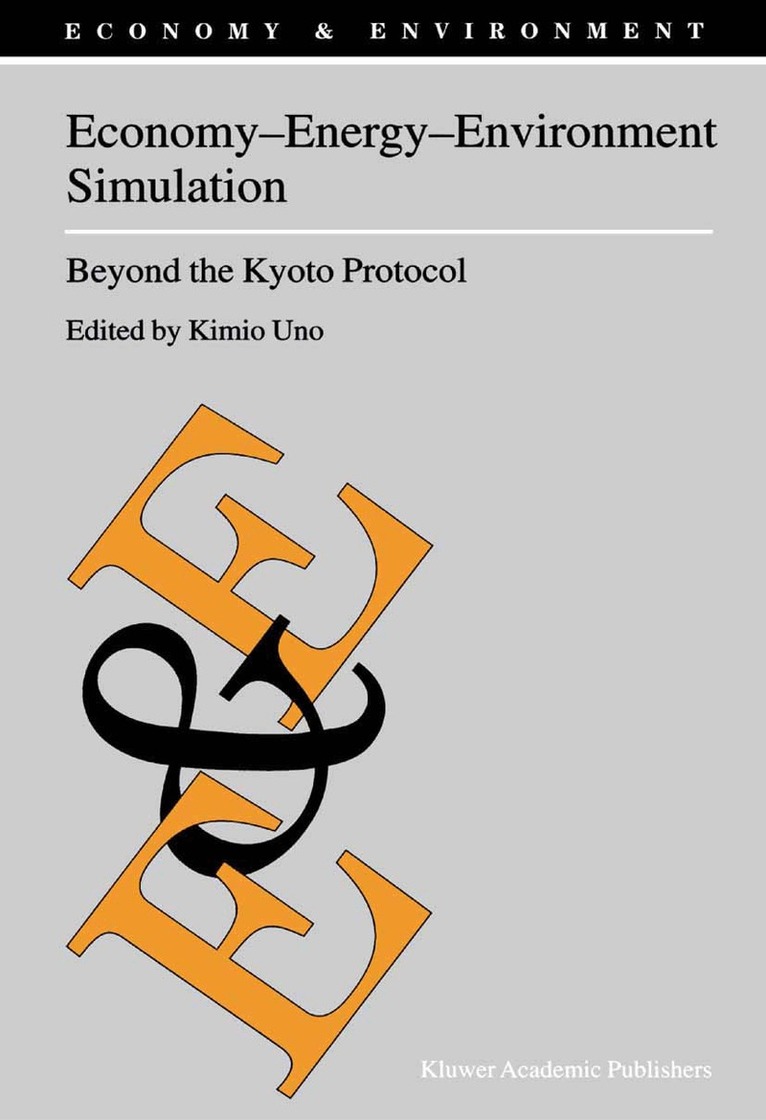
    Economy—Energy—Environment Simulation

    Beyond the Kyoto Protocol

    AvK. Uno

    Inbunden, Engelska, 2002

    Del i serien Economy & Environment

    1 674 kr

    Beställningsvara. Skickas inom 10-15 vardagar. Fri frakt över 249 kr.

    Beskrivning

    In the policy arena, as well as in the academic world, a new challenge is having to deal with the global community. We are increasingly aware that the world is linked through economy–energy–environment interactions. We are increasingly aware, at the same time, that the emergence of the global community does not imply an integrated harmonious world; rather, it is a community where co- tries/regions of different interests and values face each other directly. Global governance has to be achieved through actions of national governments under different motives and constraints. We need to have an analytical tool that is capable of producing a global picture, yet with detailed country resolution. If the world is a better place now compared to 100 years ago in terms of p- capita income, this is due to the industrialization that continued throughout the 20th century. We entered the 21st century knowing that the human aspiration that translates into ever-increasing production may not be tenable in the long run. Sustainability of the global community is at stake. In contrast to inc- mental decision making through the market mechanism that should lead to some optimal state under some assumptions such as perfect knowledge, smooth movement of resources, no externalities, and so forth, we need to have an a- lytical tool to provide us with details of the future state of the world.

    Produktinformation

    • Utgivningsdatum:2002-05-31
    • Mått:156 x 234 x 24 mm
    • Vikt:699 g
    • Format:Inbunden
    • Språk:Engelska
    • Serie:Economy & Environment
    • Antal sidor:342
    • Upplaga:2002
    • Förlag:Kluwer Academic Publishers
    • ISBN:9781402004506

    Utforska kategorier

    • Miljöekonomi inom Ekonomi och Ledarskap

    Innehållsförteckning

    • Economy-energy-environment: COMPASS approach.- The Framework of Analysis.- Object-oriented database and modelling system.- IO, macro-finance, and trade model specification.- Endogenized trade shares in a global model.- Developing an energy balance simulation model.- Economy-Energy-Environment, 2010.- Policy agenda.- Price-induced energy intensity and inter-energy substitution of G7 countries.- The case of South-East Asia.- The case of China.- The case of Russia.- Carbon tax and labour compensation - a simulation for G7.- Methodologies.- Energy projections: comparison of methodologies.