• Fri frakt över 249 kr
  • •
  • Snabba leveranser
  • •
  • Billiga böcker
Kundservice

Du är på sajten för privatpersoner.

Företag, bibliotek eller offentlig verksamhet?

Du handlar på classic.bokus.com, där alla dina funktioner finns intakta.
Till classic.bokus.com
Bokus logotyp. Gå till startsidan.
  • Erbjudanden
  • Nyheter
  • Student
  • Topplistor
  • Barn & ungdom
  • Bokus Play
  • E-böcker
  • Pocketböcker
  • Spel & pussel

10% rabatt på allt med kod: NYSTART10 →

Sidfot

Mina sidor

    Hjälp

    • Kundservice
    • Vanliga frågor och svar
    • Frakt och leverans
    • Retur vid ångerrätt
    • Reklamera vara
    • Betalning
    • Köpvillkor
    • Allmänna villkor
    • Information om webbplatsens tillgänglighet

    Om Bokus

    • Om oss
    • Pressrum
    • För studenter
    • För företag
    • För bibliotek och offentlig verksamhet
    • För leverantörer
    • Hållbarhet

    Populärt

    • Aktuella erbjudanden
    • Presentkort
    • Studentlitteratur
    • Nya böcker
    • Topplistor
    • Signerade böcker
    • Engelska böcker

    Inspiration

    • Boktips
    • BookTok
    • Populära bokserier
    • Barnbokskaraktärer
    • Populära författare
    Logotyp för Bokus
    Följ oss på Facebook (extern länk)Följ oss på Instagram (extern länk)Följ oss på YouTube (extern länk)Följ oss på TikTok (extern länk)
    bokus @ CookiesAnpassa cookiesIntegritetspolicyKöpvillkor
    Till Citymail hemsida (extern länk)Till Budbee hemsida (extern länk)Till Postnord hemsida (extern länk)Till Schenker hemsida (extern länk)Till Early Bird hemsida (extern länk)Till Walleys hemsida (extern länk)
    1. Djur och Natur
    2. Djurböcker
    3. Vilda djur
    4. Fjärilar, insekter, spindlar

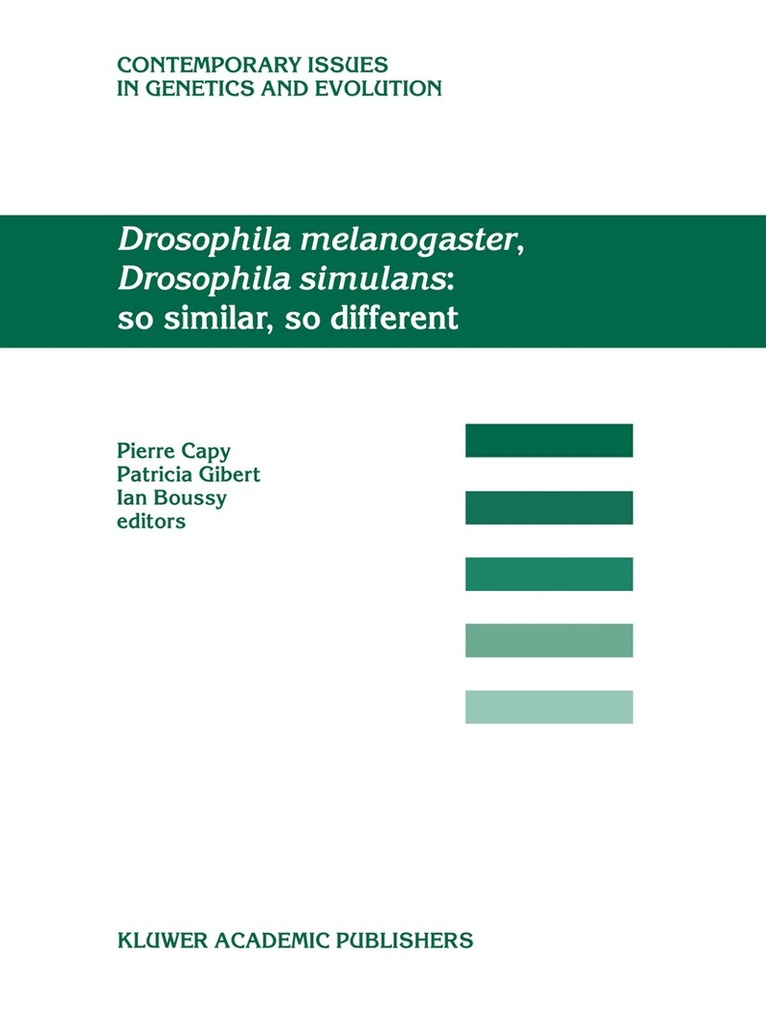
    Drosophila melanogaster, Drosophila simulans: So Similar, So Different

    AvPierre Capy,Patricia Gibert

    Inbunden, Engelska, 2004

    Del 11 i serien Contemporary Issues in Genetics and Evolution

    1 626 kr

    Beställningsvara. Skickas inom 10-15 vardagar. Fri frakt över 249 kr.

    Beskrivning

    Comparison of closely related species is a powerful D. melanogaster. In D. melanogaster, microsatel- approach to understanding the changes that have oc- lites reveal that West African popUlations are more curred since their divergence from a common ancestor. closely related to non-African populations than to The sibling species Drosophila melanogaster and D. East African popUlations. East African populations are simulans are probably the species pair for which the more variable than West African or non-African popu- most genetic data are available. A workshop held at lations, suggesting that East African populations may 1 Gif/Yvette in January 2002 reviewed and discussed more closely reflect African ancestral variability. comparisons between these species, from their ecol- Ecophysiology, popUlation dynamics and popula- tion structure are also important to understanding the ogy and biogeography to their behavior and DNA evolution of the two species. Genetic diversity (8) polymorphism. is higher in D. simulans (S. Mousset and R. Singh).

    Produktinformation

    • Utgivningsdatum:2004-03-31
    • Mått:210 x 279 x 24 mm
    • Vikt:1 159 g
    • Format:Inbunden
    • Språk:Engelska
    • Serie:Contemporary Issues in Genetics and Evolution
    • Antal sidor:293
    • Upplaga:2004
    • Förlag:Springer-Verlag New York Inc.
    • ISBN:9781402019593

    Utforska kategorier

    • Fjärilar, insekter, spindlar inom Djur och Natur
    • Insekter inom Naturvetenskap och teknik

    Innehållsförteckning

    • Drosophila melanogaster, Drosophila simulans: so similar yet so different.- How two Afrotropical endemics made two cosmopolitan human commensals: the Drosophila melanogaster-D. simulans palaeogeographic riddle.- Mitochondrial DNA in the Drosophila melanogaster complex.- Wolbachia infections in Drosophila melanogaster and D. simulans: polymorphism and levels of cytoplasmic incompatibility.- Historicity and the population genetics of Drosophila melanogaster and D. simulans.- Patterns of microsatellite variability in the Drosophila melanogaster complex.- Molecular polymorphism in Drosophila melanogaster and D. simulans: what have we learned from recent studies?.- The sex-ratio trait and its evolution in Drosophila simulans: a comparative approach.- A reanalysis of protein polymorphism in Drosophila melanogaster, D. simulans, D. sechellia and D. mauritiana: effects of population size and selection.- Transposable element dynamics in two sibling species: Drosophila melanogaster and Drosophila simulans.- Wanderings of hobo: a transposon in Drosophila melanogaster and its close relatives.- Mitotic and polytene chromosomes: comparisons between Drosophila melanogaster and Drosophila simulans.- Comparative life histories and ecophysiology of Drosophila melanogaster and D. simulans.- Comparative analysis of morphological traits among Drosophila melanogaster and D. simulans: genetic variability, clines and phenotypic plasticity.- Ecological and genetic interactions in DrosopMa-parasitoids communities: a case study with D. melanogaster, D. simulans and their common Leptopilina parasitoids in south-eastern France.- Relations between cuticular hydrocarbon (HC) polymorphism, resistance against desiccation and breeding temperature; a model for HC evolution in D. melanogaster and D. simulans.- Molecular analysis of circadian clocks in Drosophila simulans.- A mutation in Drosophila simulans that lengthens the circadian period of locomotor activity.- Sperm size evolution in Drosophila: inter- and intraspecific analysis.- The nature of genetic variation in sex and reproduction-related genes among sibling species of the Drosophila melanogaster complex.- Genetics of hybrid inviability and sterility in Drosophila: dissection of introgression of D. simulans genes in D. melanogaster genome.- A new hybrid rescue allele in Drosophila melanogaster.- Male-specific expression of the Fruitless protein is not common to all Drosophila species.- Genetic basis of sexual isolation in Drosophila melanogaster.- Why there is a one-way crossability between D. melanogaster and D. simulans?.