Pierre Capy - Böcker
Visar alla böcker från författaren Pierre Capy. Handla med fri frakt och snabb leverans.
8 produkter
8 produkter
2 100 kr
Skickas inom 10-15 vardagar
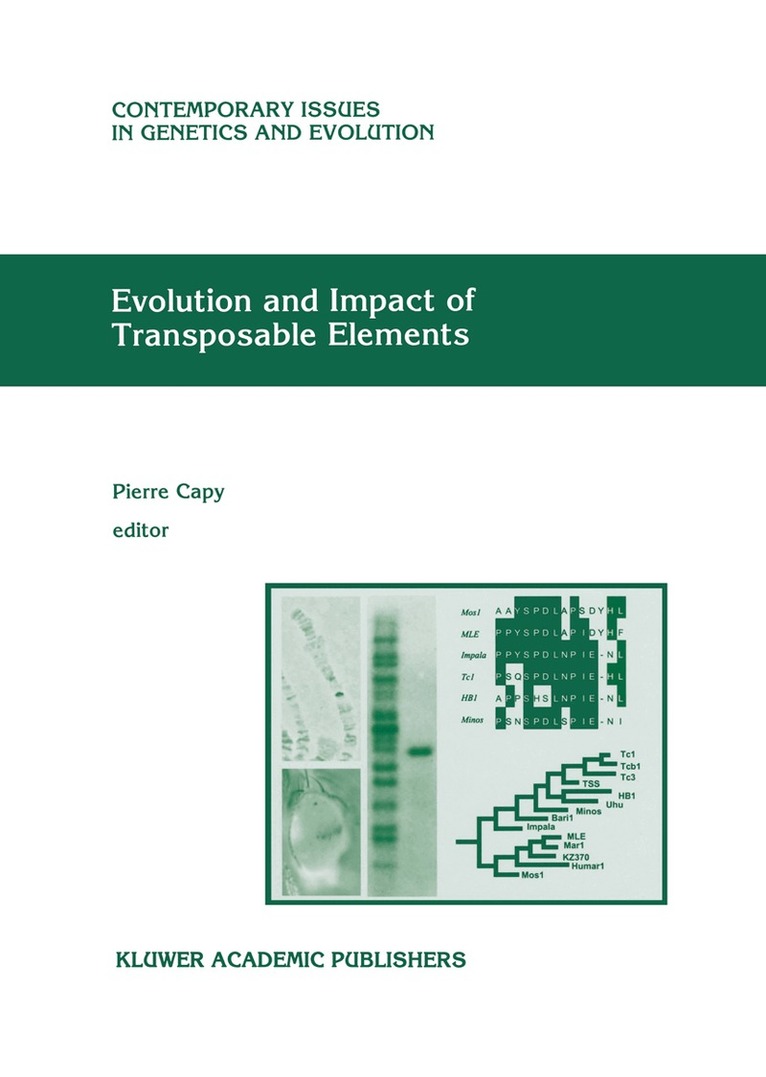
The existence of transposable elements was implied by Barbara McClintock in the 1940s, based on genetic experiments, and verified in the 1970s by molecular biology. By the late 1990s, hundreds of elements have been detected in all living organisms and are believed to represent more than 15% of every organism's genome. Major questions remain to be answered concerning how transposable elements have evolved within the context of interacting host genomes. These questions are of great interest because transposable elements may have had a significant impact on the evolution of host genome structure and the ability of populations and species to successfully adapt to their environments. In this book, complementary aspects of the evolution impact of transposable elements are discussed in papers presented by participants of the ESF workshop entitled Evolution and Role of Transposable Elements which was held at CNRS in Gif-sur-Yvette, France in September 1996.
Del 11 - Contemporary Issues in Genetics and Evolution
Drosophila melanogaster, Drosophila simulans: So Similar, So Different
Inbunden, Engelska, 2004
1 584 kr
Skickas inom 10-15 vardagar
Comparison of closely related species is a powerful D. melanogaster. In D. melanogaster, microsatel- approach to understanding the changes that have oc- lites reveal that West African popUlations are more curred since their divergence from a common ancestor. closely related to non-African populations than to The sibling species Drosophila melanogaster and D. East African popUlations. East African populations are simulans are probably the species pair for which the more variable than West African or non-African popu- most genetic data are available. A workshop held at lations, suggesting that East African populations may 1 Gif/Yvette in January 2002 reviewed and discussed more closely reflect African ancestral variability. comparisons between these species, from their ecol- Ecophysiology, popUlation dynamics and popula- tion structure are also important to understanding the ogy and biogeography to their behavior and DNA evolution of the two species. Genetic diversity (8) polymorphism. is higher in D. simulans (S. Mousset and R. Singh).
1 069 kr
Skickas inom 10-15 vardagar
Mobile Genetic Elements: Protocols and Genomic Applications brings together a wide array of transposon-based protocols and stategies for studying genome structure, function, and evolution into a highly practical, single-source volume. Such transposable element (TE)-derived techniques have been applied succe- fully for a variety of purposes ranging from mutagenesis, gene silencing, transgenesis, and their use as polymorphic marker systems. To our knowledge no such synthesis has been presented before. Chapters 2-4 provide a series of DNA hybridization techniques for anal- ing the distribution and dynamics of mobile DNAs at the hosts' genomic level. With the current revolution in genomics and the availability of complete genome sequences, computational analyses provide an extremely powerful tool for i- lating and investigating TEs at the in silico level (Chapter 5). For the analyses of transpositional mechanisms at the biochemical level Chapter 6 provides a detailed protocol for LTR retrotransposons in heterologous host systems. Ch- ters 7-10 are focused on TE-based mutagenesis protocols for studying gene functions in a broad range of organisms.Based on their ubiquitous nature and their activity in creating genomic diversity by integrating novel DNA segments into genomes, TEs provide highly informative sets of polymorphic markers (Chapters 11-13). Finally, the last two chapters are dedicated to their technical applications during transgenesis in arthropods and vertebrates.
1 095 kr
Skickas inom 10-15 vardagar
Mobile Genetic Elements: Protocols and Genomic Applications brings together a wide array of transposon-based protocols and stategies for studying genome structure, function, and evolution into a highly practical, single-source volume. Such transposable element (TE)-derived techniques have been applied succe- fully for a variety of purposes ranging from mutagenesis, gene silencing, transgenesis, and their use as polymorphic marker systems. To our knowledge no such synthesis has been presented before. Chapters 2-4 provide a series of DNA hybridization techniques for anal- ing the distribution and dynamics of mobile DNAs at the hosts' genomic level. With the current revolution in genomics and the availability of complete genome sequences, computational analyses provide an extremely powerful tool for i- lating and investigating TEs at the in silico level (Chapter 5). For the analyses of transpositional mechanisms at the biochemical level Chapter 6 provides a detailed protocol for LTR retrotransposons in heterologous host systems. Ch- ters 7-10 are focused on TE-based mutagenesis protocols for studying gene functions in a broad range of organisms.Based on their ubiquitous nature and their activity in creating genomic diversity by integrating novel DNA segments into genomes, TEs provide highly informative sets of polymorphic markers (Chapters 11-13). Finally, the last two chapters are dedicated to their technical applications during transgenesis in arthropods and vertebrates.
623 kr
Kommande
1 606 kr
Skickas inom 7-10 vardagar
Since their discovery by Barbara McClintock in the mid-20th century, the importance of transposable elements in shaping the architecture, function and evolution of genomes has gradually been unveiled.These DNA sequences populate nearly all genomes and are viewed as genomic parasites. They are mobile, capable of proliferating within genomes and also commonly travel between species.These elements are mutagenic and are responsible for several human genetic disorders, but they also constitute a major source of genetic diversity. Some insertions have beneficial effects for the host and are selected for, giving rise to significant evolutionary innovations. Their dynamics within genomes are intricate, as are their interactions with other genome components. To limit their proliferation, the genome has evolved sophisticated defense mechanisms.While researchers commonly use these elements as genetic tools, their identification in newly sequenced genomes remains a challenge due not only to their extensive diversity, but also their large copy numbers.
1 624 kr
Skickas inom 10-15 vardagar
Comparison of closely related species is a powerful D. melanogaster. In D. melanogaster, microsatel- approach to understanding the changes that have oc- lites reveal that West African popUlations are more curred since their divergence from a common ancestor. closely related to non-African populations than to The sibling species Drosophila melanogaster and D. East African popUlations. East African populations are simulans are probably the species pair for which the more variable than West African or non-African popu- most genetic data are available. A workshop held at lations, suggesting that East African populations may 1 Gif/Yvette in January 2002 reviewed and discussed more closely reflect African ancestral variability. comparisons between these species, from their ecol- Ecophysiology, popUlation dynamics and popula- tion structure are also important to understanding the ogy and biogeography to their behavior and DNA evolution of the two species. Genetic diversity (8) polymorphism. is higher in D. simulans (S. Mousset and R. Singh).
2 163 kr
Skickas inom 10-15 vardagar
During the last 50 years, the perception oftransposable elements (TEs) has changed considerably from selfish DNA to sequences that may contribute significantly to genome function and evolution. (iii) TEs can influence the regulation of other TEs by insertion or deletion;