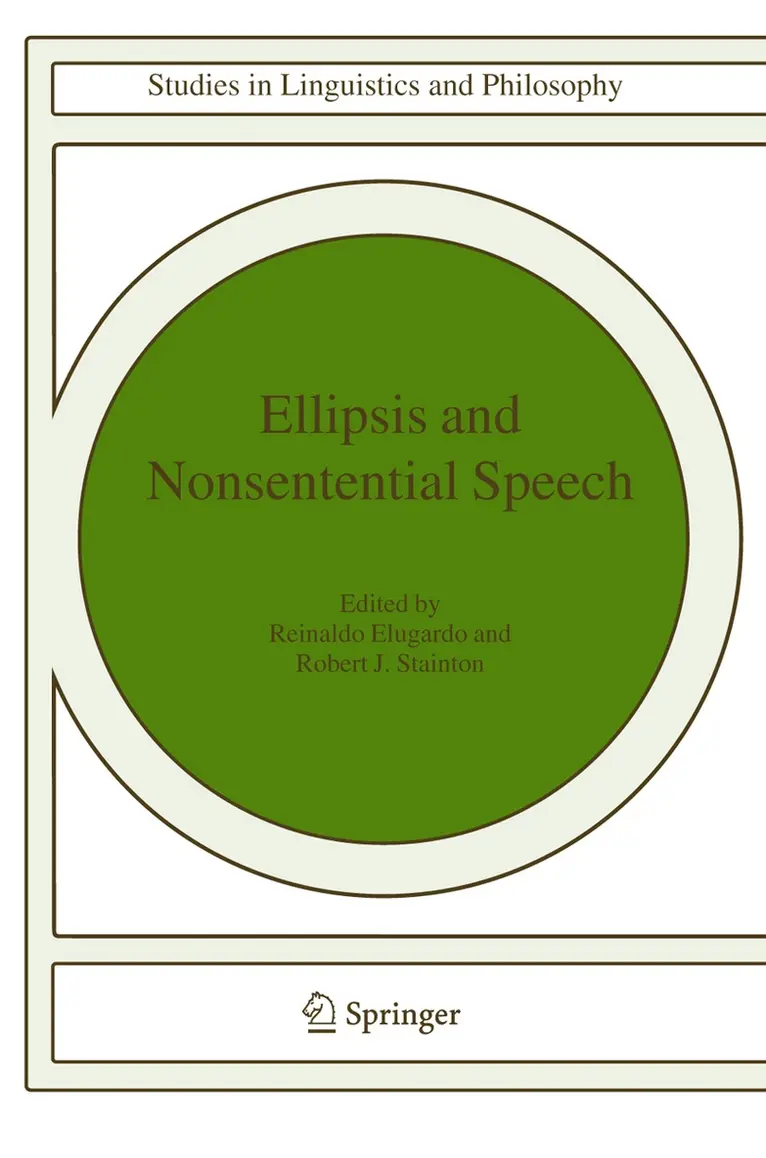
Häftad, Engelska, 2005
Ellipsis and Nonsentential Speech
Av Reinaldo Elugardo, Robert J. Stainton
1129 kr
Beställningsvara. Skickas inom 10-15 vardagar. Fri frakt över 249 kr.
Beskrivning
The papers in this volume address two main topics: Q1: What is the nature, and especially the scope, of ellipsis in natural l- guage? Q2: What are the linguistic/philosophical implications of what one takes the nature/scope of ellipsis to be? As will emerge below, each of these main topics includes a large sub-part that deals speci?cally with nonsentential speech. Within the ?rst main topic, Q1, there arises the sub-issueofwhethernonsententialspeechfallswithinthescopeofellipsisornot;within the second main topic, Q2, there arises the sub-issue of what linguistic/philosophical implications follow, if nonsentential speech does/does not count as ellipsis. I. THE NATURE AND SCOPE OF ELLIPSIS A. General Issue: How Many Natural Kinds? There are many things to which the label ‘ellipsis’ can be readily applied. But it’s quite unclear whether all of them belong in a single natural kind. To explain, consider a view, assumed in Stainton (2000), Stainton (2004a), and elsewhere. It is the view that there are fundamentally (at least) three very different things that readily get called ‘ellipsis’, each belonging to a distinct kind. First, there is the very broad phenomenon of a speaker omitting information which the hearer is expected to make use of in interpreting an utterance. Included therein, possibly as a special case, is the use of an abbreviated form of speech, when one could have used a more explicit expression. (See Neale (2000) and Sellars (1954) for more on this idea.
Produktinformation
- Utgivningsdatum: 2005-05-10
- Mått: 155 x 235 x 15 mm
- Vikt: 390 g
- Format: Häftad
- Språk: Engelska
- Serie: Studies in Linguistics and Philosophy
- Antal sidor: 262
- Upplaga: 2005
- Förlag: Springer-Verlag New York Inc.
- ISBN: 9781402023002
Utforska kategorier
Betyg & recensioner
0 recensioner
Inga recensioner tillgängliga.