• Fri frakt över 249 kr
  • •
  • Snabba leveranser
  • •
  • Billiga böcker
Kundservice

Du är på sajten för privatpersoner.

Företag, bibliotek eller offentlig verksamhet?

Du handlar på classic.bokus.com, där alla dina funktioner finns intakta.
Till classic.bokus.com
Bokus logotyp. Gå till startsidan.
  • Erbjudanden
  • Nyheter
  • Student
  • Topplistor
  • Barn & ungdom
  • Bokus Play
  • E-böcker
  • Pocketböcker
  • Spel & pussel

10% rabatt på allt med kod: NYSTART10 →

Sidfot

Mina sidor

    Hjälp

    • Kundservice
    • Vanliga frågor och svar
    • Frakt och leverans
    • Retur vid ångerrätt
    • Reklamera vara
    • Betalning
    • Köpvillkor
    • Allmänna villkor
    • Information om webbplatsens tillgänglighet

    Om Bokus

    • Om oss
    • Pressrum
    • För studenter
    • För företag
    • För bibliotek och offentlig verksamhet
    • För leverantörer
    • Hållbarhet

    Populärt

    • Aktuella erbjudanden
    • Presentkort
    • Studentlitteratur
    • Nya böcker
    • Topplistor
    • Signerade böcker
    • Engelska böcker

    Inspiration

    • Boktips
    • BookTok
    • Populära bokserier
    • Barnbokskaraktärer
    • Populära författare
    Logotyp för Bokus
    Följ oss på Facebook (extern länk)Följ oss på Instagram (extern länk)Följ oss på YouTube (extern länk)Följ oss på TikTok (extern länk)
    bokus @ CookiesAnpassa cookiesIntegritetspolicyKöpvillkor
    Till Citymail hemsida (extern länk)Till Budbee hemsida (extern länk)Till Postnord hemsida (extern länk)Till Schenker hemsida (extern länk)Till Early Bird hemsida (extern länk)Till Walleys hemsida (extern länk)
    1. Samhälle och politik
    2. Krig och försvar
    3. Vapen och utrustning

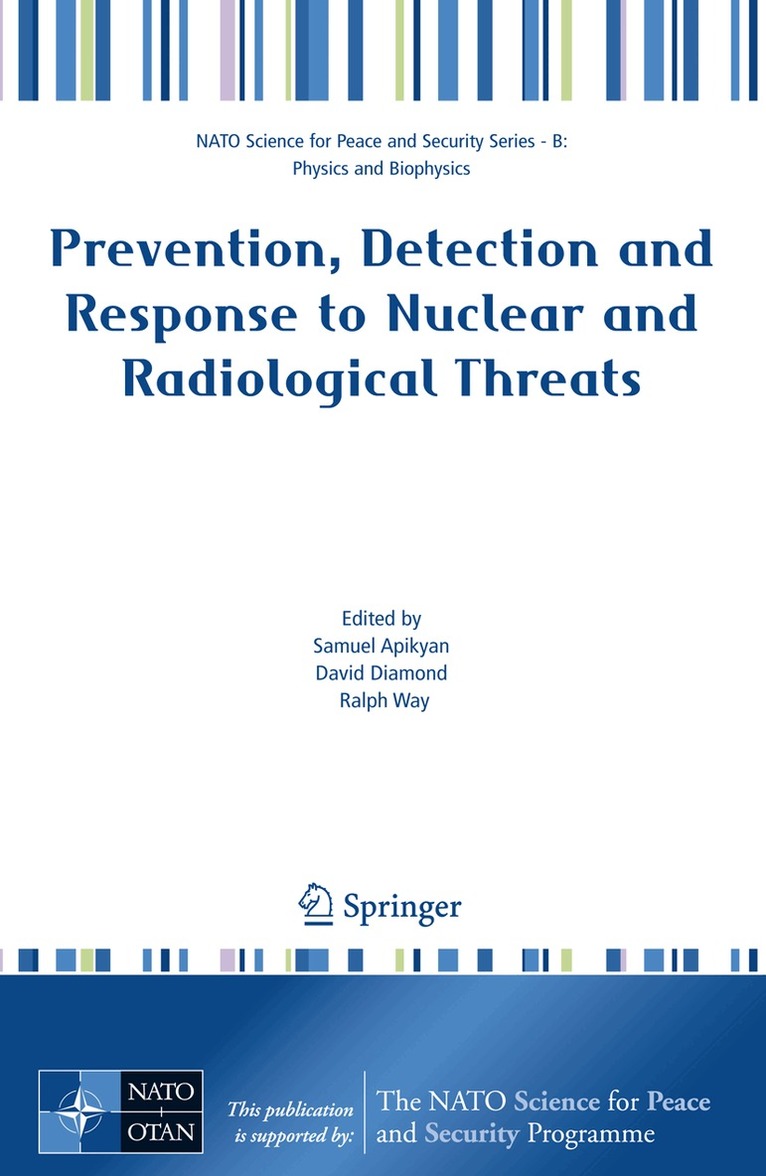
    Prevention, Detection and Response to Nuclear and Radiological Threats

    AvSamuel Apikyan,David Diamond

    Inbunden, Engelska, 2007

    Del i serien NATO Science for Peace and Security Series B: Physics and Biophysics

    2 165 kr

    Beställningsvara. Skickas inom 10-15 vardagar. Fri frakt över 249 kr.

    Beskrivning

    Since the end of the Cold War, the nuclear threats facing the world are dramatically evolving and have become even much more complex. However, the events of the past years have proved the necessity to reevaluate these threats on a level never before considered. The need to prevent, detect and respond to Nuclear/Radiological threats leads to many requirements that are not met by current scientific technologies and scientific communities.For this concern now we are aware and recognize, the first, that no single institution (no single country) possesses all the required assets to address these complex problems. It will require the formation of international science and technology teams that combine multiple scientific disciplines and span from basic research to systems engineering and manufacturing; the second, that fundamental scientific challenges must be overcome to achieve new and improved technologies that effectively counter radiological and nuclear threats. The primary goal of any counter-terrorism effort is to prevent an attack as early in the development stages as possible. Many current approaches employed to prevent a nuclear/radiological attack rely upon detection of materials. Another general category of threat reduction involves preventing acquisition or utilization of the materials. Therefore while the organizers and participants of this meeting recognize that the Nuclear/Radiological threats is extremely broad, we necessarily limited the scope of this NATO Advanced Research Workshop and the programme focused on science and technology challenges associated with our need to prevent, detect and respond to Nuclear/Radiological threats. The book can serve as a tool for communicating the outcomes of the workshop not only to the multi-national scientific and technical communities engaged in combating nuclear/ radiological terrorism, but also to those working at governmental and policy levels whose actions affect the directions thescience takes and how the technology is incorporated into country-specific national systems for combating nuclear/radiological terrorism.

    Produktinformation

    • Utgivningsdatum:2007-10-22
    • Mått:155 x 235 x 29 mm
    • Vikt:592 g
    • Format:Inbunden
    • Språk:Engelska
    • Serie:NATO Science for Peace and Security Series B: Physics and Biophysics
    • Antal sidor:308
    • Upplaga:2008
    • Förlag:Springer-Verlag New York Inc.
    • ISBN:9781402066566

    Utforska kategorier

    • Vapen och utrustning inom Samhälle och politik
    • Kärnvapen inom Samhälle och politik

    Innehållsförteckning

    • Prevention.- From Cold War to International Terrorism.- Nuclear Terrorism: An Overview.- Prospects for Cooperative Threat Reduction Beyond the FSU.- Perspectives on International Radiological Trafficking.- Proliferation Resistance Features in Nuclear Reactor Designs For Small-Power Plants.- Integrated Border Management: R&D Activities at JRC.- Individual Protection Against Inhalation of Long Living Radioactive Dust Due to an Uncontrolled Release.- Contributions of Legislative, Regulatory and Institutional Infrastructures to Sustaining National Nuclear Security Regimes.- Identification, Assessment and Prevention of Different Environmental Risk-Factors Impact, Including Radiation, on the Population Health.- Detection.- Neutrinos, Dark Matter and Nuclear Detection.- Detection of ‘Dirty Bombs’ Using Nanosecond Neutron Analysis (NNA) Technique.- Ansi and IEC Standards for, and Evaluation of, Radiation Detection Instrumentation.- New Devices for the Detection and Identification of Radioactive Sources.- Perspectives of High Pressure Xenon Gamma-Ray Spectrometers to Detect and Identify Radioactive and Fissile Materials.- Experimental Model of the Device for Detection of Nuclear Materials by Pulsed Photoneutron Technology.- Radioecological Monitoring to the South Caucasus' Rivers as a Tool for Early Warning System.- Response.- Calibration of a Cloud Rise Model for a Rdd Scenario.- Application of a Decision Support System in Nuclear and Radiological Emergency: Opportunities and Challenges.- A 3D-Monte Carlo Based Dispersion Model for an Rdd or a Nuclear Terror Scenario.- Challenges in Responding to Incidents Involving the Malevolent use of Radiation.- French Emergency Response in Case of Dirty Bomb Threat.- Psychological and Social Response to a Nuclear Terrorist Event.-Cleanup and Site Restoration Strategy After a Radiological Terror Attack.- Activity Estimation of Gamma-Ray Emitting Sources Without the Preliminary Knowledge on a Shielding Design. Simulation and Experiment for NAI(TL) Detector.- Assessment of Radiological Risks and Possible Ecological and Economic Damages From Large-Scale Natural and Man-Induced Catastrophes in Ecology-Hazard Regionscatastrophes in Ecology-Hazard Regions of Central Asia and the Caucasus.- Results of Implementation of the State Program ‘Radiation’ in Georgia.