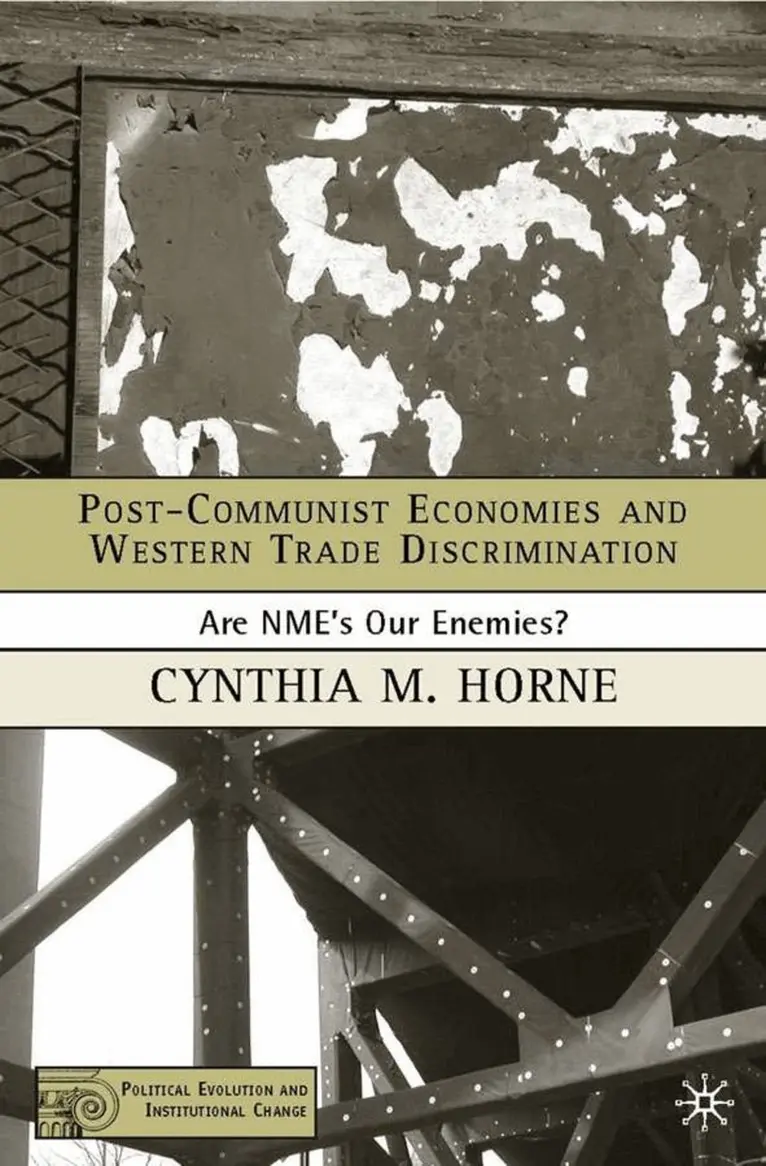
Post-Communist Economies and Western Trade Discrimination
Are NMEs Our Enemies?
557 kr
Beställningsvara. Skickas inom 10-15 vardagar. Fri frakt över 249 kr.
Du är på sajten för privatpersoner.
557 kr
Beställningsvara. Skickas inom 10-15 vardagar. Fri frakt över 249 kr.
CYNTHIA M. HORNE is an Assistant Professor at Seton Hall University's School of Diplomacy and International Relations, USA.
"This book identifies a vital puzzle - why do American and European trade officials discriminate against formerly communist countries100 percent of the time? This outcome is unexpected, given repeated institutional rule changes since the end of the Cold War. Horne provides a novel and compelling argument that demonstrates how and why individual beliefs and ideas matter in explaining policy outcomes." - Deborah K. Elms, Assistant Professor, Institute of Defence and Strategic Studies, Nanyang Technological University, Singapore 'Why do government agencies fail to implement their own regulations? Cynthia M. Horne wrestles this critical question to the ground by examining how lingering Cold War perceptions of NMEs as 'the enemy' have reinforced trade discrimination. Her five case studies of formal trade rule changes, combined with a quantitative refutation of traditional political economy explanations, clearlyillustrate the gap between formal rule changes and outcomeswhileexposing the explanatory importance of informal beliefs.' - Alexandra Vacroux, Woodrow Wilson International Center for Scholars, Washington, D.C.
J. Kornai, B. Rothstein, S. Rose-Ackerman
Häftad, 2015
557 kr
Janos Kornai, Susan Rose-Ackerman, J. Kornai
Inbunden, 2004
557 kr
M. Lange, D. Rueschemeyer, Matthew Lange, Dietrich Rueschemeyer
Häftad, 2005
460 kr
Du är på sajten för privatpersoner.
557 kr
Beställningsvara. Skickas inom 10-15 vardagar. Fri frakt över 249 kr.
CYNTHIA M. HORNE is an Assistant Professor at Seton Hall University's School of Diplomacy and International Relations, USA.
"This book identifies a vital puzzle - why do American and European trade officials discriminate against formerly communist countries100 percent of the time? This outcome is unexpected, given repeated institutional rule changes since the end of the Cold War. Horne provides a novel and compelling argument that demonstrates how and why individual beliefs and ideas matter in explaining policy outcomes." - Deborah K. Elms, Assistant Professor, Institute of Defence and Strategic Studies, Nanyang Technological University, Singapore 'Why do government agencies fail to implement their own regulations? Cynthia M. Horne wrestles this critical question to the ground by examining how lingering Cold War perceptions of NMEs as 'the enemy' have reinforced trade discrimination. Her five case studies of formal trade rule changes, combined with a quantitative refutation of traditional political economy explanations, clearlyillustrate the gap between formal rule changes and outcomeswhileexposing the explanatory importance of informal beliefs.' - Alexandra Vacroux, Woodrow Wilson International Center for Scholars, Washington, D.C.
J. Kornai, B. Rothstein, S. Rose-Ackerman
Häftad, 2015
557 kr
Janos Kornai, Susan Rose-Ackerman, J. Kornai
Inbunden, 2004
557 kr
M. Lange, D. Rueschemeyer, Matthew Lange, Dietrich Rueschemeyer
Häftad, 2005
460 kr