• Fri frakt över 249 kr
  • •
  • Snabba leveranser
  • •
  • Billiga böcker
Kundservice

Du är på sajten för privatpersoner.

Företag, bibliotek eller offentlig verksamhet?

Du handlar på classic.bokus.com, där alla dina funktioner finns intakta.
Till classic.bokus.com
Bokus logotyp. Gå till startsidan.
  • Erbjudanden
  • Nyheter
  • Student
  • Topplistor
  • Barn & ungdom
  • Bokus Play
  • E-böcker
  • Pocketböcker
  • Spel & pussel

10% rabatt på allt med kod NYSTART10 →

Sidfot

Mina sidor

    Hjälp

    • Kundservice
    • Vanliga frågor och svar
    • Frakt och leverans
    • Retur vid ångerrätt
    • Reklamera vara
    • Betalning
    • Köpvillkor
    • Allmänna villkor
    • Information om webbplatsens tillgänglighet

    Om Bokus

    • Om oss
    • Pressrum
    • För studenter
    • För företag
    • För bibliotek och offentlig verksamhet
    • För leverantörer
    • Hållbarhet

    Populärt

    • Aktuella erbjudanden
    • Presentkort
    • Studentlitteratur
    • Nya böcker
    • Topplistor
    • Signerade böcker
    • Engelska böcker

    Inspiration

    • Boktips
    • BookTok
    • Populära bokserier
    • Barnbokskaraktärer
    • Populära författare
    Logotyp för Bokus
    Följ oss på Facebook (extern länk)Följ oss på Instagram (extern länk)Följ oss på YouTube (extern länk)Följ oss på TikTok (extern länk)
    bokus @ CookiesAnpassa cookiesIntegritetspolicyKöpvillkor
    Till Citymail hemsida (extern länk)Till Budbee hemsida (extern länk)Till Postnord hemsida (extern länk)Till Schenker hemsida (extern länk)Till Early Bird hemsida (extern länk)Till Walleys hemsida (extern länk)
    1. Filosofi och religion
    2. Filosofi
    3. Filosofiska discipliner

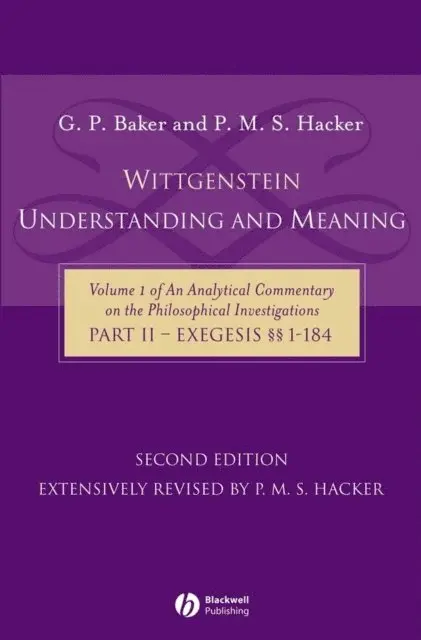
    Wittgenstein: Understanding and Meaning

    Volume 1 of an Analytical Commentary on the Philosophical Investigations, Part I: Essays

    AvGordon P. Baker,P. M. S. Hacker

    Inbunden, Engelska, 2004

    609 kr

    Beställningsvara. Skickas inom 5-8 vardagar. Fri frakt över 249 kr.

    Fler format och utgåvor

    Häftad

    401 kr

    Häftad

    373 kr

    Beskrivning

    This is a new edition of the first volume of G.P.Baker and P.M.S. Hacker’s definitive reference work on Wittgenstein’s Philosophical Investigations. New edition of the first volume of the monumental four-volume Analytical Commentary on the Philosophical Investigations. Takes into account much material that was unavailable when the first edition was written. Following Baker’s death in 2002, P.M.S. Hacker has thoroughly revised the first volume, rewriting many essays and sections of exegesis completely. Part One - the Essays - now includes two completely new essays: 'Meaning and Use' and 'The Recantation of a Metaphysician'. Part Two - Exegesis §§1-184 - has been thoroughly revised in the light of the electronic publication of Wittgenstein’s Nachlass, and includes many new interpretations of the remarks, a history of the composition of the book, and an overview of its structure. The revisions will ensure that this remains the definitive reference work on Wittgenstein’s masterpiece for the foreseeable future.
    Produktinformation

    • Utgivningsdatum:2004-12-17
    • Mått:156 x 238 x 36 mm
    • Vikt:739 g
    • Format:Inbunden
    • Språk:Engelska
    • Antal sidor:424
    • Upplaga:2
    • Förlag:John Wiley and Sons Ltd
    • ISBN:9781405101769

    Utforska kategorier

    • Filosofiska discipliner inom Filosofi och religion

    Mer om författaren

    G.P. Baker was a Fellow of St John’s College, Oxford from 1967 until his death in 2002. He is the co-author with P.M.S. Hacker of the first two volumes of the four-volume Analytical Commentary on the Philosophical Investigations (Blackwell, 1980–96), and with Katherine Morris of Descartes’ Dualism (1996). He also wrote numerous articles on Wittgenstein, Frege, Russell, Waismann and Descartes. P.M.S. Hacker is the leading authority on the philosophy of Wittgenstein. He is author of the four-volume Analytical Commentary on the Philosophical Investigations, the first two volumes co-authored with G.P. Baker, (Blackwell, 1980–96) and of Wittgenstein’s Place in Twentieth-century Analytic Philosophy (Blackwell, 1996). He has also written extensively on philosophy of language and philosophy of mind, most recently The Philosophical Foundations of Neuroscience (Blackwell, 2003), co-authored with M.R. Bennett.

    Recensioner i media

    "The essays...are scholarly, and profound, and also acute, confident, and full of good sense and judgment" (Colin Radford, Mind)"This book is a landmark in Wittgenstein studies, raising to a new level the criteria for an adequate understanding of Wittgenstein." (Philosophical Studies) "For someone who wants to understand, point for point and in detail, how Wittgenstein's later philosophy upsets the philosophies of Russell, Frege and the Tractatus, this is the book to read." (Philosophical Books) "[The authors'] interpretive essays develop with care, subtlety, and in considerable detail...they have performed a great service in presenting the programmatic views clearly, carefully and dispassionately."--James Bogen "Wittgenstein: Meaning and Understanding is a sort of compendium which I wouldn’t want to do without. As a matter of fact, I cannot do without it, both in the sense that I need it to get all kinds of historical or philological information, as well as philosophical stimulation, and in the sense that I have become addicted to the book's magisterial way of bringing out and dealing with the difficulties of Wittgenstein’s masterpiece."--Joachim Schulte, University of Bielefeld

    Innehållsförteckning

    • Acknowledgements xiIntroduction to Part I: Essays xiiiAbbreviations xixI The Augustinian conception of language ( 1) 11. Augustine’s picture 12. The Augustinian family 4(a) word-meaning 4(b) correlating words with meanings 6(c) ostensive explanation 7(d) metapsychological corollaries 9(e) sentence-meaning 113. Moving off in new directions 144. Frege 195. Russell 236. The Tractatus 26II Explanation ( 6) 291. Training, teaching and explaining 292. Explanation and meaning 333. Explanation and grammar 354. Explanation and understanding 39III The language-game method ( 7) 451. The emergence of the game analogy 452. An intermediate phase: comparisons with invented calculi 543. The emergence of the language-game method 574. Invented language-games 615. Natural language-games 63IV Descriptions and the uses of sentences (§18) 651. Flying in the face of the facts 652. Sentences as descriptions of facts: surface-grammatical paraphrase 673. Sentences as descriptions: depth-grammatical analysis and descriptive contents 704. Sentences as instruments 735. Assertions, questions, commands make contact in language 76V Ostensive definition and its ramifications (§28) 811. Connecting language and reality 812. The range and limits of ostensive explanations 833. The normativity of ostensive definition 884. Samples 925. Misunderstandings resolved 976. Samples and simples 103VI Indexicals (§39) 107VII Logically proper names (§39) 1131. Russell 1132. The Tractatus 1173. The criticisms of the Investigations: assailing the motivation 1204. The criticisms of the Investigations: real proper names and simple names 124VIII Meaning and use (§43) 1291. The concept of meaning 1292. Setting the stage 1363. Wittgenstein: meaning and its internal relations 1444. Qualifications 152IX Contextual dicta and contextual principles (§50) 1591. The problems of a principle 1592. Frege 1643. The Tractatus 1704. After the Tractatus 1715. Compositional theories of meaning 1736. Computational theories of understanding 181X The standard metre (§50) 1891. The rudiments of measurement 1892. The standard metre and canonical samples 1923. Fixing the reference or explaining the meaning? 1934. Defusing paradoxes 197XI Family resemblance (§65) 2011. Background: definition, logical constituents and analysis 2012. Family resemblance: precursors and anticipations 2083. Family resemblance: a minimalist interpretation 2124. Sapping the defences of orthodoxy 2165. Problems about family-resemblance concepts 2196. Psychological concepts 2227. Formal concepts 224XII Proper names (§79) 2271. Stage-setting 2272. Frege and Russell: simple abbreviation theories 2303. Cluster theories of proper names 2334. Some general principles 2355. Some critical consequences 2386. The significance of proper names 2397. Proper names and meaning 244XIII Turning the examination around: the recantation of a metaphysician (§89) 2511. Reorienting the investigation 2512. The sublime vision 2533. Diagnosis: projecting the mode of representation on to what is represented 2564. Idealizing the prototype 2595. Misunderstanding the role of the Ideal 2636. Turning the examination around 266XIV Philosophy (§109) 2711. A revolution in philosophy 2712. The sources of philosophical problems 2773. The goals of philosophy: conceptual geography and intellectual therapy 2844. The difficulty of philosophy 2875. The methods of philosophy 2906. Negative corollaries 2947. Misunderstandings 2998. Retrospect: the Tractatus and the Investigations 303XV Surveyability and surveyable representations (§122) 3071. Surveyability 3072. Precursors: Hertz, Boltzmann, Ernst, Goethe, Spengler 3113. The morphological method and the difficulty of surveying grammar 3204. Surveyable representations 326XVI Truth and the general propositional form (§134) 3351. The demands of the picture theory 3352. ‘That’s the way the cookie crumbles’ 3403. ‘. . . do we have a single concept of proposition?’ (PG 112) 3444. ‘. . . the use of the words “true” and “false” . . . belongs to our concept “proposition” but does not fit it . . .’ (PI §136) 3465. Truth, correspondence and multi-valued logic 349XVII Understanding and ability (§143) 3571. The place of the elucidation of understanding in the Investigations 3572. Meaning and understanding as the soul of signs 3593. Categorial misconceptions of understanding 3624. Categorial clarification 367(a) Understanding is not an experience 368(b) Understanding is not a process 369(c) Understanding is not a mental state 371(d) Understanding is neither a dispositional state of the brain nor a disposition 3735. Powers and abilities 3756. Understanding and ability 380Index 387