• Fri frakt över 249 kr
  • •
  • Snabba leveranser
  • •
  • Billiga böcker
Kundservice

Du är på sajten för privatpersoner.

Företag, bibliotek eller offentlig verksamhet?

Du handlar på classic.bokus.com, där alla dina funktioner finns intakta.
Till classic.bokus.com
Bokus logotyp. Gå till startsidan.
  • Erbjudanden
  • Nyheter
  • Student
  • Topplistor
  • Barn & ungdom
  • Bokus Play
  • E-böcker
  • Pocketböcker
  • Spel & pussel

10% rabatt på allt med kod: NYSTART10 →

Sidfot

Mina sidor

    Hjälp

    • Kundservice
    • Vanliga frågor och svar
    • Frakt och leverans
    • Retur vid ångerrätt
    • Reklamera vara
    • Betalning
    • Köpvillkor
    • Allmänna villkor
    • Information om webbplatsens tillgänglighet

    Om Bokus

    • Om oss
    • Pressrum
    • För studenter
    • För företag
    • För bibliotek och offentlig verksamhet
    • För leverantörer
    • Hållbarhet

    Populärt

    • Aktuella erbjudanden
    • Presentkort
    • Studentlitteratur
    • Nya böcker
    • Topplistor
    • Signerade böcker
    • Engelska böcker

    Inspiration

    • Boktips
    • BookTok
    • Populära bokserier
    • Barnbokskaraktärer
    • Populära författare
    Logotyp för Bokus
    Följ oss på Facebook (extern länk)Följ oss på Instagram (extern länk)Följ oss på YouTube (extern länk)Följ oss på TikTok (extern länk)
    bokus @ CookiesAnpassa cookiesIntegritetspolicyKöpvillkor
    Till Citymail hemsida (extern länk)Till Budbee hemsida (extern länk)Till Postnord hemsida (extern länk)Till Schenker hemsida (extern länk)Till Early Bird hemsida (extern länk)Till Walleys hemsida (extern länk)
    1. Naturvetenskap och teknik
    2. Teknik och industri
    3. Agronomi och lantbruk

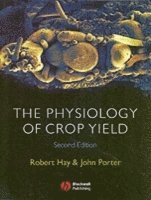
    Physiology of Crop Yield

    AvRobert K. M. Hay,John R. Porter

    Häftad, Engelska, 2006

    1 063 kr

    Beställningsvara. Skickas inom 5-8 vardagar. Fri frakt över 249 kr.

    Beskrivning

    The Physiology of Crop Yield, 2nd EditionFirst published in 1989, Physiology of Crop Yield was the first student textbook to digest and assimilate the many advances in crop physiology, within a framework of resource capture and use. Retaining the central core of the first edition, this long-awaited second edition draws on recent developments in areas such as phenology, canopy dynamics and crop modelling, and the concepts of sustainable crop production. A broad perspective is developed, from the gene through the plant and crop to the ecosystem, covering: Advances in molecular biology relating to crop scienceLimitation of crop yield by the supply of water or nitrogenGlobal climate change and its impact on crop modellingPhysiological aspects of crop qualityA wider range of species, with emphasis on wheat, maize and soybeanThis book will be a valuable tool for advanced undergraduate and postgraduate students of agricultural science, plant science, applied ecology and environmental science. It will be an essential addition to all libraries in universities and relevant research establishments.

    Produktinformation

    • Utgivningsdatum:2006-09-11
    • Mått:191 x 246 x 18 mm
    • Vikt:798 g
    • Format:Häftad
    • Språk:Engelska
    • Antal sidor:336
    • Upplaga:2
    • Förlag:John Wiley and Sons Ltd
    • ISBN:9781405108591

    Utforska kategorier

    • Agronomi och lantbruk inom Naturvetenskap och teknik

    Mer om författaren

    Robert K M Hay was, until 2004, director of the Scottish Agricultural Science Agency. He is currently Visiting Professor in the Swedish University of Agricultural Sciences, Uppsala.John R Porter is Professor of Agroecology at the Royal Veterinary and Agricultural University in Denmark and was formerly President of the European Society for Agronomy.

    Recensioner i media

    "Physiology of Crop Yield would be useful to any scientist who works to integrate and better understand growth, development and yield from a perspective of whole plant physiology.This is a much needed and timely publication."P.V. Vara Prasad, Kansas State University"Hay and Porter have produced an excellent book, well-suited for undergraduate teaching and for those seeking an overview of processes contributing to crop yield. They even tell us how long the sun needs to shine to deliver a bowl of breakfast cereal."Tim Wheeler, University of Reading "Although described as the second edition of An Introduction to the Physiology of Crop Yield, which was authored by R. Hay and A. J. Walker (1989). The Physiology of Crop Yield is completely rewritten and focuses more explicitly on quantitative prediction of Crop growth. The Physiology of Crop Yield contains numerous line drawings and tables, as well as 30 pages of reference. The overall layout and design of text, tables, and figures follows that of traditional textbooks...the text seems well suited for an upper-level undergraduate course with a pre-requisite of plant physiology."Jeffrey W. White reproduced from Crop Science "This book extensively covers the theoretical aspects of crop physiological processes...It is useful for understanding and interpreting agronomic phenomena and therfore clearly has a considerable value to advanced students, teachers and scientists in the field of agronomy, crop management and even plant breeding. The array of literature cited is broad and also up-to-date. The Order of presentation is logical and comprehensive overviews are given...it remains an excellent reference that should be recommended for any teaching of crop phsiology at the graduate level."Annals of Botany, 1-2, 2007

    Innehållsförteckning

    • Preface ixCopyright acknowledgements xi1 Introduction 12 Development and phenology 72.1 Crop development: concepts and tools 82.1.1 Growth stages and phasic development 92.1.2 Events at the stem apex: the leek as a simple model species 112.1.3 Events at stem apices: branching and reproductive development in wheat 132.1.4 Events at stem apices: the consequences of separation of male and female organs in maize 152.1.5 Phenology determined by events at axillary meristems: determinate and indeterminate soybean varieties 182.1.6 Components of yield 212.2 Case histories: the influence of environment and management on crop development and phenology 222.2.1 Convergence and synchrony: the influence of sowing date on winter wheat in Northern Europe 222.2.2 Crop improvement and the anthesis–silking interval in maize 252.2.3 Adaptation of soybean to different latitudes: phasic analysis of the photoperiodic control of flowering 262.2.4 Development in storage: physiological age and tuber initiation in the potato 302.2.5 Complementary phenologies and plant habits in mixed cropping: temperate grass/clover swards 323 Interception of solar radiation by the canopy 353.1 The life history of a leaf 353.2 The components of plant leaf area expansion 403.2.1 Crop emergence 403.2.2 Leaf production 413.2.3 Leaf expansion 433.2.4 Branching 473.2.5 Senescence, removal and damage – leaf lifespan 503.3 The development of the crop canopy: leaf area index 533.3.1 Seasonal development of leaf area index 533.3.2 Leaf area index and crop management 553.4 Canopy architecture and the interception of solar radiation 603.4.1 Seasonal patterns of interception 603.4.2 Optimum and critical leaf area indices 613.4.3 Leaf photosynthesis and canopy properties 633.4.4 Canopy extinction coefficient 664 Photosynthesis and photorespiration 734.1 Introduction 734.2 Photosynthetic efficiency 754.3 Photosynthetic processes 804.3.1 Photosynthesis as a cellular biochemical process 804.3.2 Photosynthesis as a leaf diffusive process 894.3.3 Photosynthesis as a crop canopy process 954.4 The C 4 photosynthesis mechanism 994.5 Water shortage and photosynthesis 1044.6 Nitrogen effects on photosynthesis 1094.7 Ozone effects on photosynthesis and crop productivity 1125 The loss of CO 2 : respiration 1175.1 Introduction 1175.2 The basis of crop respiration 1205.3 Growth and maintenance respiration 1235.4 The respiration of different plant substrates 1265.5 Growth and maintenance respiration in the field 1305.6 Respiration associated with crop processes 1345.7 Environmental effects on respiration 1405.8 Crop respiration in the future 1426 The partitioning of dry matter to harvested organs 1456.1 The processes and pathways of assimilate partitioning 1456.2 Ontogeny and assimilate partitioning: a survey of source/sink relationships 1486.3 Time courses of dry matter partitioning: harvest index 1516.4 Limitation of yield by source or sink 1536.5 Sink limitation of yield in cereals – physiology of ineffective grain setting 1576.6 Assimilate partitioning and crop improvement: historic trends in harvest index of wheat and barley 1626.7 Assimilate partitioning and crop improvement: historic trends in harvest index of maize 1656.8 Assimilate partitioning to potato tubers 1676.9 Assimilate partitioning in grassland: implications for management of grass yield 1716.10 Assimilate partitioning in grassland: implications for the overwintering and early growth of white clover 1766. 11 Assimilate partitioning in diseased plants: temperate cereals affected by biotrophic fungal pathogens 1787 Limiting factors and the achievement of high yield 1807.1 Limitation by water supply 1817.1.1 Acquisition of water 1827.1.2 Water use efficiency 1867.1.3 Crop yield where water supply is limiting 1907.2 Limitation by nitrogen supply 1937.2.1 Acquisition of nitrogen 1937.2.2 Nitrogen use efficiency 1967.2.3 Crop yield where N supply is limiting 2007.3 Achieving high yield: resource capture and assimilate partitioning 2028 Physiology of crop quality 2058.1 Wheat: protein content 2068.2 Soybean: oil and protein contents 2098.3 Oilseed rape: glucosinolates and erucic acid 2128.4 Potato: tuber size and processing quality 2158.5 The quality of conserved forages: ontogeny and yield 2179 The simulation modelling of crops 2229.1 Introduction 2229.2 Building a crop model 2259.3 Crop models of wheat (AFRC2), soybean (CROPGRO) and maize 2279.3.1 The AFRC2 wheat model 2289.3.2 The CROPGRO soybean model 2439.3.3 The maize model 2539.4 Modelling variety differences and traits 2579.5 Conclusions 26110 Crop physiology: the future 26410.1 Introduction 26410.2 Lowering inputs 26510.3 Climate change 26710.4 Quality 26910.5 New crops 27010.6 The potential for increasing crop photosynthesis and yield 27210.7 The last words 275References 277Index 309