• Fri frakt över 249 kr
  • •
  • Snabba leveranser
  • •
  • Billiga böcker
Kundservice

Du är på sajten för privatpersoner.

Företag, bibliotek eller offentlig verksamhet?

Du handlar på classic.bokus.com, där alla dina funktioner finns intakta.
Till classic.bokus.com
Bokus logotyp. Gå till startsidan.
  • Erbjudanden
  • Nyheter
  • Student
  • Topplistor
  • Barn & ungdom
  • Bokus Play
  • E-böcker
  • Pocketböcker
  • Spel & pussel

10% rabatt på allt med kod NYSTART10 →

Sidfot

Mina sidor

    Hjälp

    • Kundservice
    • Vanliga frågor och svar
    • Frakt och leverans
    • Retur vid ångerrätt
    • Reklamera vara
    • Betalning
    • Köpvillkor
    • Allmänna villkor
    • Information om webbplatsens tillgänglighet

    Om Bokus

    • Om oss
    • Pressrum
    • För studenter
    • För företag
    • För bibliotek och offentlig verksamhet
    • För leverantörer
    • Hållbarhet

    Populärt

    • Aktuella erbjudanden
    • Presentkort
    • Studentlitteratur
    • Nya böcker
    • Topplistor
    • Signerade böcker
    • Engelska böcker

    Inspiration

    • Boktips
    • BookTok
    • Populära bokserier
    • Barnbokskaraktärer
    • Populära författare
    Logotyp för Bokus
    Följ oss på Facebook (extern länk)Följ oss på Instagram (extern länk)Följ oss på YouTube (extern länk)Följ oss på TikTok (extern länk)
    bokus @ CookiesAnpassa cookiesIntegritetspolicyKöpvillkor
    Till Citymail hemsida (extern länk)Till Budbee hemsida (extern länk)Till Postnord hemsida (extern länk)Till Schenker hemsida (extern länk)Till Early Bird hemsida (extern länk)Till Walleys hemsida (extern länk)
    1. Samhälle och politik
    2. Sociologi och antropologi
    3. Antropologi

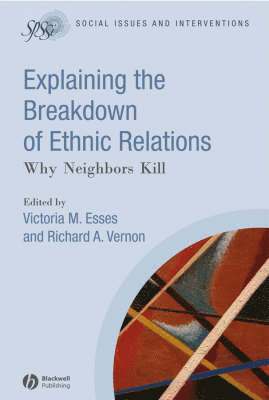
    Explaining the Breakdown of Ethnic Relations

    Why Neighbors Kill

    AvVictoria M. Esses,Richard A. Vernon

    Inbunden, Engelska, 2008

    Del 1 i serien Social Issues and Interventions

    1 267 kr

    Beställningsvara. Skickas inom 11-20 vardagar. Fri frakt över 249 kr.

    Beskrivning

    Written by an international team of renowned scholars, this volume addresses the multitude of factors that may lead to the deadly breakdown of ethnic relations. The book• Draws on real-world case studies, such as Rwanda, Sudan, and the Second Palestinian Intifada • Brings together original contributions and theoretical perspectives by a team of experts in psychology and related disciplines such as sociology and political science • Identifies events and processes that can break down inhibitions against violence, and lead to mass killings and genocide • Examines explanations that must be considered in making sense of past acts, and offers suggestions for interventions to prevent future repetitions

    Produktinformation

    • Utgivningsdatum:2008-07-11
    • Mått:155 x 231 x 23 mm
    • Vikt:544 g
    • Format:Inbunden
    • Språk:Engelska
    • Serie:Social Issues and Interventions
    • Antal sidor:296
    • Förlag:John Wiley and Sons Ltd
    • ISBN:9781405170598

    Utforska kategorier

    • Antropologi inom Samhälle och politik
    • Psykologi inom Psykologi och pedagogik

    Mer om författaren

    Victoria M. Esses is Professor of Psychology at the University of Western Ontario, Canada. Richard A. Vernon is Professor of Political Science at the University of Western Ontario, Canada.

    Recensioner i media

    "This volume provides a striking overview of basic human motivations and societal conditions that can incite and perpetuate violence, both through the acts of individuals and the inaction of others" Linda R. Tropp, University of Massachusetts at Amherst "Richard Vernon and Victoria Esses have brought together an outstanding group of contributors to focus on a contemporary problem, which has a long and dreadful history. I think Explaining the Breakdown of Ethnic Relations is one of the most exciting and innovative edited volumes to be published in recent years. I congratulate the editors for producing an extremely important and original contribution to the understanding of intergroup violence." Louis Penner, Wayne State University “The chapters of this compelling volume brim with urgency and breadth of scholarship. The book does more than simply summarize, review and integrate and is characterized by a real vibrancy and force which makes reading it as engaging a task as the topic itself is painful. There are points that one might contest, and gaps one might like to see filled, but such debate is the editors’ intent. This book will command a very broad readership and will attract many plaudits. The real tragedy, of course, is that such a volume is so very necessary.” Alex Haslam, University of Exeter

    Innehållsförteckning

    • Notes on Contributors. Series Preface.Acknowledgments.1 Why Neighbors Kill: An Overview: Richard A. Vernon and Victoria M. Esses (University of Western Ontario).Part I. Individual Factors.2 Extreme Harmdoing: A View from the Social Psychology of Justice: Carolyn L. Hafer (Brock University), James M. Olson (University of Western Ontario), and Alexandra A. Peterson (University of Toronto).3 On the Nature of Contemporary Prejudice: From Subtle Bias to Severe Consequences: John F. Dovidio and Adam R. Pearson (Yale University), Samuel L. Gaertner (University of Delaware), and Gordon Hodson (Brock University).4 Why Neighbors Kill: Prior Intergroup Contact and Killing of Ethnic Outgroup Neighbors: Miles Hewstone (University of Oxford), Nicole Tausch (Cardiff University), Alberto Voci (University of Padova), Jared Kenworthy (University of Texas at Arlington), Joanne Hughes (Queen’s University Belfast), and Ed Cairns (University of Ulster).5 Why Neighbors Don’t Stop the Killing: The Role of Group-Based Schadenfreude: Russell Spears (Cardiff University/University of Amsterdam) and Colin Wayne Leach (University of Sussex).Part II. Societal Factors.6 When Neighbors Blame Neighbors: Scapegoating and the Breakdown of Ethnic Relations: Peter Glick (Lawrence University).7 The Influence of the Threatening Transitional Context on Israeli Jews’ Reactions to Al Aqsa Intifada: Daniel Bar-Tal and Keren Sharvit (Tel-Aviv University).8 Why Do States Kill Citizens? Or, Why Racism is an Insufficient Explanation: Patricia Marchak (University of British Columbia).Part III. Synthesis.9 Theories of Genocide: The Case of Rwanda: Howard Adelman (Griffith University).10 Applying the Unified Instrumental Model of Group Conflict to Understanding Ethnic Conflict and Violence: The Case of Sudan: Victoria M. Esses (University of Western Ontario) and Lynne M. Jackson (King’s University College at the University of Western Ontario).11 The Origins of Genocide and Mass Killing, Prevention, Reconciliation, and their Application to Rwanda: Ervin Staub (University of Massachusetts at Amherst).Index