• Fri frakt över 249 kr
  • •
  • Snabba leveranser
  • •
  • Billiga böcker
Kundservice

Du är på sajten för privatpersoner.

Företag, bibliotek eller offentlig verksamhet?

Du handlar på classic.bokus.com, där alla dina funktioner finns intakta.
Till classic.bokus.com
Bokus logotyp. Gå till startsidan.
  • Erbjudanden
  • Nyheter
  • Student
  • Topplistor
  • Barn & ungdom
  • Bokus Play
  • E-böcker
  • Pocketböcker
  • Spel & pussel

10% rabatt på allt med kod: NYSTART10 →

Sidfot

Mina sidor

    Hjälp

    • Kundservice
    • Vanliga frågor och svar
    • Frakt och leverans
    • Retur vid ångerrätt
    • Reklamera vara
    • Betalning
    • Köpvillkor
    • Allmänna villkor
    • Information om webbplatsens tillgänglighet

    Om Bokus

    • Om oss
    • Pressrum
    • För studenter
    • För företag
    • För bibliotek och offentlig verksamhet
    • För leverantörer
    • Hållbarhet

    Populärt

    • Aktuella erbjudanden
    • Presentkort
    • Studentlitteratur
    • Nya böcker
    • Topplistor
    • Signerade böcker
    • Engelska böcker

    Inspiration

    • Boktips
    • BookTok
    • Populära bokserier
    • Barnbokskaraktärer
    • Populära författare
    Logotyp för Bokus
    Följ oss på Facebook (extern länk)Följ oss på Instagram (extern länk)Följ oss på YouTube (extern länk)Följ oss på TikTok (extern länk)
    bokus @ CookiesAnpassa cookiesIntegritetspolicyKöpvillkor
    Till Citymail hemsida (extern länk)Till Budbee hemsida (extern länk)Till Postnord hemsida (extern länk)Till Schenker hemsida (extern länk)Till Early Bird hemsida (extern länk)Till Walleys hemsida (extern länk)
    1. Filosofi och religion
    2. Religion och tro
    3. Religion: allmänt

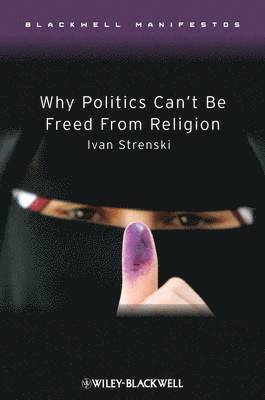
    Why Politics Can't Be Freed From Religion

    AvIvan Strenski

    Inbunden, Engelska, 2010

    Del 37 i serien Wiley-Blackwell Manifestos

    1 070 kr

    Beställningsvara. Skickas inom 11-20 vardagar. Fri frakt över 249 kr.

    Fler format och utgåvor

    Häftad

    430 kr

    E-bok

    1 246 kr

    Beskrivning

    Why Politics Can't be Freed From Religion is an original, erudite, and timely new book from Ivan Strenski. Itinterrogates the central ideas and contexts behind religion, politics, and power, proposing an alternative way in which we should think about these issues in the twenty-first century. A timely and highly original contribution to debates about religion, politics and power – and how historic and social influences have prejudiced our understanding of these conceptsProposes a new theoretical framework to think about what these ideas and institutions mean in today&'s societyApplies this new perspective to a variety of real-world issues, including insights into suicide bombers in the Middle EastIncludes radical critiques of the religious and political perspectives of thinkers such as Talal Asad and Michel FoucaultDislodges our conventional thinking about politics and religion, and in doing so, helps make sense of the complexities of our twenty-first century world

    Produktinformation

    • Utgivningsdatum:2010-02-12
    • Mått:160 x 238 x 18 mm
    • Vikt:463 g
    • Format:Inbunden
    • Språk:Engelska
    • Serie:Wiley-Blackwell Manifestos
    • Antal sidor:216
    • Förlag:John Wiley and Sons Ltd
    • ISBN:9781405176491

    Utforska kategorier

    • Religion: allmänt inom Filosofi och religion

    Mer om författaren

    Ivan Strenski is Holstein Family and Community Distinguished Professor of Religious Studies at the University of California, Riverside. He is the author of numerous books, including: Contesting Sacrifice: Religion, Nationalism and Social Thought (2002); Theology and the First Theory of Sacrifice (2003); The New Durkheim: Essays on Philosophy, Religious Identity and the Politics of Knowledge (2006); Thinking About Religion: An Historical Introduction to Theories of Religion and Thinking About Religion: A Reader (both Wiley-Blackwell, 2006).

    Recensioner i media

    “Overall the book is an excellent contribution.”  (Political Studies Review, 1 January 2013) “But as a powerful myth-buster of some of the great fallacies about religion and politics, or even as a primer in the study of religion for undergraduates, it works very well and would serve to provoke lively debate.”  (Modern Believing, 1 April 2012)"The book is written in an accessible and engaging style, and readers who are new to the field of religion and politics will find it readable and helpful". (Religion, September 2010)

    Innehållsförteckning

    • Acknowledgments xi1 When God Plays Politics: Radical Interrogations of Religion, Power, and Politics 12 Interrogating ‘Religion’ 81. Religion Trouble 82. ‘Seeing’ Religion: Six Common Clichés 113. Gagging at the Feast of Two Unexamined Assumptions: Religion, All Good or All Bad 144. The Religion-Is-No-Good Cliché 215. The Second Set of Two Clichés: Religion Is Belief and Belief in God 246. ‘Religion’s’ Private Parts 337. Powerless in Paradise 358. Two Ways to Eliminate ‘Religion’ 369. Is Religion Our Phlogiston? An Historical Test Case 3910. Talal Asad’s ‘Religion’ Trouble 4211. The Trick of Defining ‘Religion’ 4612. Owning ‘Religion’ 5013. How Durkheim Took ‘Ownership’ of ‘Religion’ 5514. Religion and Its Despisers 593 Interrogating ‘Power’ 621. Confronting the Paradox of ‘Power’ 622. How ‘Power’ Plays Havoc with Thinking about “Institutional Violence” 663. Whom Should We Blame? ‘History’ on Trial 704. History’s Helper: We Should Also Blame Foucault 815. Problematizing Power in South Africa 846. Foucault versus Foucault 887. Thinking about Power as Auctoritas and Hierarchy 908. What More Is to Be Done? Thinking about Power as Auctoritas and Social Force 974 Interrogating ‘Politics’ 1001. Defining ‘Politics’ 1002. Where There Is No Politics: Despotism and Totalitarianism 1023. Autonomous Politics 1054. Where Our ‘Politics’ Makes No Sense 1075. Politics, the Construct 1096. Two Pernicious Views of ‘Politics’ 1127. History Lessons for Professor Morgenthau 1168. What Constitutionalism Owes the Council of Constance 1199. The Emergence of the Political . . . from the Religious 12310. Machiavelli and Luther: Critical Contributions to the Autonomy of Politics 12511. Foucault’s Fault II: ‘Everything Is Political’ 13012. The Hidden Fascism of Thinking that Everything Is Political 13313. Public and Private: No Absolute Line of Demarcation 13514. Resisting the Panopticon 13615. Afterword: The Autonomy of ‘Politics’ and the Nation-State 1405 Testing Interrogations of ‘Religion,’ ‘Power,’ and ‘Politics’: Human Bombers and the Authority of Sacrifice in the Middle East 1421. Is ‘Suicide’ Bombing Religious? 1422. Making Too Much of Religion in ‘Suicide’ Bombing: ‘Islamofascism’ 1443. Dying to Make Too Little of Religion in ‘Suicide’ Bombing: Robert A. Pape 1474. No Religion in ‘Suicide’ Bombing: Talal Asad 1505. How Religion Helps Explain Human Bombing 1536. Human Bombing Is “Catastrophe,” but also a “Triumph” of “Secular Immortality” 1557. Human Bombing = Jihad + Sacrifice 1608. Sacrifice or Suicide? 1649. But Do Any Muslims Really Think Human Bombers Are ‘Sacrifices’? 16810. Sacrifice Makes Authority 17511. How and Why Sacrifice Works: The Authority of Sacralization 17612. How and Why Sacrifice Works: No Free Gifts 18013. Concluding Remarks 182References 187Index 196