• Fri frakt över 249 kr
  • •
  • Snabba leveranser
  • •
  • Billiga böcker
Kundservice

Du är på sajten för privatpersoner.

Företag, bibliotek eller offentlig verksamhet?

Du handlar på classic.bokus.com, där alla dina funktioner finns intakta.
Till classic.bokus.com
Bokus logotyp. Gå till startsidan.
  • Erbjudanden
  • Student
  • Topplistor
  • Barn & ungdom
  • Bokus Play
  • E-böcker
  • Ljudböcker
  • Pocketböcker
  • Spel och pussel

Pocketfynda! Hundratals böcker för 49 kr/st →

Sidfot

Mina sidor

    Hjälp

    • Kundservice
    • Vanliga frågor och svar
    • Frakt och leverans
    • Retur vid ångerrätt
    • Reklamera vara
    • Betalning
    • Köpvillkor
    • Allmänna villkor
    • Information om webbplatsens tillgänglighet

    Om Bokus

    • Om oss
    • Pressrum
    • För studenter
    • För företag
    • För bibliotek och offentlig verksamhet
    • För leverantörer
    • Hållbarhet

    Populärt

    • Aktuella erbjudanden
    • Presentkort
    • Studentlitteratur
    • Nya böcker
    • Topplistor
    • Signerade böcker
    • Engelska böcker

    Inspiration

    • Boktips
    • BookTok
    • Barnbokskaraktärer
    • Populära författare
    Logotyp för Bokus
    Följ oss på Facebook (extern länk)Följ oss på Instagram (extern länk)Följ oss på YouTube (extern länk)Följ oss på TikTok (extern länk)
    bokus @ CookiesAnpassa cookiesIntegritetspolicyKöpvillkor
    Till Citymail hemsida (extern länk)Till Budbee hemsida (extern länk)Till Postnord hemsida (extern länk)Till Schenker hemsida (extern länk)Till Early Bird hemsida (extern länk)Till Walleys hemsida (extern länk)
    1. Samhälle och politik
    2. Samhälle och kultur
    3. Sociala grupper och identitet

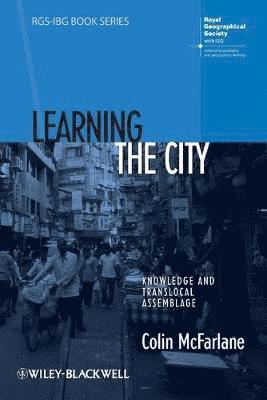
    Learning the City

    Knowledge and Translocal Assemblage

    AvColin McFarlane

    Häftad, Engelska, 2011

    Del 55 i serien RGS-IBG Book Series

    348 kr

    Beställningsvara. Skickas inom 5-8 vardagar. Fri frakt över 249 kr.

    Fler format och utgåvor

    Inbunden

    836 kr

    E-bok

    947 kr

    E-bok

    395 kr

    Beskrivning

    Learning the City: Translocal Assemblage and Urban Politics critically examines the relationship between knowledge, learning, and urban politics, arguing both for the centrality of learning for political strategies and developing a progressive international urbanism.   Presents a distinct approach to conceptualising the city through the lens of urban learningIntegrates fieldwork conducted in Mumbai's informal settlements with debates on urban policy, political economy, and developmentConsiders how knowledge and learning are conceived and created in citiesAddresses the way knowledge travels and opportunities for learning about urbanism between North and South

    Produktinformation

    • Utgivningsdatum:2011-08-05
    • Mått:152 x 229 x 14 mm
    • Vikt:345 g
    • Format:Häftad
    • Språk:Engelska
    • Serie:RGS-IBG Book Series
    • Antal sidor:240
    • Förlag:John Wiley and Sons Ltd
    • ISBN:9781405192811

    Utforska kategorier

    • Sociala grupper och identitet inom Samhälle och politik
    • Geografi inom Naturvetenskap och teknik

    Mer om författaren

    Colin McFarlane is Lecturer in Human Geography at Durham University, UK. His research focuses on urban geography, especially theorising the intersections between urban inequality, materiality, and knowledge.

    Recensioner i media

    “Readers who have ever puzzled over the movement of particular discourses or knowledge systems from one urban context to another, or between otherwise disparate groups, will find in this volume an exhaustive and compelling effort to theorize the development, movement, and effects of learning … Its revelatory power is arguably profound: for McFarlane, it promises nothing short of understanding the power to forge a different kind of city. In the 21st century city, the material and analytical stakes of learning could not be higher.” (Antipode, 1 September 2013)“This book is a significant step in bringing learning to the core of urban study … This volume’s detailed fieldwork effectively supports its desire to see learning occupy a central place in the production of more socially just urbanisms.”  (Area, 1 May 2013)“Learning the City is a critical academic contribution useful for scholars of the field ... It is sure to become indispensable for academics of the discipline.”  (Geography Helvitica, 1 December  2012)"Through Learning the City McFarlane has made a major contribution to our understandings of the urban. In its commitment to the diverse and lively practices through which the city is learned and known, in its engagement with the diverse forms of agency and political practices through which agency is assembled and re-assembled the book enlivens understandings of spatial politics. It is also a text that is animated by a powerful sense of hope that cities might come to bere-assembled in different ways that are more equitable and more open to different agentic forces and contributions." (Society and Space, 1 November 2012) "In Learning the City, McFarlane successfully manages to open the black box of urban learning in widening the perspective to acknowledge diverse urban learning practices, which may even bear a transformative potential in certain contexts." (International Planning Studies, 23 October 2012)"Learning the City is an important and theoretically sophisticated piece of work. It is like a good movie: you need to re-view it in your mind several times to position yourself ... McFarlane’s innovative theory of urban learning is very helpful to an understanding of contemporary urbanism and of how it can be changed for the better. Its great merit is to make us see cities as complex learning assemblages and milieus." (Urban Geography, 34.1) “A wonderfully insightful book that rewards careful attention and deserves a wide readership ... A powerful framework for re-thinking issues of poverty, urban informality and development in the Global South.” (Singapore Journal of Tropical Geography 34 (2013))“A rich and perceptive account of how we dwell in and learn about cities and what it takes to live an urban life … McFarlane’s book forces us to review the conceptual tools we have in the planning field for “getting to know” what cities are like and how urban life is experienced.” (Patsy Healey, Planning Theory & Practice, 14:2) “Urbanism, McFarlane believes, needs a theory of learning; throughout his book he builds a very sophisticated one…[he] brings us closer to the material stuff of urban life and politics…a kind of urbanism in motion, whereby what we come to term ‘knowledge’, ‘infrastructure’ and ‘resources’ are never simply ‘there’, but must be translated, distributed, coordinated, perceived and inhabited”. (International Journal of Urban and Regional Research, Volume 38.1, January 2014).

    Innehållsförteckning

    • Series Editors' Preface ix Acknowledgements xIntroduction 11 Learning Assemblages 15Introduction 15Translation: Distribution, Practice and Comparison 17Coordinating Learning 19Dwelling and Perception 21Assemblage Space 23Conclusion 302 Assembling the Everyday: Incremental Urbanism and Tactical Learning 32Introduction 32Incremental Urbanism 33Learning the Unknown City: Street Children in Mumbai 43Learning, Rhythm, Space 47Tactical Learning 54Conclusion 593 Learning Social Movements: Tactics, Urbanism and Politics 62Introduction 62Knowing Social Movements 63Global Slumming 66The Housing Assemblage: Materializing Learning 69Learning and Representation: Counting the Poor 74Entrepreneurial Learning 85Conclusion 904 Urban Learning Forums 92Introduction 92Uncertain Forums 93Dialogic Urban Forums 98Translocalism and Translation 105Conclusion 1135 Travelling Policies, Ideological Assemblages 115Introduction 115Translating Policy 117Comparative Learning: Translation and Colonial Urbanism 122Ideology and Postwar Urban Planning 128Neoliberal Urban Learning Assemblages 134Ideology and Explanation: Beyond Diffusionist Story-Making 145Conclusion 1516 A Critical Geography of Urban Learning 153Introduction 153The Actual and the Possible 155Agency and Critical Learning 160Assemblage and the Critical Learning Imaginary 164Postcolonial Urban Learning? 167Conclusion 172Conclusion 174References 185Index 205