• Fri frakt över 249 kr
  • •
  • Snabba leveranser
  • •
  • Billiga böcker
Kundservice

Du är på sajten för privatpersoner.

Företag, bibliotek eller offentlig verksamhet?

Du handlar på classic.bokus.com, där alla dina funktioner finns intakta.
Till classic.bokus.com
Bokus logotyp. Gå till startsidan.
  • Erbjudanden
  • Nyheter
  • Student
  • Topplistor
  • Barn & ungdom
  • Bokus Play
  • E-böcker
  • Pocketböcker
  • Spel & pussel

10% rabatt på allt med kod: NYSTART10 →

Sidfot

Mina sidor

    Hjälp

    • Kundservice
    • Vanliga frågor och svar
    • Frakt och leverans
    • Retur vid ångerrätt
    • Reklamera vara
    • Betalning
    • Köpvillkor
    • Allmänna villkor
    • Information om webbplatsens tillgänglighet

    Om Bokus

    • Om oss
    • Pressrum
    • För studenter
    • För företag
    • För bibliotek och offentlig verksamhet
    • För leverantörer
    • Hållbarhet

    Populärt

    • Aktuella erbjudanden
    • Presentkort
    • Studentlitteratur
    • Nya böcker
    • Topplistor
    • Signerade böcker
    • Engelska böcker

    Inspiration

    • Boktips
    • BookTok
    • Populära bokserier
    • Barnbokskaraktärer
    • Populära författare
    Logotyp för Bokus
    Följ oss på Facebook (extern länk)Följ oss på Instagram (extern länk)Följ oss på YouTube (extern länk)Följ oss på TikTok (extern länk)
    bokus @ CookiesAnpassa cookiesIntegritetspolicyKöpvillkor
    Till Citymail hemsida (extern länk)Till Budbee hemsida (extern länk)Till Postnord hemsida (extern länk)Till Schenker hemsida (extern länk)Till Early Bird hemsida (extern länk)Till Walleys hemsida (extern länk)
    1. Historia och arkeologi
    2. Historia
    3. Historia: särskilda händelser och ämnen
    4. Kolonialism och imperialism

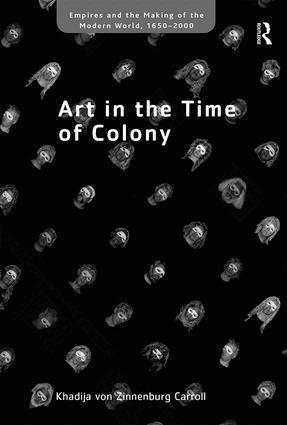
    Art in the Time of Colony

    AvKhadija von Zinnenburg Carroll

    Inbunden, Engelska, 2014

    Del i serien Empire and the Making of the Modern World, 1650-2000

    2 724 kr

    Beställningsvara. Skickas inom 10-15 vardagar. Fri frakt över 249 kr.

    Fler format och utgåvor

    Häftad

    918 kr

    E-bok

    1 091 kr

    E-bok

    1 088 kr

    Beskrivning

    It is often assumed that the verbal and visual languages of Indigenous people had little influence upon the classification of scientific, legal, and artistic objects in the metropolises and museums of nineteenth-century colonial powers. However colonized locals did more than merely collect material for interested colonizers. In developing the concept of anachronism for the analysis of colonial material this book writes the complex biographies for five key objects that exemplify, embody, and refract the tensions of nineteenth-century history. Through an analysis of particular language notations and drawings hidden in colonial documents and a reexamination of cross-cultural communication, the book writes biographies for five objects that exemplify the tensions of nineteenth-century history. The author also draws on fieldwork done in communities today, such as the group of Koorie women whose re-enactments of tradition illustrate the first chapter’s potted history of indigenous mediums and debates. The second case study explores British colonial history through the biography of the proclamation boards produced under George Arthur (1784-1854), Governor of British Honduras, Tasmania, British Columbia, and India. The third case study looks at the maps of the German explorer of indigenous taxonomy Wilhelm von Blandowski (1822-1878), and the fourth looks at a multi-authored encyclopaedia in which Blandowski had taken into account indigenous knowledge such as that in the work of Kwat-Kwat artist Yakaduna, whose hundreds of drawings (1862-1901) are the material basis for the fifth and final case study. Through these three characters’ histories Art in the Time of Colony demonstrates the political importance of material culture by using objects to revisit the much-contested nineteenth-century colonial period, in which the colonial nations as a cultural and legal-political system were brought into being.

    Produktinformation

    • Utgivningsdatum:2014-06-02
    • Mått:156 x 234 x 25 mm
    • Vikt:780 g
    • Format:Inbunden
    • Språk:Engelska
    • Serie:Empire and the Making of the Modern World, 1650-2000
    • Antal sidor:336
    • Förlag:Taylor & Francis Ltd
    • ISBN:9781409455967

    Utforska kategorier

    • Kolonialism och imperialism inom Historia och arkeologi
    • Konsthistoria inom Kultur

    Mer om författaren

    Khadija von Zinnenburg Carroll is Professor of Global Art at the University of Birmingham. An expert in contemporary art and colonialism, the history of museums and collecting, she wrote her M.A. and Ph.D. at Harvard University. Her films and installations have been exhibited at the Venice Biennale, Extracity Antwerp, Savvy Contemporary Berlin,Haus der Kulturen der Welt and the Marrakech Biennale. She has been the curator of various international exhibitions and has held British Academy, Sackler-Caird, and Humboldt Stiftung fellowships. She is an editor of the journal Third Text and of the edited volumes Botanical Drift and The Important of Being Anachronistic.www.kdja.org

    Recensioner i media

    'Art in the Time of Colony is an absorbing, experimental interrogation of colonial art and encounter in Australia. The book is notable on many grounds, not least for its fresh research on the intriguing mid-nineteenth century scientific traveller Blandowski, almost forgotten until very recently, but above all for its perspective on art history, from the vantage point of contemporary art. Khadija von Zinnenburg Carroll's voice is distinctive and compelling.' Nicholas Thomas, University of Cambridge, UK 'History would have it that there are people without history. Or as Hegel wrote, they were natural cultures that had to perish as soon as the spirit of the West approached. The spirit of Hegel is a temporal spectre for Khadija von Zinnenburg Carroll in her Art in the Time of Colony, and its inevitable teleology is brought into question by what she leads us to see in Australia’s fragments of visual historical reckoning. Thus the artistic engagement in the nineteenth century between Australian inhabitants and European colonists is not just the subject of this original, passionate and beautifully written book, but it is the means of inquiry about the nature of time and perception and the arts of Australia today, reinserting a claim to history and aesthetics that is too often still denied to too many.’ Thomas B.F. Cummins, Harvard University, USA 'In this captivating book, historian, artist and curator Khadija von Zinnenburg Carroll draws on contemporary Australian Aboriginal art to challenge historical blind spots and re-think stuffy conventions of art criticism. In exploring encounters between colonial visual cultures, her surprising, fresh and delightful juxtapositions bring new ideas and objects into view, and allow us to see familiar things anew. This book tackles the important task of reclaiming Aboriginal practice from anthropology for art and in doing so, challenges outmoded notions of colonialism, media, art, and even time.’ Jane Lydon, author of Eye Contact and The Flash of Recognition'In her stunning study, Khadija von Zinnenburg Carroll takes her readers beyond the armchair enchantments of conventional accounts of Indigenous art, dissolving boundaries among art history, anthropology, history of science and contemporary art. She shows that resistance to white norms can take many and subtle forms, both in the nineteenth century and in the present. Readers of this book will see how Indigenous cultural traditions - in this instance Australian, however artificial that concept may be - though mutable and adaptable, perdure and interact with settler values in unexpected ways. Carroll's distinctive art history thereby brings pasts to light - Aboriginal and white - that would otherwise have remained obscure.'Ivan Gaskell, Bard Graduate Center: Decorative Arts, Design History, Material Culture, New York, USA 'The fascinating premise behind Khadjia von Zinnenburg Carroll's Art in the Time of Colony is an examination of how contemporary art has been used to stand in for gaps in the historical record of Indigenous Australians'. Kelli Cole, University of Adelaide In: Artlink journal Indigenous Issue 'Art in the Time of Colonyis an experiment in writing history and generating new knowledge via the discipline of fine art practice, asking what happens if the relationship between art and history is reversed? Instead of history being written to understand art, art becomes the paradigm through which to navigate our understanding of history... One of the achievements of Art in the Time of Colony is its articulation and embodiment of art practice as generative of knowledge. The book is an instance of an artist writing about both art and history as art, reflecting cogently and intelligently on her own practice and that of others, as well contextualising this practice in wider historical narratives. In doing so, Art in the Time of Colony demonstrates that art can be understood as a knowledge-forming discipline.' Alana Jelinek, University of Cambridge; In: Journal of Museum Ethnography'This is a stunning and ambitious study of cross cultural encounters which reveals their nuanced and unexpected poetics and violence. Khadija von Zinnenburg Carroll's self proclaimed 'museum in a book' employs a creative and highly original way of thinking about the time of the colony through anachronism and how the arc of colonial time might be best thought of as being like the boomerang. Her stark juxtapositions and subtle weaving together of Aboriginal and colonial nineteenth-century art create emotive and acute alignments that are fascinating and timely. Rigorously researched, Art in the Time of the Colony is a seminal study that will change the way in which scholars approach visual culture and the postcolony. A tour de force.'Natasha Eaton, University College London, In: Art History: Journal of the Association of Art Historians

    Innehållsförteckning

    • Contents: Introduction; Mimesis of tradition; The picture proclamation; The encyclopaedia Terra Cognita; Anachronistic mapping; Telling race in silhouette; Conclusions and other performances; Bibliography; Indexes.