• Fri frakt över 249 kr
  • •
  • Snabba leveranser
  • •
  • Billiga böcker
Kundservice

Du är på sajten för privatpersoner.

Företag, bibliotek eller offentlig verksamhet?

Du handlar på classic.bokus.com, där alla dina funktioner finns intakta.
Till classic.bokus.com
Bokus logotyp. Gå till startsidan.
  • Erbjudanden
  • Nyheter
  • Student
  • Topplistor
  • Barn & ungdom
  • Bokus Play
  • E-böcker
  • Pocketböcker
  • Spel & pussel

10% rabatt på allt med kod: NYSTART10 →

Sidfot

Mina sidor

    Hjälp

    • Kundservice
    • Vanliga frågor och svar
    • Frakt och leverans
    • Retur vid ångerrätt
    • Reklamera vara
    • Betalning
    • Köpvillkor
    • Allmänna villkor
    • Information om webbplatsens tillgänglighet

    Om Bokus

    • Om oss
    • Pressrum
    • För studenter
    • För företag
    • För bibliotek och offentlig verksamhet
    • För leverantörer
    • Hållbarhet

    Populärt

    • Aktuella erbjudanden
    • Presentkort
    • Studentlitteratur
    • Nya böcker
    • Topplistor
    • Signerade böcker
    • Engelska böcker

    Inspiration

    • Boktips
    • BookTok
    • Populära bokserier
    • Barnbokskaraktärer
    • Populära författare
    Logotyp för Bokus
    Följ oss på Facebook (extern länk)Följ oss på Instagram (extern länk)Följ oss på YouTube (extern länk)Följ oss på TikTok (extern länk)
    bokus @ CookiesAnpassa cookiesIntegritetspolicyKöpvillkor
    Till Citymail hemsida (extern länk)Till Budbee hemsida (extern länk)Till Postnord hemsida (extern länk)Till Schenker hemsida (extern länk)Till Early Bird hemsida (extern länk)Till Walleys hemsida (extern länk)
    1. Kultur
    2. Konstböcker
    3. Konsthistoria

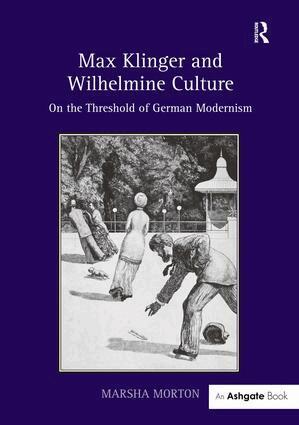
    Max Klinger and Wilhelmine Culture

    On the Threshold of German Modernism

    AvMarsha Morton

    Inbunden, Engelska, 2014

    2 724 kr

    Beställningsvara. Skickas inom 10-15 vardagar. Fri frakt över 249 kr.

    Fler format och utgåvor

    Häftad

    802 kr

    Beskrivning

    The Wilhelmine Empire’s opening decades (1870s - 1880s) were crucial transitional years in the development of German modernism, both politically and culturally. Here Marsha Morton argues that no artist represented the shift from tradition to unsettling innovation more compellingly than Max Klinger. The author examines Klinger’s early prints and drawings within the context of intellectual and material transformations in Wilhelmine society through an interdisciplinary approach that encompasses Darwinism, ethnography, dreams and hypnosis, the literary Romantic grotesque, criminology, and the urban experience. His work, in advance of Expressionism, revealed the psychological and biological underpinnings of modern rational man whose drives and passions undermined bourgeois constructions of material progress, social stability, and class status at a time when Germans were engaged in defining themselves following unification. This book is the first full-length study of Klinger in English and the first to consistently address his art using methodologies adopted from cultural history. With an emphasis on the popular illustrated media, Morton draws upon information from reviews and early books on the artist, writings by Klinger and his colleagues, and unpublished archival sources. The book is intended for an academic readership interested in European art history, social science, literature, and cultural studies.

    Produktinformation

    • Utgivningsdatum:2014-08-11
    • Mått:174 x 246 x 30 mm
    • Vikt:1 224 g
    • Format:Inbunden
    • Språk:Engelska
    • Antal sidor:434
    • Förlag:Taylor & Francis Ltd
    • ISBN:9781409467588

    Utforska kategorier

    • Konsthistoria inom Kultur

    Mer om författaren

    Marsha Morton, Professor of Art History at Pratt Institute in New York, has published and lectured frequently on topics in nineteenth-century German art and culture.

    Recensioner i media

    'Morton’s text, the first, major English-language study on Klinger, is a triumph. This invaluable resource on Wilhelmine visual culture explores the intersections between Klinger and German Romantic literary theory, Darwinism, the unconscious, and criminality. Her wide-ranging, historically-grounded interdisciplinary approach is a vital addition to the field and will ignite further research on this complex and endlessly fascinating artist.' Jay A. Clarke, Manton Curator of Prints, Drawings, and Photographs at the Clark and author of Becoming Edvard Munch: Influence Anxiety, and Myth'Marsha Morton's excellent monograph is the first full-length study in English on the German artist Max Klinger. ...[Morton] deftly explores the question of Klinger's modernism, and her cultural studies approach sheds new light on Klinger in the context of Wilhelmine society. ... The text is finely illustrated and expertly researched.' German Studies Review'The research and critical analysis presented in Morton’s book attests to the author’s sustained intellectual engagement withMax Klinger and Imperial Germany. This way of working seems to come under increasing pressure and it has been a pleasure to review a book that upholds such high academic standards. The book has been beautifully produced by Ashgate and includes 141 high-quality black and white illustrations (ideally suited for the reproduction of prints and drawings). ...Morton’s book represents a new Standardwerk on Klinger and a must-read for any scholar interested in Imperial Germany’s fascinating and often fractured cultural history.' The German Quarterly'Max Klinger and Wilhelmine Culture: On the Threshold of German Modernism is not only essential reading for any Klinger scholar, but also for those interested in understanding the complex connections between modern European art history, literature, cultural studies and the social sciences.' Art History'Morton's book represents a new Standardwerk on Klinger and a must-read for any scholar interested in Imperial Germany's fascinating and often fractured cultural history.' Sabine Wieber, University of Glasgow

    Innehållsförteckning

    • Contents: Introduction: Klinger: defining a modern spirit; An anxious art: foundations in German romantic irony and the grotesque; Structuring an anxious art: arabesque ‘methods of composition’; Darwinian tales: men and women in nature; The global network and the human condition: German anthropology and Klinger; Archetypes and symbols: Klinger’s mythological representations in an age of ethnography and psychology; Dreams and hypnosis: senses, symbols and the corporeal unconscious; In the papers and on the stage: crime, passion, and punishment in Wilhelmine Berlin; Epilogue; Biographical highlights; Select bibliography of writings on Max Klinger (graphic arts); Index.