• Fri frakt över 249 kr
  • •
  • Snabba leveranser
  • •
  • Billiga böcker
Kundservice

Du är på sajten för privatpersoner.

Företag, bibliotek eller offentlig verksamhet?

Du handlar på classic.bokus.com, där alla dina funktioner finns intakta.
Till classic.bokus.com
Bokus logotyp. Gå till startsidan.
  • Erbjudanden
  • Nyheter
  • Student
  • Topplistor
  • Barn & ungdom
  • Bokus Play
  • E-böcker
  • Pocketböcker
  • Spel & pussel

10% rabatt på allt med kod: NYSTART10 →

Sidfot

Mina sidor

    Hjälp

    • Kundservice
    • Vanliga frågor och svar
    • Frakt och leverans
    • Retur vid ångerrätt
    • Reklamera vara
    • Betalning
    • Köpvillkor
    • Allmänna villkor
    • Information om webbplatsens tillgänglighet

    Om Bokus

    • Om oss
    • Pressrum
    • För studenter
    • För företag
    • För bibliotek och offentlig verksamhet
    • För leverantörer
    • Hållbarhet

    Populärt

    • Aktuella erbjudanden
    • Presentkort
    • Studentlitteratur
    • Nya böcker
    • Topplistor
    • Signerade böcker
    • Engelska böcker

    Inspiration

    • Boktips
    • BookTok
    • Populära bokserier
    • Barnbokskaraktärer
    • Populära författare
    Logotyp för Bokus
    Följ oss på Facebook (extern länk)Följ oss på Instagram (extern länk)Följ oss på YouTube (extern länk)Följ oss på TikTok (extern länk)
    bokus @ CookiesAnpassa cookiesIntegritetspolicyKöpvillkor
    Till Citymail hemsida (extern länk)Till Budbee hemsida (extern länk)Till Postnord hemsida (extern länk)Till Schenker hemsida (extern länk)Till Early Bird hemsida (extern länk)Till Walleys hemsida (extern länk)
    1. Kultur
    2. Konstböcker
    3. Konsthistoria

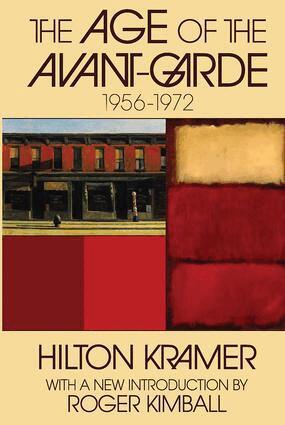
    Age of the Avant-garde

    1956-1972

    AvHilton Kramer

    Häftad, Engelska, 2008

    759 kr

    Beställningsvara. Skickas inom 10-15 vardagar. Fri frakt över 249 kr.

    Fler format och utgåvor

    Inbunden

    2 493 kr

    E-bok

    901 kr

    E-bok

    898 kr

    Beskrivning

    Hilton Kramer, well known as perhaps the most perceptive, courageous, and influential art critic in America, is also the founder and co-editor (with Roger Kimball) of The New Criterion. This comprehensive book collects a sizable selection of his early essays and reviews published in Artforum, Commentary, Arts Magazine, The New York Review of Books, and The Times, and thus constituted his first complete statement about art and the art world.The principal focus is on the artists and movements of the last hundred years: the Age of the Avant-Garde that begins in the nineteenth century with Realism and Impressionism. Most of the major artists of this rich period, from Monet and Degas to Jackson Pollock and Claes Oldenburg, are discussed and often drastically revaluated. A brilliant introductory essay traces the rise and fall of the avant-garde as a historical phenomenon, and examines some of the cultural problems which the collapse of the avant-garde poses for the future of art. In addition, there are chapters on art critics, museums, the relation of avant-garde art to radical politics, and on the growth of photography as a fine art.This collection is not intended to be the last word on one of the greatest as well as one of the most complex periods in the history of the artistic imagination. The essays and reviews gathered here were written in response to particular occasions and for specific deadlines--in the conviction that a start in the arduous task of critical revaluation needed to be made, not because a critical theory prescribed it but because our experience compelled it!

    Produktinformation

    • Utgivningsdatum:2008-11-30
    • Mått:152 x 229 x 35 mm
    • Vikt:907 g
    • Format:Häftad
    • Språk:Engelska
    • Antal sidor:646
    • Förlag:Taylor & Francis Inc
    • ISBN:9781412808347

    Utforska kategorier

    • Konsthistoria inom Kultur

    Mer om författaren

    Hilton Kramer is co-editor and publisher of The New Criterion. He has been an editor of Arts Magazine and an art critic for The Nation and The New York Times. Some of his most recent writings include The Triumph of Modernism and The Twilight of the Intellectuals: Culture and Politics in the Era of the Cold War. Roger Kimball is co-editor and publisher of The New Criterion and president and publisher of Encounter Books. He is author of numerous titles including The Rape of the Masters: How Political Correctness Sabotages Art and Art's Prospect: The Challenge of Tradition in an Age of Celebrity.

    Innehållsförteckning

    • I: The Age of the Avant-Garde; The Age of the Avant-Garde; II: The Nineteenth Century; 1: The Turner Revival; 2: The Radicalism of Courbet; 3: Late Monet; 4: The Conscience of Impressionism; 5: Degas as Expressionist; 6: Neo-Impressionism; 7: Odilon Redon: “The Medium of Mind”; 8: Medardo Rosso; 9: Simeon Solomon: Preview of a Revival; 10: The Pre-Raphaelite Revival; 11: Rediscovering Puvis de Chavannes; 12: Aubrey Beardsley: The Erotic and the Exquisite; 13: The Erotic Style; 14: Whistler: Choosing London over Paris; 15: Whistler in the Seminar Room; 16: Mary Cassatt: An American in Paris; 17: The Stratagems of Realism; III: The Twentieth Century: Germans and Other Northerners; 1: Lovis Corinth; 2: Edvard Munch; 3: The Rebellion of Oskar Kokoschka; 4: Egon Schiele; 5: Nolde: An Aggrieved Solitary; 6: Kirchner and Expressionism; 7: Feininger: A Visionary Cubist; 8: George Grosz: A Moral Recoil; 9: Poet and Pedagogue: Paul Klee; 10: Max Beckmann: “The Quality of Pulsating Life”; 11: Kandinsky: Theosophy and Abstraction; 12: Kandinsky: The Last Decade; 13: Mondrian’s Freedom; 14: Moholy-Nagy; 15: Rodchenko: Art in the Service of Revolution; 16: Thinking about Tatlin; 17: “The World of Art” in Exile; 18: Oskar Schlemmer’s Abstract Universe; 19: Walter Sickert and the Malaise of English Painting; 20: Epstein in London; 21: Barbara Hepworth: From the Avant-Garde to the Establishment; 22: Henry Moore: A Very English Romantic; The Twentieth Century: The School of Paris; 1: Matisse: The Paintings; 2: Matisse: The Sculpture; 3: Bourdelle: The Age of Innocence; 4: Vuillard; 5: Bonnard’s Drawings; 6: Picasso’s Radical Inventions; 7: Picasso’s “Guitar”; 8: Were These Braque’s “Great Years”?; 9: Juan Gris; 10: The Conversion of Julio Gonzalez; 11: Laurens: “The Ripening of Forms”; 12: Lipchitz’s Eloquence; 13: Chagall; 14: Soutine and the Problem of Expressionism; 15: Modigliani: Reconsidering a “Little Master”; 16: Miró: Enchanted Objects; 17: Arp: Purity of Heart, Purity of Form; 18: The Two Archipenkos; 19: Late Léger; 20: Duchamp: Resplendent Triviality; 21: Dali; 22: Picabia’s Dada Holiday; 23: Torres-Garcia: Scenario of Exile; 24: Giacometti; The Twentieth Century: Americans; 1: Reflections on Lachaise; 2: Prendergast; 3: Marsden Hartley: The Return of the Native; 4: The Loneliness of Arthur Dove; 5: The Ordeal of Alfred Maurer; 6: Introducing H. Lyman Sayen; 7: Man Ray’s Self-Portrait; 8: Arnold Friedman: “He Is Not a Pleasant Painter”; 9: Charles Sheeler: American Pastoral; 10: The Return of John Storrs; 11: The Legendary John Graham; 12: Walkowitz; 13: Edward Hopper: An American Vision; 14: The Sculpture of Saul Baizerman; 15: Romaine Brooks; 16: Arshile Gorky: Between Two Worlds; 17: The Confidence of Milton Avery; IV: Contemporaries; 1: The Sculpture of David Smith; 2: The Jackson Pollock Myth; 3: Robert Motherwell; 4: Willem de Kooning; 5: Ad Reinhardt; 6: Jean Dubuffet: Playing the Primitive; 7: Hofmann in Perspective; 8: Albers; 9: Louise Nevelson; 10: Joseph Cornell’s Baudelairean “Voyage”; 11: Balthus; 12: The Problem of Francis Bacon; 13: The Comic Fantasies of Saul Steinberg; 14: Isamu Noguchi; 15: “Homage to Trajan”; 16: José de Rivera; 17: Hélion: Returning from the Absolute; 18: Helen Frankenthaler: “The Landscape Paradigm”; 19: Mark di Suvero; 20: Anthony Caro; 21: Frank Stella; 22: Robert Morris: The Triumph of Ideas over Art; 23: An Art of Boredom?; 24: Claes Oldenburg; 25: Matta: Style vs. Ideology; 26: Prague: 1969; 27: Jean Ipousteguy; 28: Nicolas de Staël; 29: Fairfield Porter: Against the Historical Grain; 30: Expressionism plus Objects: The Art of Jim Dine; 31: Lindner’s Dream; 32: The Futurism of Ernest Trova; 33: Plebeian Figures, Banal Anecdotes: The Tableaux of George Segal; 34: Philip Pearlstein; 35: Ellsworth Kelly; 36: Mary Frank; 37: Richard Hunt; 38: Leland Bell: Painting in the Shadow of the Museum; 39: Dude-Ranch Dada; 40: Anne Arnold’s Peaceable Kingdom; 41: Alex Katz; 42: Comedies of Manners: Cecil Beaton and David Hockney; 43: The Sculpture of William King; V: The Art of Photography; 1: The Classicism of Henri Cartier-Bresson; 2: Edward Weston’s Privy and the Mexican Revolution; 3: Paul Strand; 4: Bill Brandt; 5: Walker Evans and Henri Cartier-Bresson; 6: From Fashion to Freaks: Diane Arbus; VI: Critics; 1: A Critic on the Side of History: Notes on Clement Greenberg; 2: The Contradictions of Herbert Read; 3: The Strange Case of Harold Rosenberg; VII: Into the Seventies; 1: “Information”; 2: Art and Politics: Incursions and Conversions; 3: Avant-Gardism; 4: And Now . . . Pop Art: Phase II; 5: William Bailey and the Artifice of Realism; 6: Andy’s “Mao” and Other Entertainments; 7: The Return of “Handmade” Painting; 8: Documenta 5: The Bayreuth of the Neo-Dadaists