• Fri frakt över 249 kr
  • •
  • Snabba leveranser
  • •
  • Billiga böcker
Kundservice

Du är på sajten för privatpersoner.

Företag, bibliotek eller offentlig verksamhet?

Du handlar på classic.bokus.com, där alla dina funktioner finns intakta.
Till classic.bokus.com
Bokus logotyp. Gå till startsidan.
  • Erbjudanden
  • Nyheter
  • Student
  • Topplistor
  • Barn & ungdom
  • Bokus Play
  • E-böcker
  • Pocketböcker
  • Spel & pussel

10% rabatt på allt med kod: NYSTART10 →

Sidfot

Mina sidor

    Hjälp

    • Kundservice
    • Vanliga frågor och svar
    • Frakt och leverans
    • Retur vid ångerrätt
    • Reklamera vara
    • Betalning
    • Köpvillkor
    • Allmänna villkor
    • Information om webbplatsens tillgänglighet

    Om Bokus

    • Om oss
    • Pressrum
    • För studenter
    • För företag
    • För bibliotek och offentlig verksamhet
    • För leverantörer
    • Hållbarhet

    Populärt

    • Aktuella erbjudanden
    • Presentkort
    • Studentlitteratur
    • Nya böcker
    • Topplistor
    • Signerade böcker
    • Engelska böcker

    Inspiration

    • Boktips
    • BookTok
    • Populära bokserier
    • Barnbokskaraktärer
    • Populära författare
    Logotyp för Bokus
    Följ oss på Facebook (extern länk)Följ oss på Instagram (extern länk)Följ oss på YouTube (extern länk)Följ oss på TikTok (extern länk)
    bokus @ CookiesAnpassa cookiesIntegritetspolicyKöpvillkor
    Till Citymail hemsida (extern länk)Till Budbee hemsida (extern länk)Till Postnord hemsida (extern länk)Till Schenker hemsida (extern länk)Till Early Bird hemsida (extern länk)Till Walleys hemsida (extern länk)
    1. Samhälle och politik
    2. Politik och statsskick
    3. Politisk aktivism

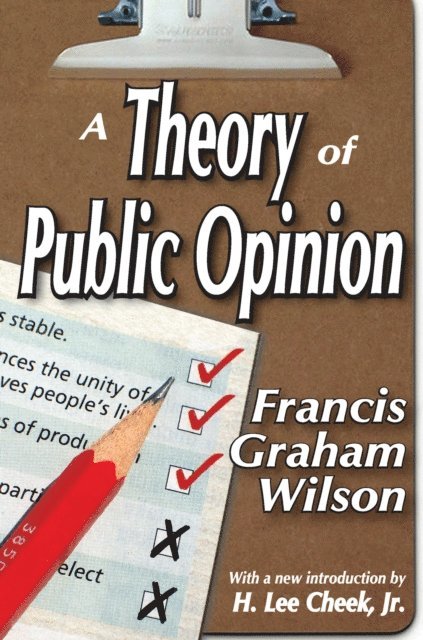
    Theory of Public Opinion

    AvFrancis Wilson,Francis Wilson

    Häftad, Engelska, 2013

    723 kr

    Beställningsvara. Skickas inom 10-15 vardagar. Fri frakt över 249 kr.

    Fler format och utgåvor

    Inbunden

    2 421 kr

    E-bok

    855 kr

    E-bok

    858 kr

    Beskrivning

    This book traces the emergence of the ideas and institutions that evolved to give people mastery over their own destiny through the force of public opinion. The Greek belief in citizen participation is shown as the ground upon which the idea of public opinion began and grew. For Wilson, public opinion is an "orderly force," contributing to social and political life. Wilson appraises the influence of modern psychology and the slow appearance of methodologies that would enable people not only to measure the opinions of others, but to mold them as well. He examines the relation of the theory of public opinion to the intellectuals, the middle class, and the various revolutionary and proletarian movements of the modern era. The circumstances in which the individual may refuse to follow the opinions of the experts are succinctly and movingly analyzed. This book is a historical and philosophical evaluation of a concept that has played a decisive part in history, and whose overwhelming force is underestimated. The author's insight brings an understanding that is invaluable at a time when public opinion, the force developed to enable the ruled to restrain their rulers, has become controllable. Attempts to manipulate it are made by those who would impose their will upon their fellow men.

    Produktinformation

    • Utgivningsdatum:2013-06-30
    • Mått:152 x 229 x 18 mm
    • Vikt:470 g
    • Format:Häftad
    • Språk:Engelska
    • Antal sidor:329
    • Förlag:Taylor & Francis Inc
    • ISBN:9781412815017

    Utforska kategorier

    • Politisk aktivism inom Samhälle och politik

    Innehållsförteckning

    • Introduction to the Transaction Edition, H. Lee Cheek, Jr. Acknowledgments A Preface and an ExplanationPart I. The Historical Inquiry Chapter 1. In Quest of a Public Chapter 2. The Great Ideas: A Converging Stream Chapter 3. The Necessary Institutions of Public OpinionPart II. The Modern Inquiry Chapter 4. The Emergence and Shaping of the Study of Public Opinion Chapter 5. Controversy, Tradition, and Culture Chapter 6. The Quality of Opinion Chapter 7. Systematic TechniquesPart III. Groups and the Ordering of Opinion Chapter 8. Public Opinion and the Intellectuals Chapter 9. The Middle Class Chapter 10. The Proletarian DefinitionPart IV. Assessments and Conclusions Chapter 11. The Situation of the Common Man Chapter 12. Theory for TomorrowIndex