• Fri frakt över 249 kr
  • •
  • Snabba leveranser
  • •
  • Billiga böcker
Kundservice

Du är på sajten för privatpersoner.

Företag, bibliotek eller offentlig verksamhet?

Du handlar på classic.bokus.com, där alla dina funktioner finns intakta.
Till classic.bokus.com
Bokus logotyp. Gå till startsidan.
  • Erbjudanden
  • Nyheter
  • Student
  • Topplistor
  • Barn & ungdom
  • Bokus Play
  • E-böcker
  • Pocketböcker
  • Spel & pussel

10% rabatt på allt med kod NYSTART10 →

Sidfot

Mina sidor

    Hjälp

    • Kundservice
    • Vanliga frågor och svar
    • Frakt och leverans
    • Retur vid ångerrätt
    • Reklamera vara
    • Betalning
    • Köpvillkor
    • Allmänna villkor
    • Information om webbplatsens tillgänglighet

    Om Bokus

    • Om oss
    • Pressrum
    • För studenter
    • För företag
    • För bibliotek och offentlig verksamhet
    • För leverantörer
    • Hållbarhet

    Populärt

    • Aktuella erbjudanden
    • Presentkort
    • Studentlitteratur
    • Nya böcker
    • Topplistor
    • Signerade böcker
    • Engelska böcker

    Inspiration

    • Boktips
    • BookTok
    • Populära bokserier
    • Barnbokskaraktärer
    • Populära författare
    Logotyp för Bokus
    Följ oss på Facebook (extern länk)Följ oss på Instagram (extern länk)Följ oss på YouTube (extern länk)Följ oss på TikTok (extern länk)
    bokus @ CookiesAnpassa cookiesIntegritetspolicyKöpvillkor
    Till Citymail hemsida (extern länk)Till Budbee hemsida (extern länk)Till Postnord hemsida (extern länk)Till Schenker hemsida (extern länk)Till Early Bird hemsida (extern länk)Till Walleys hemsida (extern länk)
    1. Psykologi och pedagogik
    2. Pedagogik
    3. Pedagogisk metodik

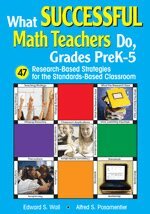
    What Successful Math Teachers Do, Grades PreK-5

    47 Research-Based Strategies for the Standards-Based Classroom

    AvEdward S. Wall,Alfred S. Posamentier

    Inbunden, Engelska, 2006

    1 106 kr

    Beställningsvara. Skickas inom 3-6 vardagar. Fri frakt över 249 kr.

    Fler format och utgåvor

    Häftad

    566 kr

    Beskrivning

    "The book is very easy to follow, with practical, research-based strategies for the teacher to use. It also provides insight to better remediate students who are struggling."
    -Allen Stevens, Math/Science Teacher Mooresville Middle School, NC

    "The 'Precautions and Pitfalls' section is such a welcome feature! This is a powerful book for beginning teachers or seasoned teachers who want to improve their practice to ensure student learning."
    -Rhonda Naylor, Math Teacher/Coordinator Campus Middle School, Englewood, CO

    "The research and vignettes that follow each strategy clearly support why the strategy is important and how it can be effective."
    -Trish Guinee, Mathematics Coordinator Peoria Public Schools, IL

    Facilitate learning in PreK-5 mathematics and maximize student achievement with research-based teaching strategies!

    This easy-to-navigate guide offers research-based teaching strategies for introducing prekindergarten and elementary school students to the content and skills recommended by the NCTM principles and standards for mathematics. Using the popular format of the What Successful Teachers Do books, the authors present 47 dynamic learning activities, each including:

    • A concise statement of the teaching strategy
    • Research-based validations for the strategy
    • How the strategy aligns with NCTM standards
    • Grade-specific classroom applications and vignettes
    • Precautions and possible pitfalls
    • Primary sources for further reading

    This insightful resource allows teachers to increase students' confidence in math-and their enthusiasm-with practical and engaging activities, while responding effectively to NCTM standards.

    Produktinformation

    • Utgivningsdatum:2006-11-02
    • Mått:177 x 254 x 14 mm
    • Vikt:540 g
    • Format:Inbunden
    • Språk:Engelska
    • Antal sidor:168
    • Upplaga:1
    • Förlag:SAGE Publications
    • ISBN:9781412915021

    Utforska kategorier

    • Pedagogisk metodik inom Psykologi och pedagogik

    Mer om författaren

    Edward S. Wall is assistant professor of elementary mathematics education at the City College of the City University of New York. In 1968 he received his MA in mathematics at the University of Maryland and, after a number of years working as an applied mathematician, received a Sloan Foundation Fellowship for the purposes of pursuing a PhD in mathematical biology at the University of Chicago. Along the way, he became intrigued by the very notion of teaching mathematics and, after several years, found himself deeply involved in full-time K-12 mathematics teaching. In 2003 he received a PhD in mathematics education at the University of Michigan and subsequently joined the faculty at City College. He still finds himself intrigued by the very notion of teaching mathematics and his research reflects that fascination. Alfred S. Posamentier is professor of mathematics education and dean of the School of Education at the City College of the City University of New York. He has authored and co-authored several resource books in mathematics education for Corwin Press.

    Recensioner i media

    "This is an excellent book. If every elementary teacher does not have one, it should at least be available in the school′s professional library."

    Innehållsförteckning

    • PrologueAcknowledgmentsAbout the Authors1. Numbers and OperationsGrades PreK-21. Encourage young children′s exploration and understanding of relationships among numbers.2. Encourage young children′s understanding of addition and subtraction and how they relate to each other.3. Encourage young children′s fluent computation.Grades 3-54. Encourage an understanding of the structure of numbers and relationships among numbers.5. Encourage an understanding of the meanings of multiplication and division and how they relate to each other.6. Encourage students to compute fluently and make reasonable estimates.2. AlgebraGrades PreK-27. Encourage young children′s systematic sorting and classification as they work with a variety of patterns, geometric shapes, and data.8. Encourage young children′s systematic exploration of the general principles and properties of operations such as addition and subtraction.Grades 3-59. Encourage the expression and generalization of mathematics relationships.10. Encourage further understanding of multiplicative structures through application and analysis of the distributivity of multiplication over addition.3. GeometryGrades PreK-211. Encourage young children′s exploration of characteristics and properties of two- and three-dimensional shapes.12. Encourage young children′s application of similarity transformations to analyze geometric situations.13. Encourage young children′s use of visualization and spatial reasoning in their exploration of geometric shapes.Grades 3-514. Encourage students′ exploration and mathematical analysis of the properties of two-dimensional geometric shapes.15. Encourage students′ use of geometric transformations to analyze mathematical situations.16. Encourage students′ use of visualization, spatial reasoning, and geometric modeling to solve problems.4. MeasurementGrades PreK-217. Encourage young children′s exploration and understanding of measurement concepts and relationships.18. Encourage young children to accurately apply appropriate tools and techniques to linear measurement.Grades 3-519. Encourage students′ exploration and understanding of measurement concepts and relationships.20. Encourage students′ appropriate application of conventional measuring tools in varied situations.5. Data Analysis and ProbabilityGrades PreK-221. Encourage young children′s collection, display, and organization of objects and data.22. Encourage the idea in young children that data, graphs, and charts give information.23. Encourage young children′s informal explorations of probability.Grades 3-524. Encourage students to explore questions they find personally relevant and that can be addressed by data collection and analysis.25. Encourage students to become more precise in their mathematical descriptions of data.26. Encourage students to explore and evaluate issues of representativeness and inference.27. Encourage students′ exploration and quantification of simple probabilistic events.6. Problem SolvingGrades PreK-228. Encourage young children to ask mathematical questions and to identify essential mathematical information.29. Assess young children′s abilities to solve problems through examination of student work and conversations.Grades 3-530. Encourage students′ development and application of problem-solving strategies.31. Select rich, appropriate, and challenging problems and orchestrate their use.7. Reasoning and ProofGrades PreK-232. Encourage young children to explain their thinking by stating their reasons.33. Ask questions that encourage young children to make conjectures and to justify their thinking.Grades 3-534. Encourage children to reason about the relationships that apply to the numbers, operations, or shapes that they are studying.35. Focus on general mathematical structures and relationships.8. CommunicationGrades PreK-236. Encourage young children′s verbal and written communication of mathematics concepts and ideas.37. Expect young children to explain their thinking and give them opportunities to talk with and listen to their peers.Grades 3-538. Encourage students to share their thinking, to ask questions, and to justify their ideas.39. Provide models for student dialogue about mathematics.9. ConnectionsGrades PreK-240. Encourage young children to make connections among mathematical ideas, vocabulary, and representations.41. Make links between routine school activities and mathematics.Grades 3-542. Encourage students to see that mathematics is a web of closely connected ideas.43. Select tasks that help students explore and develop increasingly sophisticated mathematical ideas.10. RepresentationGrades PreK-244. Encourage young children to represent their mathematical ideas and procedures in varied ways.45. Create a learning environment that supports and encourages children′s use of multiple representations.Grades 3-546. Encourage students to use representations to support, clarify, and extend their mathematical ideas.47. Choose tasks that embody rich and varied representational structures.EpilogueIndex