• Fri frakt över 249 kr
  • •
  • Snabba leveranser
  • •
  • Billiga böcker
Kundservice

Du är på sajten för privatpersoner.

Företag, bibliotek eller offentlig verksamhet?

Du handlar på classic.bokus.com, där alla dina funktioner finns intakta.
Till classic.bokus.com
Bokus logotyp. Gå till startsidan.
  • Erbjudanden
  • Nyheter
  • Student
  • Topplistor
  • Barn & ungdom
  • Bokus Play
  • E-böcker
  • Pocketböcker
  • Spel & pussel

10% rabatt på allt med kod: NYSTART10 →

Sidfot

Mina sidor

    Hjälp

    • Kundservice
    • Vanliga frågor och svar
    • Frakt och leverans
    • Retur vid ångerrätt
    • Reklamera vara
    • Betalning
    • Köpvillkor
    • Allmänna villkor
    • Information om webbplatsens tillgänglighet

    Om Bokus

    • Om oss
    • Pressrum
    • För studenter
    • För företag
    • För bibliotek och offentlig verksamhet
    • För leverantörer
    • Hållbarhet

    Populärt

    • Aktuella erbjudanden
    • Presentkort
    • Studentlitteratur
    • Nya böcker
    • Topplistor
    • Signerade böcker
    • Engelska böcker

    Inspiration

    • Boktips
    • BookTok
    • Populära bokserier
    • Barnbokskaraktärer
    • Populära författare
    Logotyp för Bokus
    Följ oss på Facebook (extern länk)Följ oss på Instagram (extern länk)Följ oss på YouTube (extern länk)Följ oss på TikTok (extern länk)
    bokus @ CookiesAnpassa cookiesIntegritetspolicyKöpvillkor
    Till Citymail hemsida (extern länk)Till Budbee hemsida (extern länk)Till Postnord hemsida (extern länk)Till Schenker hemsida (extern länk)Till Early Bird hemsida (extern länk)Till Walleys hemsida (extern länk)
    1. Samhälle och politik
    2. Sociologi och antropologi
    3. Sociologi

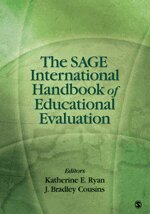
    SAGE International Handbook of Educational Evaluation

    AvKatherine E. Ryan,J. Bradley Cousins

    Inbunden, Engelska, 2009

    2 946 kr

    Beställningsvara. Skickas inom 3-6 vardagar. Fri frakt över 249 kr.

    Beskrivning

    Bringing together the expertise of top evaluation leaders from around the world, The SAGE International Handbook of Educational Evaluation addresses methods and applications in the field, particularly as they relate to policy- and decision-making in an era of globalization. The comprehensive collection of articles in the Handbook compels readers to consider globalization influences on educational evaluation within distinct genres or families of evaluation approaches.Key FeaturesDiscusses substantive issues surrounding globalization, and its implication for educational policy and practice and ultimately evaluation;Includes state-of-the-art theory chapters and method chapters within scientific, accountability-oriented, learning-oriented, and political genres of evaluation approaches;Provides real-world case exemplar chapters to illustrate core concepts within genres;Extends dialogue on controversial topics and contemporary educational evaluation tensions in the context of globalization;Summarizes, by means of an integration chapter, the issues, tensions and dilemmas confronting educational evaluators in an era of globalization. Serving as a state-of-the-art resource on educational evaluation, this volume is designed for graduate students, evaluation scholars and researchers and professional evaluation practitioners with an interest in educational program and policy evaluation.

    Produktinformation

    • Utgivningsdatum:2009-10-01
    • Mått:177 x 254 x 38 mm
    • Vikt:1 240 g
    • Format:Inbunden
    • Språk:Engelska
    • Antal sidor:608
    • Förlag:SAGE Publications Inc
    • ISBN:9781412940689

    Utforska kategorier

    • Sociologi inom Samhälle och politik

    Mer om författaren

    Katherine Ryan (B.S., Psychology, M.Ed., Special Education, Ph.D., Educational Psychology, University of Illinois - Urbana) is Associate Professor of Educational Psychology in the College of Education at UIUC. Her areas of specialization include Educational Measurement, Program Evaluation, and Applied Statistics, and she is currently Head of Measurement and Evaluation in the College of Education. Her research interests include assessment validation issues, particularly the evaluation of validity evidence based on response processes and consequences of assessments. Other interests include differential item/test functioning, and issues in program evaluation theory and practice. She teaches Descriptive and Inferential Statistics, Classroom Assessment, Introduction to Measurement, Introduction to Program Evaluation Theory, and Introduction to Evaluation Methods. She has edited two volumes of New Directions in Evaluation for the American Evaluation Association (AEA), one on evaluation as a democratic process, and the other on teaching evaluation in higher education. J. Bradley Cousins is professor of Evaluation at the Faculty of Education, University of Ottawa. Cousins’ main interests are in program evaluation including participatory and collaborative approaches, use, and capacity building. He received his PhD in Educational Measurement and Evaluation from the University of Toronto in 1988. Throughout his career he has received several awards for his work in evaluation including the Contribution to Evaluation in Canada award (CES, 1999), the Paul F. Lazarsfeld Award for Theory in Evaluation (AEA, 2008) and the AERA Research on Evaluation Distinguished Scholar Award (2011). He has published many articles and books on evaluation and was editor of the Canadian Journal of Program Evaluation from 2002 to 2010. Throughout his career, Cousins has had considerable experience planning, delivering, and evaluating evaluation training and capacity building in Canada and abroad. Internationally he led evaluation capacity building in Central and West Africa and a major three and one-half year project in India. He is currently leading a nation-wide evaluation of teacher in-service training in that country in collaboration with several of the people he had previously trained. Cousins completed a three and one-half year term as director of the Centre for Research on Educational and Community Services at the University of Ottawa in July 2015. He continues to be an active member of CRECS, which has a strong mandate for research and evaluation capacity building. For more information, visit www.crecs.uottawa.ca.

    Innehållsförteckning

    • IntroductionAcknowledgmentsPART I. THE EDUCATIONAL EVALUATION CONTEXT1. Globalization and Policy Research in Education - Fazal Rizvi2. Globalizing Influences on the Western Evaluation Imaginary - Thomas A. Schwandt3. Fundamental Evaluation Issues in a Global Society - Nick L. SmithPART II. THE ROLE OF SCIENCE IN EDUCATIONAL EVALUATION4. Evaluation, Method Choices, and Pathways to Consequences: Trying to Making Sense of How Evaluation Can Contribute to Sensemaking5. Randomized Experiments and Quasi-Experimental Designs in Educational Research - Peter M. Steiner, Angela Wroblewski & Thomas D. Cook6. Enhancing Impact Evidence on How Global Education Initiatives Work: Theory, Epistemological Foundations, and Principles for Applying Multiphase, Mixed Method Designs7. The Evaluation of the Georgia Pre-K Program: An Example of a Scientific Evaluation of an Early Education Program - Gary T. Henry & Dana K. Rickman8. Globalization-Blessing and Bane in Empirical Evaluation: Lessons in Three Acts - Jacob Marszalek & Debra D. Bragg9. Science-Based Educational Evaluation and Student Learning in a Global Society: A Critical Appraisal - Lois-ellin DattaPART III. EDUCATIONAL EVALUATION, CAPACITY BUILDING, AND MONITORING10. Evaluation, Accountability and Performance Measurement in National Education Systems: Trends, Methods, and Issues - Katherine E. Ryan11. A Precarious Balance: Educational Evaluation Capacity Building in a Globalized Society12. International Assessments and Indicators: How Will Assessments and Performance Indicators Improve Educational Policies and Practices in a Globalized Society?13. Exemplary Case: Implementing Large-Scale Assessment of Education in Mexico14. Inquiry-Minded District Leaders: Evaluation as Inquiry, Inquiry as Practice15. Where Global Meets Local: Contexts, Constraints, and Consensus in School Evaluation in Ireland - Gerry McNamara & Joe O?Hara16. Accountability and Capacity Building: Can They Live Together?PART IV. EDUCATIONAL EVALUATION AS LEARNING AND DISCOVERY17. Learning-Oriented Educational Evaluation in Contemporary Society18. Meaningfully Engaging With Difference Through Mixed Methods Educational Evaluation19. Case Study Methods in Educational Evaluation - Linda Mabry20. Developing a Community of Practice: Learning and Transformation Through Evaluation21. Learning-in-(Inter)action: A Dialogical Turn to Evaluation and Learning22. Educational Evaluation as Mediated Mutual Learning - John ElliottPART V. EDUCATIONAL EVALUATION IN A POLITICAL WORLD23. Own Goals: Democracy, Evaluation, and Rights in Millennium Projects24. Reclaiming Knowledge at the Margins: Culturally Responsive Evaluation in the Current Evaluation Moment25. Evaluation for and by Navajos: A Narrative Case of the Irrelevance of Globalization - Stafford Hood26. Dialogue, Deliberation and Democracy in Educational Evaluation: Theoretical Arguments and a Case Narrative27. Pursuing the Wrong Indicators? The Development and Impact of Test-Based AccountabilityPART VI. EDUCATIONAL EVALUATION: OPPORTUNITIES AND NEW DILEMMAS28. Evaluation and Educational Policymaking29. Technology and Educational Evaluation - Michael Scriven30. Serving the Public Interest Through Educational Evaluation: Salvaging Democracy by Rejecting Neoliberalism31. Dilemmas for Educational Evaluation in a Globalized Society - J. Bradley Cousins & Katherine RyanAuthor IndexSubject IndexAbout the EditorsAbout the Contributors