• Fri frakt över 249 kr
  • •
  • Snabba leveranser
  • •
  • Billiga böcker
Kundservice

Du är på sajten för privatpersoner.

Företag, bibliotek eller offentlig verksamhet?

Du handlar på classic.bokus.com, där alla dina funktioner finns intakta.
Till classic.bokus.com
Bokus logotyp. Gå till startsidan.
  • Erbjudanden
  • Nyheter
  • Student
  • Topplistor
  • Barn & ungdom
  • Bokus Play
  • E-böcker
  • Pocketböcker
  • Spel & pussel

10% rabatt på allt med kod: NYSTART10 →

Sidfot

Mina sidor

    Hjälp

    • Kundservice
    • Vanliga frågor och svar
    • Frakt och leverans
    • Retur vid ångerrätt
    • Reklamera vara
    • Betalning
    • Köpvillkor
    • Allmänna villkor
    • Information om webbplatsens tillgänglighet

    Om Bokus

    • Om oss
    • Pressrum
    • För studenter
    • För företag
    • För bibliotek och offentlig verksamhet
    • För leverantörer
    • Hållbarhet

    Populärt

    • Aktuella erbjudanden
    • Presentkort
    • Studentlitteratur
    • Nya böcker
    • Topplistor
    • Signerade böcker
    • Engelska böcker

    Inspiration

    • Boktips
    • BookTok
    • Populära bokserier
    • Barnbokskaraktärer
    • Populära författare
    Logotyp för Bokus
    Följ oss på Facebook (extern länk)Följ oss på Instagram (extern länk)Följ oss på YouTube (extern länk)Följ oss på TikTok (extern länk)
    bokus @ CookiesAnpassa cookiesIntegritetspolicyKöpvillkor
    Till Citymail hemsida (extern länk)Till Budbee hemsida (extern länk)Till Postnord hemsida (extern länk)Till Schenker hemsida (extern länk)Till Early Bird hemsida (extern länk)Till Walleys hemsida (extern länk)
    1. Psykologi och pedagogik
    2. Pedagogik
    3. Undervisning i specifika ämnen

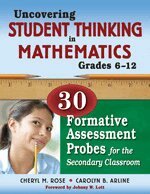
    Uncovering Student Thinking in Mathematics, Grades 6-12

    30 Formative Assessment Probes for the Secondary Classroom

    AvCheryl M. Rose,Carolyn B. Arline

    Häftad, Engelska, 2008

    643 kr

    Beställningsvara. Skickas inom 3-6 vardagar. Fri frakt över 249 kr.

    Fler format och utgåvor

    Inbunden

    1 311 kr

    Beskrivning

    "Cheryl Rose and Carolyn Arline provide a valuable resource to teachers who are interested in determining how their students think and answer questions in mathematics classes."—From the Foreword by Johnny W. LottDirector, Center for Excellence in Teaching and LearningUniversity of MississippiUse these targeted probes to assess secondary students′ grasp of key mathematics concepts!Research findings show that formative assessment is an important strategy for improving student achievement in mathematics. This practical resource by best-selling authors Cheryl M. Rose and Carolyn B. Arline provides tools and examples that allow middle and high school teachers to gauge students′ knowledge of core mathematics concepts and strengthen their ability to teach effectively.The authors provide 30 formative assessment probes—brief, easily administered activities targeting specific mathematics ideas—to reveal common understandings and misunderstandings in student thinking. Field-tested with teachers and students at various grade levels, these powerful diagnostic tools help teachers modify their teaching and identify areas that require more instruction. Written in accessible language, this invaluable book:Discusses standards, research results, and practical craft knowledgeDescribes the purpose, structure, and development of mathematics assessment probesHelps teachers build on students′ current understandings while addressing their identified difficultiesOffers examples of the faulty thinking students are likely to exhibit and typical obstacles they may encounterThese assessment probes will help teachers can make sound instructional choices and increase the mathematics knowledge of all their students!

    Produktinformation

    • Utgivningsdatum:2008-08-19
    • Mått:215 x 279 x 16 mm
    • Vikt:680 g
    • Format:Häftad
    • Språk:Engelska
    • Antal sidor:248
    • Förlag:SAGE Publications Inc
    • ISBN:9781412963770

    Utforska kategorier

    • Undervisning i specifika ämnen inom Psykologi och pedagogik

    Mer om författaren

    Cheryl Rose Tobey is a senior mathematics associate at Education Development Center (EDC) in Massachusetts. She is the project director for Formative Assessment in the Mathematics Classroom: Engaging Teachers and Students (FACETS) and a mathematics specialist for Differentiated Professional Development: Building Mathematics Knowledge for Teaching Struggling Students (DPD); both projects are funded by the National Science Foundation (NSF). She also serves as a director of development for an Institute for Educational Science (IES) project, Eliciting Mathematics Misconceptions (EM2). Her work is primarily in the areas of formative assessment and professional development.Prior to joining EDC, Tobey was the senior program director for mathematics at the Maine Mathematics and Science Alliance (MMSA), where she served as the co–principal investigator of the mathematics section of the NSF-funded Curriculum Topic Study, and principal investigator and project director of two Title IIa state Mathematics and Science Partnership projects. Prior to working on these projects, Tobey was the co–principal investigator and project director for MMSA’s NSF-funded Local Systemic Change Initiative, Broadening Educational Access to Mathematics in Maine (BEAMM), and she was a fellow in Cohort 4 of the National Academy for Science and Mathematics Education Leadership. She is the coauthor of six published Corwin books, including seven books in the Uncovering Student Thinking series (2007, 2009, 2011, 2013, 2014), two Mathematics Curriculum Topic Study resources (2006, 2012), and Mathematics Formative Assessment: 75 Practical Strategies for Linking Assessment, Instruction and Learning (2011). Before joining MMSA in 2001 to begin working with teachers, Tobey was a high school and middle school mathematics educator for ten years. She received her BS in secondary mathematics education from the University of Maine at Farmington and her MEd from City University in Seattle. She currently lives in Maine with her husband and blended family of five children.Carolyn B. Arline is a secondary mathematics educator, currently teaching high school students in Maine. Carolyn also works as a teacher leader in the areas of mathematics professional development, learning communities, assessment, systematic school reform, standards-based teaching, learning and grading, student-centered classrooms, and technology.  She has previously worked as a mathematics specialist at the Maine Mathematics and Science Alliance (MMSA) and continues her work with them as a consultant. Carolyn is a fellow of the second cohort group of the Governor’s Academy for Science and Mathematics Educators and serves as a mentor teacher with the current cohort. She participated as a mathematics mentor in the NSF-funded Northern New England Co-Mentoring Network (NNECN) and continues her role as a mentor teacher. She serves as a board member of the Association of Teachers of Mathematics in Maine (ATOMIM) and on local curriculum committees.  Carolyn received her B.S. in secondary mathematics education from the University of Maine.

    Recensioner i media

    "Cheryl Rose and Carolyn Arline provide a valuable resource to teachers who are interested in determining how their students think and answer questions in mathematics classes."

    Innehållsförteckning

    • Foreword by Johnny W. LottPrefaceAcknowledgmentsAbout the Authors1. Mathematics Assessment ProbesIntroductionWhat Types of Understandings and Misunderstandings Does a Mathematics Assessment Probe Uncover?How Were the Mathematics Assessment Probes Developed?What Is the Structure of a Mathematics Assessment Probe?What Additional Information Is Provided With Each Mathematics Assessment Probe?What Mathematics Assessment Probes Are Included in the Book?2. Instructional ImplicationsDifferentiating InstructionAssessing Points of EntryAnalyzing Trends in Student ThinkingGiving Student InterviewsPromoting Student-to-Student DialogueDeveloping VocabularyAllowing for Individual Think TimeImproving Students′ Process SkillsAssessing Effectiveness of Instructional ActivitiesMoving Beyond the Individual ClassroomSummary3. Number and Operations Assessment ProbesProbe 1: What Is the Value of the Digit?Teachers′ Notes: What Is the Value of the Digit?Probe 1a: What Is the Value of the Digit? VariationProbe 2: What Is the Meaning of 2/3?Teachers′ Notes: What Is the Meaning of 2/3?Probe 2a: What Is the Meaning of 2/3? VariationProbe 3: Is It Equivalent?Teachers′ Notes: Is It Equivalent?Probe 3a: Is It Equivalent? VariationProbe 4: What′s Your Estimate?Teachers′ Notes: What′s Your Estimate?Probe 5: Is It an Estimate?Teachers′ Notes: Is It an Estimate?Probe 6: Is It Simplified?Teachers′ Notes: Is It Simplified?Probe 6a: Is It Simplified? Algebraic VariationProbe 7: Where Is a Million?Teachers′ Notes: Where Is a Million?Probe 8: How Low Can You Go?Teachers’ Notes: How Low Can You Go?Probe 8a: How Low Can You Go? VariationProbe 9: What’s Your Addition Strategy?Teachers’ Notes: What’s Your Addition Strategy?Probe 9a: What’s Your Addition Strategy? Decimals VariationProbe 9b: What’s Your Addition Strategy? Fractions VariationProbe 10: What’s Your Subtraction Strategy?Teachers’ Notes: What’s Your Subtraction Strategy?Probe 10a: What’s Your Subtraction Strategy? Decimals VariationProbe 10b: What’s Your Subtraction Strategy? Fractions VariationProbe 11: What’s Your Multiplication Strategy?Teachers’ Notes: What’s Your Multiplication Strategy?Probe 11a: What’s Your Multiplication Strategy? Decimals VariationProbe 12: What’s Your Division Strategy?Teachers’ Notes: What’s Your Division Strategy?Probe 12a: What’s Your Division Strategy? Decimals Variation4. Geometry, Measurement, and Data Assessment ProbesProbe 1: What’s the Measure?Teachers’ Notes: What’s the Measure?Probe 1a: What’s the Measure? VariationProbe 2: Are Area and Perimeter Related?Teachers’ Notes: Are Area and Perimeter Related?Probe 3: What’s the Area?Teachers’ Notes: What’s the Area?Probe 4: What’s the Capacity?Teachers’ Notes: What’s the Capacity?Probe 5: Is It Transformed?Teachers’ Notes: Is It Transformed?Probe 6: Are They Similar?Teachers’ Notes: Are They Similar?Probe 7: What Do You Mean?Teachers’ Notes: What Do You Mean?Probe 7a: What Do You Mean? VariationProbe 8: Name of the Graph?Teachers’ Notes: Name of the Graph?Probe 9: Graph Construction?Teachers’ Notes: Graph Construction?5. Algebra and Data Assessment ProbesProbe 1: Equal or Not Equal?Teachers’ Notes: Equal or Not Equal?Probe 2: Is It the Same as a+b?Teachers’ Notes: Is It the Same as a+b?Probe 3: M & N’s?Teachers’ Notes: M & N’s?Probe 4: What’s the Substitute?Teachers’ Notes: What’s the Substitute?Probe 5: Is It True?Teachers’ Notes: Is It True?Probe 6: Solving Equations?Teachers’ Notes: Solving Equations?Probe 7: Correct Representation of the Inequality?Teachers’ Notes: Correct Representation of the Inequality?Probe 8: Is It a Variable?Teachers’ Notes: Is It a Variable?Probe 9: Binomial Expansion?Teachers’ Notes: Binomial Expansion?Probe 10: Is It Quadratic?Teachers’ Notes: Is It Quadratic?Resource A: Note Template for QUEST CycleReferencesIndex