• Fri frakt över 249 kr
  • •
  • Snabba leveranser
  • •
  • Billiga böcker
Kundservice

Du är på sajten för privatpersoner.

Företag, bibliotek eller offentlig verksamhet?

Du handlar på classic.bokus.com, där alla dina funktioner finns intakta.
Till classic.bokus.com
Bokus logotyp. Gå till startsidan.
  • Erbjudanden
  • Nyheter
  • Student
  • Topplistor
  • Barn & ungdom
  • Bokus Play
  • E-böcker
  • Pocketböcker
  • Spel & pussel

10% studentrabatt med kod TERM26

Sidfot

Mina sidor

    Hjälp

    • Kundservice
    • Vanliga frågor och svar
    • Frakt och leverans
    • Retur vid ångerrätt
    • Reklamera vara
    • Betalning
    • Köpvillkor
    • Allmänna villkor
    • Information om webbplatsens tillgänglighet

    Om Bokus

    • Om oss
    • Pressrum
    • För studenter
    • För företag
    • För bibliotek och offentlig verksamhet
    • För leverantörer
    • Hållbarhet

    Populärt

    • Aktuella erbjudanden
    • Presentkort
    • Studentlitteratur
    • Nya böcker
    • Topplistor
    • Signerade böcker
    • Engelska böcker

    Inspiration

    • Boktips
    • BookTok
    • Populära bokserier
    • Barnbokskaraktärer
    • Populära författare
    Logotyp för Bokus
    Följ oss på Facebook (extern länk)Följ oss på Instagram (extern länk)Följ oss på YouTube (extern länk)Följ oss på TikTok (extern länk)
    bokus @ CookiesAnpassa cookiesIntegritetspolicyKöpvillkor
    Till Citymail hemsida (extern länk)Till Budbee hemsida (extern länk)Till Postnord hemsida (extern länk)Till Schenker hemsida (extern länk)Till Early Bird hemsida (extern länk)Till Walleys hemsida (extern länk)
    1. Samhälle och politik
    2. Social välfärd och brottslighet
    3. Brottslighet och kriminologi

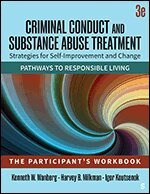
    Criminal Conduct and Substance Abuse Treatment: Strategies For Self-Improvement and Change, Pathways to Responsible Living

    The Participant's Workbook

    AvKenneth W. Wanberg,Harvey B. Milkman

    Häftad, Engelska, 2026

    302 kr

    Beställningsvara. Skickas inom 5-8 vardagar. Fri frakt över 249 kr.

    Beskrivning

    Criminal Conduct and Substance Abuse Treatment: Strategies for Self-Improvement and Change (SSC), The Participant’s Workbook, is a 50-session, comprehensive guide, designed to help individuals overcome substance abuse, criminal behavior, and antisocial tendencies. It is structured into three phases: Challenge to Change, Commitment to Change, and Ownership of Change, each focusing on specific skills and strategies for personal growth and responsible living.

    The Workbook is intended for use by justice involved clients with co-occurring substance use issues and criminal conduct, guided by counselors skilled in Motivational Interviewing and Cognitive-Behavioral treatment techniques. The curriculum is designed to be delivered in structured treatment settings including jails, prisons, parole, outpatient and residential community settings. It can be delivered in group or individual treatment modalities.

    Phase I: Challenge to Change

    This phase introduces participants to the Cognitive-Behavioral (CB) Map, which helps identify how thoughts, attitudes, and beliefs influence emotions and actions. Participants learn to recognize high-risk situations and thinking patterns that lead to substance abuse and criminal conduct. Key skills include mental self-control, relaxation techniques, and managing urges and cravings. Modules focus on understanding personal history, identifying problem areas, and setting relapse and recidivism prevention goals. Participants develop a Master Profile (MP) and Master Assessment Plan (MAP) to guide their journey, using worksheets and exercises to reflect on past behaviors, identify triggers, and set goals for change. 

    Phase II: Commitment to Change

    This phase emphasizes skill development for responsible living, including problem-solving, assertiveness, and managing anger in relationships. Participants learn to give and receive compliments, resolve conflicts, and build healthy intimate relationships. Modules address moral reasoning, empathy, and prosocial behavior, encouraging respect for others and positive community contributions. Cognitive-behavioral strategies, such as the STEP Method (Situation, Thinking Change, Emotions, Positive Action/Outcome), help participants achieve positive outcomes by changing their thoughts and beliefs. Communication skills, such as active sharing and listening, are emphasized to improve relationships and prevent relapse and recidivism. 

    Phase III: Ownership of Change

    The final phase focuses on taking full ownership of the changes made in earlier phases. Participants strengthen relapse and recidivism prevention plans, develop critical reasoning skills, and create a balanced lifestyle. Modules include managing work and time, engaging in healthy leisure activities, relaxation techniques, healthy eating, and physical activity. Participants are encouraged to give back to their community through mentoring and role modeling, reinforcing their commitment to responsible living. The goal is to sustain a drug-free and crime-free life while contributing positively to the community.

    Produktinformation

    • Utgivningsdatum:2026-03-18
    • Mått:215 x 279 x 21 mm
    • Vikt:750 g
    • Format:Häftad
    • Språk:Engelska
    • Antal sidor:320
    • Upplaga:3
    • Förlag:SAGE Publications
    • ISBN:9781412990561

    Utforska kategorier

    • Brottslighet och kriminologi inom Samhälle och politik
    • Sociala och etiska frågor inom Samhälle och politik

    Mer om författaren

    Kenneth W. Wanberg, ThD, PhD, has worked as a clinician and researcher in the field of alcohol and drug abuse for more than four decades, specializing in the intersection of criminal conduct and substance abuse.  Harvey B. Milkman, PhD received his baccalaureate degree from City College of New York and his doctorate from Michigan State University. He is currently professor of psychology at Metropolitan State College of Denver. His doctoral research was conducted with William Frosch, MD, at Bellevue Psychiatric Hospital in New York City, on the User’s Drug of Choice. From 1980–1981, he completed a sabbatical exploration of addictive behavior in Africa, India, and Southeast Asia; in 1985 he was recipient of a Fulbright-Hays Lectureship award at the National University of Malaysia. He has represented the United States Information Agency as a consultant and featured speaker in Australia, Brazil, Iceland, The Netherlands, Peru, Turkey, and Yugoslavia. He is principle author with Stanley Sunderwirth of “The Chemistry of Craving,” and author of “Better than Dope,” featured articles in Psychology Today, October, 1983 and April, 2001 respectively. From September 1992–June 2002, he was author, principal investigator, and director of Project Self-Discovery: Artistic Alternatives for High-Risk Youth, a national demonstration model funded by The Center for Substance Abuse Prevention and the Edward Byrne Foundation.