• Fri frakt över 249 kr
  • •
  • Snabba leveranser
  • •
  • Billiga böcker
Kundservice

Du är på sajten för privatpersoner.

Företag, bibliotek eller offentlig verksamhet?

Du handlar på classic.bokus.com, där alla dina funktioner finns intakta.
Till classic.bokus.com
Bokus logotyp. Gå till startsidan.
  • Erbjudanden
  • Nyheter
  • Student
  • Topplistor
  • Barn & ungdom
  • Bokus Play
  • E-böcker
  • Pocketböcker
  • Spel & pussel

10% rabatt på allt med kod: NYSTART10 →

Sidfot

Mina sidor

    Hjälp

    • Kundservice
    • Vanliga frågor och svar
    • Frakt och leverans
    • Retur vid ångerrätt
    • Reklamera vara
    • Betalning
    • Köpvillkor
    • Allmänna villkor
    • Information om webbplatsens tillgänglighet

    Om Bokus

    • Om oss
    • Pressrum
    • För studenter
    • För företag
    • För bibliotek och offentlig verksamhet
    • För leverantörer
    • Hållbarhet

    Populärt

    • Aktuella erbjudanden
    • Presentkort
    • Studentlitteratur
    • Nya böcker
    • Topplistor
    • Signerade böcker
    • Engelska böcker

    Inspiration

    • Boktips
    • BookTok
    • Populära bokserier
    • Barnbokskaraktärer
    • Populära författare
    Logotyp för Bokus
    Följ oss på Facebook (extern länk)Följ oss på Instagram (extern länk)Följ oss på YouTube (extern länk)Följ oss på TikTok (extern länk)
    bokus @ CookiesAnpassa cookiesIntegritetspolicyKöpvillkor
    Till Citymail hemsida (extern länk)Till Budbee hemsida (extern länk)Till Postnord hemsida (extern länk)Till Schenker hemsida (extern länk)Till Early Bird hemsida (extern länk)Till Walleys hemsida (extern länk)
    1. Skönlitteratur
    2. Litteraturvetenskap
    3. Litteraturvetenskap

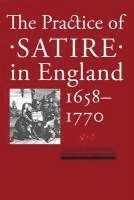
    Practice of Satire in England, 1658–1770

    AvAshley Marshall

    Inbunden, Engelska, 2013

    833 kr

    Beställningsvara. Skickas inom 5-8 vardagar. Fri frakt över 249 kr.

    Fler format och utgåvor

    Häftad

    616 kr

    Beskrivning

    Outstanding Academic Title, Choice In The Practice of Satire in England, 1658-1770, Ashley Marshall explores how satire was conceived and understood by writers and readers of the period. Her account is based on a reading of some 3,000 works, ranging from one-page squibs to novels. The objective is not to recuperate particular minor works but to recover the satiric milieu-to resituate the masterpieces amid the hundreds of other works alongside which they were originally written and read. The long eighteenth century is generally hailed as the great age of satire, and as such, it has received much critical attention. However, scholars have focused almost exclusively on a small number of canonical works, such as Gulliver's Travels and The Dunciad, and have not looked for continuity over time. Marshall revises the standard account of eighteenth-century satire, revealing it to be messy, confused, and discontinuous, exhibiting radical and rapid changes over time. The true history of satire in its great age is not a history at all. Rather, it is a collection of episodic little histories.

    Produktinformation

    • Utgivningsdatum:2013-08-23
    • Mått:156 x 235 x 36 mm
    • Vikt:794 g
    • Format:Inbunden
    • Språk:Engelska
    • Antal sidor:456
    • Förlag:Johns Hopkins University Press
    • ISBN:9781421408163

    Utforska kategorier

    • Litteraturvetenskap inom Skönlitteratur
    • Litteraturteori inom Skönlitteratur

    Mer om författaren

    Ashley Marshall is an associate professor of English at the University of Nevada, Reno. She is the author of Swift and History: Politics and the English Past

    Recensioner i media

    Impressively comprehensive and provocative... This strong and wide-ranging book... earns its authority from the wealth of information it provides... Its determination to expand the range of satirical writing, somewhat in the spirit of Eliot's admonition, is a long-needed redefinition of the scope of the subject... It also offers a considerable enlargement of our knowledge and understanding of a lively and turbulent terrain, whose boundaries are wider and more untidy than we have imagined. Times Literary Supplement Marshall... revolutionizes the study of 18th-century satire. She not only significantly revises accepted definitions of satire but also analyzes and describes vastly greater numbers of satiric works than have previous studies... This original, detailed account of satire during the period will challenge and shape the literary history of satire for decades to come. Essential. Choice So much material is included in The Practice of Satire in England, and its historiographic claims are so striking, that scholars will be discussing this book for some time. Perhaps most admirably, Marshall has put satire, recently a rather neglected genre, firmly back at the center of scholarly attention and debate. -- Nicholas Hudson Philological Quarterly The Practice of Satire in England, 1658-1770 is a tremendously ambitious book... at once, monumental and humble-conscious of its own audacity, unfailingly respectful of the scholars whose work is being called into question, yet also confident of its contribution to the advancement of humanistic learning. -- Matthew J. Kinservik Modern Philology Broadening the notion of satire to include more works, more kinds of works, and a wider range of satirical motives and effects, [Marshall] offers an account of eighteenth-century literature more amenable to contemporary sensibilities than those of previous proponents and detractors of satire. Eighteenth-Century Life

    Innehållsförteckning

    • PrefaceAcknowledgmentsA Note on Texts, Dates, and MoneyPart 1. Canonical and Noncanonical Satire, 1658–1770I. The "Definition" Quagmire and the Problem of Descriptive TerminologyII. Genre versus ModeIII. The Modern Critical Canon and Its ImplicationsIV. The Total Satire Canon and Its Economic ContextThe Production of Satire in England, 1658–1770Price, Format, Dissemination, and Implied AudiencesV. Some Issues of Coverage and OrganizationVI. The Uses of a Taxonomic MethodologyThe Varieties of SatireForecasting Some ConclusionsThe Nature of the EnterprisePart 2. Contemporary Views on Satire, 1658–1770I. Concepts of Satire"Satire"Definition by ContrastII. The Business of SatireThe Opposition to SatireThe Case for SatireIII. The Practice and Province of SatireAcceptable and Problematical Satiric MethodsAppropriate and Inappropriate Satiric TargetsIV. Characterizing the SatiristV. Perceptions of Eighteenth-Century Satire Then and NowPart 3. Satire in the Carolean PeriodI. Some Preliminary ConsiderationsII. Dryden, Rochester, BuckinghamCarolean DrydenRochesterBuckingham's Purposive SatireIII. Marvell, Ayloffe, OldhamMarvell as Polemical SatiristAyloffe's Antimonarchical DiatribesOldham's Juvenalian PerformancesIV. Hudibras and Other Camouflage SatiresV. Personal and Social Satire: From Lampoons to Otway and LeeVI. Chronological Change, 1658–1685VII. IssuesIntensityTonePresentation of PositivesThe Problem of ApplicationVIII. The Discontinuous World of Carolean SatirePart 4. Beyond CaroleanI. Altered CircumstancesII. Dryden as Satirist, 1685–1700III. Poetic SatireTutchin, Defoe, and Political SatireGould and Defamatory SatireGarth and BlackmoreBrown, Ward, and Commercial SatireIV. Dramatic SatireShadwell and Exemplary ComedyMitigated SatireHarsh Social SatireV. The State of Satire ca. 1700Part 5. Defoe, Swift, and New Varieties of Satire, 1700–1725I. Defoe as SatiristAttack and DefenseInstruction and Direct Warning (Aimed at the Audience)Indirect Exposure and DiscomfitureII. Religious and Political SatireTopical ControversyMonitory Satire in the Manner of DefoeIdeological Argumentation: Dunton, Defoe, and OthersIII. Social and Moral SatireGeneralized SatireDidactic Satire in the Manner of SteeleParticularized and Topical SatireArgument and InquiryIV. The Alleged "Scriblerians"V. Swift before GulliverJokiness and PlayDestruction and NegativityPurposive Defamation and DefenseIndirection and Difficult SatireVI. Characterizing the Early Eighteenth CenturyPart 6. Harsh and Sympathetic Satire, 1726–1745I. Pope and Swift among Their ContemporariesPolitical Commentary and CombatThe Culture WarsSocial SatireII. Pope, Swift, GayPopeSwiftGayIII. The Problem of Meaning in Gulliver's TravelsIV . Fielding and the Move toward Sympathetic SatirePlayful Satire and EntertainmentProvocation and PreachmentDistributive JusticeFielding's Concept of SatireSympathetic SatireV. Alive and WellPart 7. Churchill, Foote, Macklin, Garrick, Smollett, Sterne, and Others, 1745–1770I. The Rise of "Poetic" SatireFrivolity and EntertainmentMoral PreachmentParticularized AttackPoeticized SatireChurchill's Nonpolitical SatireII. Wilkes, Churchill, and Political Controversy in the 1760sThe North BritonChurchill's Political SatireVisual SatireWilkes's Essay on WomanIII. Satire in the Commercial TheaterSocial ComedyLightweight Afterpiece EntertainmentSamuel FooteCharles MacklinDavid GarrickIV. Satire in the Mid-Eighteenth-Century NovelSmollett's Dark SatireThe Late Career of FieldingTristram Shandy and the Singularity of SterneCharlotte Lennox, Oliver Goldsmith, Sarah FieldingV. Satire for a Stable EraEpilogueI. Motives and ModesII. Remapping English Satire, 1658–1770AppendixNotesBibliographyIndex