• Fri frakt över 249 kr
  • •
  • Snabba leveranser
  • •
  • Billiga böcker
Kundservice

Du är på sajten för privatpersoner.

Företag, bibliotek eller offentlig verksamhet?

Du handlar på classic.bokus.com, där alla dina funktioner finns intakta.
Till classic.bokus.com
Bokus logotyp. Gå till startsidan.
  • Erbjudanden
  • Nyheter
  • Student
  • Topplistor
  • Barn & ungdom
  • Bokus Play
  • E-böcker
  • Pocketböcker
  • Spel & pussel

10% rabatt på allt med kod: NYSTART10 →

Sidfot

Mina sidor

    Hjälp

    • Kundservice
    • Vanliga frågor och svar
    • Frakt och leverans
    • Retur vid ångerrätt
    • Reklamera vara
    • Betalning
    • Köpvillkor
    • Allmänna villkor
    • Information om webbplatsens tillgänglighet

    Om Bokus

    • Om oss
    • Pressrum
    • För studenter
    • För företag
    • För bibliotek och offentlig verksamhet
    • För leverantörer
    • Hållbarhet

    Populärt

    • Aktuella erbjudanden
    • Presentkort
    • Studentlitteratur
    • Nya böcker
    • Topplistor
    • Signerade böcker
    • Engelska böcker

    Inspiration

    • Boktips
    • BookTok
    • Populära bokserier
    • Barnbokskaraktärer
    • Populära författare
    Logotyp för Bokus
    Följ oss på Facebook (extern länk)Följ oss på Instagram (extern länk)Följ oss på YouTube (extern länk)Följ oss på TikTok (extern länk)
    bokus @ CookiesAnpassa cookiesIntegritetspolicyKöpvillkor
    Till Citymail hemsida (extern länk)Till Budbee hemsida (extern länk)Till Postnord hemsida (extern länk)Till Schenker hemsida (extern länk)Till Early Bird hemsida (extern länk)Till Walleys hemsida (extern länk)
    1. Medicin
    2. Andra medicinska specialiteter
    3. Klinisk psykologi

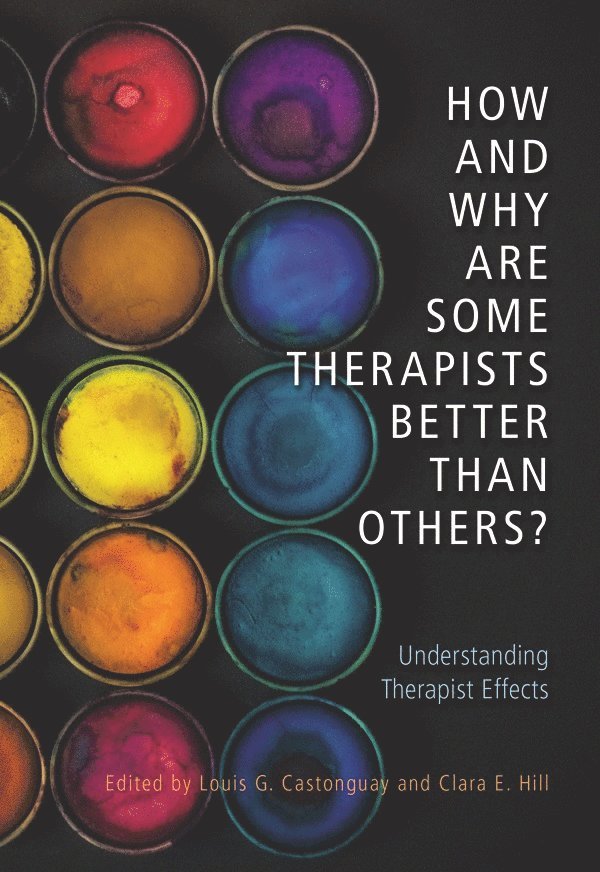
    How and Why Are Some Therapists Better Than Others?

    Understanding Therapist Effects

    AvLouis G. Castonguay,Clara E. Hill

    Inbunden, Engelska, 2017

    1 036 kr

    Beställningsvara. Skickas inom 5-8 vardagar. Fri frakt över 249 kr.

    Beskrivning

    Some therapists are more effective than others, that much is clear why they are more effective is less clear. This book identifies which characteristics make therapists more or less effective in their work and proposes guidelines to improve their effectiveness.Editors Louis Castonguay and Clara Hill have gathered a panel of expert researchers and practitioners from diverse theoretical backgrounds to answer this complicated question. Synthesizing the rich literature on therapist effects in this comprehensive volume, they explore how various effects can help or hinder clients in therapy. They then propose practical strategies that mental health practitioners can use to improve their own effectiveness.  Castonguay, Hill, and their contributors first lay the empirical foundations for understanding therapist effects and why they are important. They also acknowledge the massive variability that exists among therapists and the complexities of studying therapist effects. Drawing from this fundamental knowledge, they then carefully examine specific therapist characteristics, attitudes, and skills that are relevant in any therapeutic setting. Topics include therapists amp rsquo responsiveness, presence, attachment, and technical interventions cultural factors negative emotions humor and creativity. Exciting new studies about therapist effects in the treatment of specific disorders, including depression and generalized anxiety, are also presented. The closing chapters translate the book amp rsquo s general themes and takeaways into broader applications for research, intervention, training, and policy, including the role of routine outcome monitoring.

    Produktinformation

    • Utgivningsdatum:2017-05-15
    • Mått:183 x 262 x 23 mm
    • Vikt:817 g
    • Format:Inbunden
    • Språk:Engelska
    • Antal sidor:356
    • Förlag:American Psychological Association
    • ISBN:9781433827716

    Utforska kategorier

    • Klinisk psykologi inom Medicin
    • Psykologi inom Psykologi och pedagogik
    • Psykoterapi som behandlingsmetod inom Medicin

    Mer om författaren

    Louis G. Castonguay, PhD, completed his doctorate in Clinical Psychology at S.U.N.Y. Stony Brook, a clinical internship at U.C. Berkeley, and a Post-doctorate at Stanford University. He is currently a Professor at the Department of Psychology at Penn State University. With more than 8 publications (including eight co-edited books), his scholarly work and research focus on different aspects of the process of change and training, especially within the context of psychotherapy integration of psychotherapy. He is also involved in the investigation of the efficacy of new integrative treatments for generalized anxiety disorder and depression, and the development of Practice Research Networks aimed at facilitating the collaboration between clinicians and researchers. He has received several awards, including the Early Career Contribution Award from the Society of Psychotherapy Research, and the David Shakow Award from the Division of Clinical Psychology of the American Psychological Association (APA). He has also received four recognitions from the APA Division of Psychotherapy: the Jack D. Krasner Memorial Award, the Distinguished Contributions to Teaching and Mentoring, the Distinguished Research Publications Award, and the Distinguished Psychologist Award for his life time contributions to the field of psychotherapy. He also served as President of the North American Society for Psychotherapy Research, as well as the International Society for Psychotherapy Research.Clara E. Hill, PhD, completed her doctorate in Counseling Psychology at Southern Illinois University and a clinical internship at University of Florida. She is currently a Professor in the Department of Psychology at the University of Maryland. With 2 books, 74 book chapters, and 2 5 journal articles, her scholarly work and research focus on psychotherapy process, therapist interventions, therapist training, dream work, meaning in life, and qualitative research methods. She has received several awards, including the Leona Tyler Award from Division 7 of the American Psychological Association, the Distinguished Psychologist Award from Division 29 of the American Psychological Association, the Outstanding Lifetime Achievement Award from the Section of Counseling and Psychotherapy Process and Outcome Research of the Society for Counseling Psychology, and the Distinguished Research Career Award, Society for Psychotherapy Research. She served as the Editor of the Journal of Counseling Psychology and Psychotherapy Research, and also served as the President of the North American Society for Psychotherapy Research, as well as the International Society for Psychotherapy Research.

    Recensioner i media

    amp ldquo This book does a good job of exploring what factors impact therapist effects. amp rdquo -Doody amp rsquo s Review Serviceamp ldquo Ambitious in its scope, this book brings an innovative perspective to the improvement of psychotherapy practice. Chapter references and an index help to make the volume an invaluable resource for program directors, policy makers, and researchers, as well as practitioners themselves. amp rdquo -Choices Ambitious in its scope, this book brings an innovative perspective to the improvement of psychotherapy practice. Chapter references and an index help to make the volume an invaluable resource for program directors, policy makers, and researchers, as well as practitioners themselves.(Choice) Provides current researchers excellent reviews and critiques of existing research on various aspects of therapist effects.(PsycCRITIQUES) This book does a good job of exploring what factors impact therapist effects.(Doody's Review Service) Mix a bunch of expert research practitioners together to discuss what makes a therapist effective and you get this wonderful book filled with wisdom and research on what characteristics make some therapists better than others. Many of these characteristics can be acquired, and this is unquestionably the best current training guide for therapists.- Leslie S. Greenberg, PhD, Distinguished Research Professor Emeritus, Department of Psychology, York University, Toronto, Ontario, Canada Paraphrasing Lake Wobegon's Garrison Keillor, we would like to think that all therapists are way above average. But in fact, some therapists are better than others, and that has implications for how we practice, how we train and supervise, and how we shape health care policy. Refreshingly, this book focuses on therapists rather than treatments. It is a must-read for all of us wanting to do the best by our clients.- Hanna Levenson, PhD, Wright Institute, Berkeley, CA Program directors, policymakers, psychotherapists, and psychotherapy researchers will all find this book useful. The authors review important findings on therapist effectiveness and the factors involved in differences. One chapter considers the policy implications of the troubling finding that there is a group of 5% to 2 % of therapists who are consistently at the bottom of the heap in effectiveness.- Dianne L. Chambless, PhD, Professor of Psychology and Director of Clinical Training, University of Pennsylvania, Philadelphia

    Innehållsförteckning

    • ContributorsPrefaceIntroductionLouis G. Castonguay and Clara E. HillPart I: Empirical FoundationsChapter : Therapist Effects, Effective Therapists, and the Law of VariabilityMichael Barkham, Wolfgang Lutz, Michael J. Lambert, and David SaxonChapter 2: What Characterizes Effective Therapists?Bruce E. Wampold, Scott A. Baldwin, Martin grosse Holtforth, and Zac E. ImelChapter 3: Who Works for Whom and Why? Integrating Therapist Effects Analysis Into Psychotherapy Outcome and Process ResearchMichael J. Constantino, James F. Boswell, Alice E. Coyne, David R. Kraus, and Louis G. CastonguayPart II: Conceptual ContributionsChapter 4: Appropriate Responsiveness as a Contribution to Therapist EffectsWilliam B. Stiles and Adam O. HorvathChapter 5: Therapist Presence, Absence, and Extraordinary PresenceJeffrey A. Hayes and Maria VincaChapter : Inner Experience and the Good TherapistCharles J. Gelso and Andres E. Perez-RojasChapter 7: The Role of the Therapist's Attachment in the Process and Outcome of PsychotherapyBernhard M. Strauss and Katja PetrowskiChapter 8: The Role of Therapist Skills in Therapist EffectivenessTimothy Anderson and Clara E. HillChapter 9: The Contributions of Client Culture to Differential Therapist EffectivenessJeffrey A. Hayes, Jesse Owen, and Helene A. Nissen-LieChapter : Therapist Negative Reactions: How to Transform Toxic ExperiencesAbraham W. Wolf, Marvin R. Goldfried, and J. Christopher MuranChapter : Professional Expertise in PsychotherapyFranz CasparChapter 2: Gaining Therapeutic Wisdom and Skills From Creative Others (Writers, Actors, Musicians, and Dancers)Barry A. FarberPart III:  Empirical ContributionsChapter 3: Effective Therapists in Psychodynamic Therapy for Depression: What Interventions Are Used and How?Nadia Kuprian, Harold Chui, and Jacques P. BarberChapter 4: Effective and Less Effective Therapists for Generalized Anxiety Disorder: Are They Conducting Therapy the Same Way?Soo Jeong Youn, Henry Xiao, Hanjoo Kim, Louis G. Castonguay, Andrew A. McAleavey, Michelle G. Newman, and Jeremy D. SafranChapter 5: Something to Laugh About: Humor as a Characteristic of Effective TherapistsSarah Knox, Meghan C. Butler, Dakota J. Kaiser, Graham Knowlton, and Clara E. HillPart IV: Implications and ConclusionsChapter : The Implications of Therapist Effects for Routine Practice, Policy, and TrainingJames F. Boswell, David R. Kraus, Michael J. Constantino, Matteo Bugatti, and Louis G. CastonguayChapter 7: Therapist Effects: Integration and ConclusionsClara E. Hill and Louis G. CastonguayIndexAbout the Editors