• Fri frakt över 249 kr
  • •
  • Snabba leveranser
  • •
  • Billiga böcker
Kundservice

Du är på sajten för privatpersoner.

Företag, bibliotek eller offentlig verksamhet?

Du handlar på classic.bokus.com, där alla dina funktioner finns intakta.
Till classic.bokus.com
Bokus logotyp. Gå till startsidan.
  • Erbjudanden
  • Nyheter
  • Student
  • Topplistor
  • Barn & ungdom
  • Bokus Play
  • E-böcker
  • Pocketböcker
  • Spel & pussel

10% rabatt på allt med kod: NYSTART10 →

Sidfot

Mina sidor

    Hjälp

    • Kundservice
    • Vanliga frågor och svar
    • Frakt och leverans
    • Retur vid ångerrätt
    • Reklamera vara
    • Betalning
    • Köpvillkor
    • Allmänna villkor
    • Information om webbplatsens tillgänglighet

    Om Bokus

    • Om oss
    • Pressrum
    • För studenter
    • För företag
    • För bibliotek och offentlig verksamhet
    • För leverantörer
    • Hållbarhet

    Populärt

    • Aktuella erbjudanden
    • Presentkort
    • Studentlitteratur
    • Nya böcker
    • Topplistor
    • Signerade böcker
    • Engelska böcker

    Inspiration

    • Boktips
    • BookTok
    • Populära bokserier
    • Barnbokskaraktärer
    • Populära författare
    Logotyp för Bokus
    Följ oss på Facebook (extern länk)Följ oss på Instagram (extern länk)Följ oss på YouTube (extern länk)Följ oss på TikTok (extern länk)
    bokus @ CookiesAnpassa cookiesIntegritetspolicyKöpvillkor
    Till Citymail hemsida (extern länk)Till Budbee hemsida (extern länk)Till Postnord hemsida (extern länk)Till Schenker hemsida (extern länk)Till Early Bird hemsida (extern länk)Till Walleys hemsida (extern länk)
    1. Filosofi och religion
    2. Filosofi

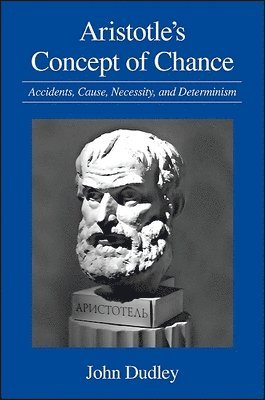
    Aristotle's Concept of Chance

    Accidents, Cause, Necessity, and Determinism

    AvJohn Dudley

    Inbunden, Engelska, 2012

    Del i serien SUNY series in Ancient Greek Philosophy

    953 kr

    Tillfälligt slut

    Fler format och utgåvor

    Häftad

    488 kr

    Beskrivning

    The first exhaustive study of Aristotle's concept of chance.This landmark book is the first to provide a comprehensive account of Aristotle's concept of chance. Chance is invoked by many to explain order in the universe, the origins of life, even human freedom and happiness. An understanding of Aristotle's concept of chance is indispensable for an appreciation of his views on nature and ethics, views which have had a tremendous influence on the development of Western philosophy. Author John Dudley analyzes Aristotle's account of chance in the Physics, the Metaphysics, in his biological and ethical treatises, and in a number of his other works as well. Important complementary considerations such as Aristotle's criticism of Presocratic philosophers, particularly Empedocles and Democritus, Plato's concept of chance, the chronology of Aristotle's works, and the relevance of Aristotle's work to evolution and quantum theory are also covered in depth. This is an essential book for scholars and students of Western philosophy.

    Produktinformation

    • Utgivningsdatum:2012-03-01
    • Mått:152 x 229 x 36 mm
    • Vikt:789 g
    • Format:Inbunden
    • Språk:Engelska
    • Serie:SUNY series in Ancient Greek Philosophy
    • Antal sidor:484
    • Förlag:State University of New York Press
    • ISBN:9781438432274

    Utforska kategorier

    • Filosofi inom Filosofi och religion
    • Filosofiska discipliner inom Filosofi och religion

    Mer om författaren

    John Dudley is Research Fellow in the De Wulf-Mansion Centre for Ancient, Mediaeval and Renaissance Philosophy at the University of Leuven in Belgium.

    Recensioner i media

    "…an indispensable resource for scholars interested in Aristotle on chance … This lucid, well-constructed, and stimulating book is highly recommended for both specialists and non-specialists with an interest in Aristotle and chance or causality more generally." — The European Legacy

    Innehållsförteckning

    • PrefaceIntroductionPART I: CHANGE IN THE PHYSICS OF ARISTOTLE 1. The doctrine of Phys. II, iv-vi i. Context and methodii. Terminologyiii. Only unusual occurrences come about by chanceiv. Chance refers to eventsv. Some events are meaningful and others are notvi. Chance events are both unusual and meaningfulvii. Chance is a causeviii. Chance is an accidental cause that is meaningfulix. Chance as an accidental cause can pertain to any categoryx. Chance events are inherently unpredictablexi. The relationship of τύχη to τέχνη; their outcomes are contingentxii. Both good luck and bad luck are meaningfulxiii. Good luckxiv. The distinction between τύχη and ταὐτόματονxv. The relationship of ταὐτόματον to μάτηνxvi. Substances generated counter to nature fall under ταὐτόματονxvii. Chance, νοῦς and φύσις 2. The structure of Phys. II, iv-vi 3. Dating Phys. II, via. Texts in which τύχη covers all of chance b. τύχη in Aristotle’s mature metaphysical writings i. the meaning of ταὐτόματον καί τύχηii. Inconclusive passages in the later metaphysical writingsiii. The sources of generationiv. Note on Met. Kv. Conclusion 4. Necessity and Chance a. Aristotle’s concept of necessity i. Introductionii. Absolute necessityiii. Final causes are not derived by absolute necessityiv. The necessity of the Unmoved Moverv. Hypothetical necessityvi. Degrees of hypothetical necessityvii. Forceviii. Fateix. The correspondence of the four causes to absolute and hypothetical necessityx. The coincidence of hypothetical and absolute necessityxi. The distinction in subject-matter and method between physics and the other two theoretical sciencesxii. Accidents occur by absolute and not by hypothetical necessityxiii. There is no science of the unusual accidentxiv. Necessity in relation to man b. Necessity and chance: Aristotle’s criticism of the Presocratics i. The compatibility of necessity and chance in Greek thoughtii. Necessity and chance in Democritusiii. Conclusion Additional notes to chapter IV a. Phys. VIII, iv b. Plato’s concept of chance c. Empedocles’ zoogony d. Phys. II, iv, 196 a 28-335. The causes of that which occurs by chancea. Chance events b. Monsters c. spontaneous generation i. The vocabulary of spontaneous generationii. The causes of spontaneous generationiii. The evolution of the theory of spontaneousd. The parallel between chance events and chance substances i. The unusualness of monsters and spontaneous generationii. The unusual category and the efficient cause e. Conclusion PART II: CHANCE IN THE ETHICS OF ARISTOTLE 6. Chance as the source of external prosperitya. The necessity of external prosperityb. Good fortune throughout a complete live (βίος τέλειος) is necessary for perfect happiness i. Aristotle recognizes the existence of various degrees of happiness ii. The happiness sought in the ethical works is perfect happinessiii. Perfect happiness must last throughout lifeiv. Perfect happiness requires a "complete life" (βίοςτέλειος)v. Perfect happiness on one day and in a complete lifetimevi. Chance, external prosperity and happiness 7. Chance and Intuition a. The doctrine of τύχη in EE VIII, ii b. The doctrine of good fortune (εὐτυχία) in MM II, viiiAdditional note on the chronology of Aristotle’s ethical works Appendix I. Chance in the lists of the sources of happiness in NE and EEAppendix II. Differences in the role of chance in NE, EE, and MMPART III: IMPLICATIONS OF ARISTOTLE’S CONCEPT OF CHANCE 8. Chance and Aristotle’s rejection of determinisma. Determinism and final causality b. Determinism and efficient causality i. Human free choiceii. Unusual accidents: Met. E(VI), iiiiii. Chance iv. Conclusion Additional note on determinist interpretations of Aristotle’s philosophy of nature 9. Aristotle’s concept of chance and related contemporary questionsa. Chance and the order in the universeb. Chance and the origin of livec. Chance and evolution i. Aristotle’s analogy of substanceii. Teleologyiii. The operation of chance d. Quantum theorye. Conclusion Conclusiona. Textual conclusionsb. Doctrinal conclusionsBibliographyIndex locorumIndex nominumIndex rerum