• Fri frakt över 249 kr
  • •
  • Snabba leveranser
  • •
  • Billiga böcker
Kundservice

Du är på sajten för privatpersoner.

Företag, bibliotek eller offentlig verksamhet?

Du handlar på classic.bokus.com, där alla dina funktioner finns intakta.
Till classic.bokus.com
Bokus logotyp. Gå till startsidan.
  • Erbjudanden
  • Nyheter
  • Student
  • Topplistor
  • Barn & ungdom
  • Bokus Play
  • E-böcker
  • Pocketböcker
  • Spel & pussel

10% rabatt på allt med kod: NYSTART10 →

Sidfot

Mina sidor

    Hjälp

    • Kundservice
    • Vanliga frågor och svar
    • Frakt och leverans
    • Retur vid ångerrätt
    • Reklamera vara
    • Betalning
    • Köpvillkor
    • Allmänna villkor
    • Information om webbplatsens tillgänglighet

    Om Bokus

    • Om oss
    • Pressrum
    • För studenter
    • För företag
    • För bibliotek och offentlig verksamhet
    • För leverantörer
    • Hållbarhet

    Populärt

    • Aktuella erbjudanden
    • Presentkort
    • Studentlitteratur
    • Nya böcker
    • Topplistor
    • Signerade böcker
    • Engelska böcker

    Inspiration

    • Boktips
    • BookTok
    • Populära bokserier
    • Barnbokskaraktärer
    • Populära författare
    Logotyp för Bokus
    Följ oss på Facebook (extern länk)Följ oss på Instagram (extern länk)Följ oss på YouTube (extern länk)Följ oss på TikTok (extern länk)
    bokus @ CookiesAnpassa cookiesIntegritetspolicyKöpvillkor
    Till Citymail hemsida (extern länk)Till Budbee hemsida (extern länk)Till Postnord hemsida (extern länk)Till Schenker hemsida (extern länk)Till Early Bird hemsida (extern länk)Till Walleys hemsida (extern länk)
    1. Naturvetenskap och teknik
    2. Teknik och industri
    3. Miljöteknik

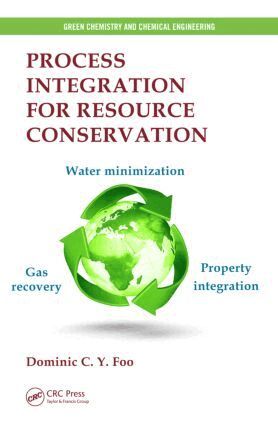
    Process Integration for Resource Conservation

    AvDominic Foo

    Inbunden, Engelska, 2012

    Del i serien Green Chemistry and Chemical Engineering

    1 591 kr

    Tillfälligt slut

    Fler format och utgåvor

    Häftad

    Tillf. slut

    Beskrivning

    To achieve environmental sustainability in industrial plants, resource conservation activities such as material recovery have begun incorporating process integration techniques for reusing and recycling water, utility gases, solvents, and solid waste. Process Integration for Resource Conservation presents state-of-the-art, cost-effective techniques, including pinch analysis and mathematical optimization, for numerous conservation problems.Following the holistic philosophy of process integration, the author emphasizes the goal of setting performance targets ahead of detailed design. He explains various industrial examples step by step and offers demo software and other materials online. Ideal for students preparing for real-world work as well as industrial practitioners, the text provides a systematic guide to the latest process integration techniques for performing material recovery in process plants.

    Produktinformation

    • Utgivningsdatum:2012-07-17
    • Mått:156 x 234 x 37 mm
    • Vikt:952 g
    • Format:Inbunden
    • Språk:Engelska
    • Serie:Green Chemistry and Chemical Engineering
    • Antal sidor:606
    • Förlag:Taylor & Francis Inc
    • ISBN:9781439860489

    Utforska kategorier

    • Miljöteknik inom Naturvetenskap och teknik

    Mer om författaren

    Dominic C.Y. Foo, Ph.D., P.E., is a Professor of Process Design and Integration and the founding director of the Centre of Excellence for Green Technologies at the University of Nottingham Malaysia Campus. Professor Foo has authored more than 70 journal papers and made more than 120 conference presentations. He has been a recipient of the Innovator of the Year Award from the Institution of Chemical Engineers UK (IChemE) and the Young Engineer Award from the Institution of Engineers Malaysia (IEM).

    Recensioner i media

    In this book, Dr. Foo manages to elegantly transform the theories and concepts into effective educational tools, exciting reading materials, and very useful applications. … Overall, this is an excellent contribution that will benefit numerous researchers, students, and process engineers and will serve the cause of sustainability worldwide.—From the Foreword, Mahmoud El-Halwagi, Texas A&M UniversityThe main contribution of this textbook is that it brings together a family of systematic design tools that can be used to determine the most cost-effective measures to implement recycle and reuse of process streams in industrial plants. … suitable for a wide range of audiences, from advanced undergraduate students to practicing engineers from the process industries. … this excellent book comes at just the right time to teach the next generation of process designers how to ‘save the planet’ more systematically and intelligently.—From the Foreword, Raymond R. Tan, De La Salle University-ManilaThis book collects all fundamentals aspects of process integration to enable readers to address issues related to resource management. I strongly recommend this book to everyone interested in the field of process integration."—Santanu Bandyopadhyay, IIT BombayThis book serves as good material for process integration … it [also] offers good knowledge of material recovery that helps people [acquire the] basics for doing further research or practical application.—Cheng-Liang Chen, National Taiwan UniversityThe chapters are written very well and cover all the topics in sufficient detail and clarity. … a wonderful and relevant contribution to the field of process integration.—T. Majozi, University of Pretoria

    Innehållsförteckning

    • Introduction. Data Extraction for Resource Conservation. INSIGHT-BASED PINCH ANALYSIS TECHNIQUES: Graphical Targeting Techniques for Direct Reuse/Recycle. Algebraic Targeting Techniques for Direct Reuse/Recycle. Process Changes for Resource Conservation Networks. Algebraic Targeting Approach for Material Regeneration Networks. Network Design and Evolution Techniques. Targeting for Waste Treatment and Total Material Networks. Synthesis of Pretreatment Network. Synthesis of Inter-Plant Resource Conservation Networks. Synthesis of Batch Material Networks. MATHEMATICAL OPTIMIZATION TECHNIQUES: Synthesis of Resource Conservation Networks: A Superstructural Approach. Automated Targeting Model for Direct Reuse/Recycle Networks. Automated Targeting Model for Material Regeneration and Pretreatment Networks. Automated Targeting Model for Waste Treatment and Total Material Networks. Automated Targeting Model for Inter-Plant Resource Conservation Networks. Automated Targeting Model for Batch Material Networks. Appendix. Index.