• Fri frakt över 249 kr
  • •
  • Snabba leveranser
  • •
  • Billiga böcker
Kundservice

Du är på sajten för privatpersoner.

Företag, bibliotek eller offentlig verksamhet?

Du handlar på classic.bokus.com, där alla dina funktioner finns intakta.
Till classic.bokus.com
Bokus logotyp. Gå till startsidan.
  • Erbjudanden
  • Nyheter
  • Student
  • Topplistor
  • Barn & ungdom
  • Bokus Play
  • E-böcker
  • Pocketböcker
  • Spel & pussel

10% rabatt på allt med kod NYSTART10 →

Sidfot

Mina sidor

    Hjälp

    • Kundservice
    • Vanliga frågor och svar
    • Frakt och leverans
    • Retur vid ångerrätt
    • Reklamera vara
    • Betalning
    • Köpvillkor
    • Allmänna villkor
    • Information om webbplatsens tillgänglighet

    Om Bokus

    • Om oss
    • Pressrum
    • För studenter
    • För företag
    • För bibliotek och offentlig verksamhet
    • För leverantörer
    • Hållbarhet

    Populärt

    • Aktuella erbjudanden
    • Presentkort
    • Studentlitteratur
    • Nya böcker
    • Topplistor
    • Signerade böcker
    • Engelska böcker

    Inspiration

    • Boktips
    • BookTok
    • Populära bokserier
    • Barnbokskaraktärer
    • Populära författare
    Logotyp för Bokus
    Följ oss på Facebook (extern länk)Följ oss på Instagram (extern länk)Följ oss på YouTube (extern länk)Följ oss på TikTok (extern länk)
    bokus @ CookiesAnpassa cookiesIntegritetspolicyKöpvillkor
    Till Citymail hemsida (extern länk)Till Budbee hemsida (extern länk)Till Postnord hemsida (extern länk)Till Schenker hemsida (extern länk)Till Early Bird hemsida (extern länk)Till Walleys hemsida (extern länk)
    1. Samhälle och politik
    2. Samhälle och kultur
    3. Kultur och medier
    4. Referensverk och tvärvetenskap

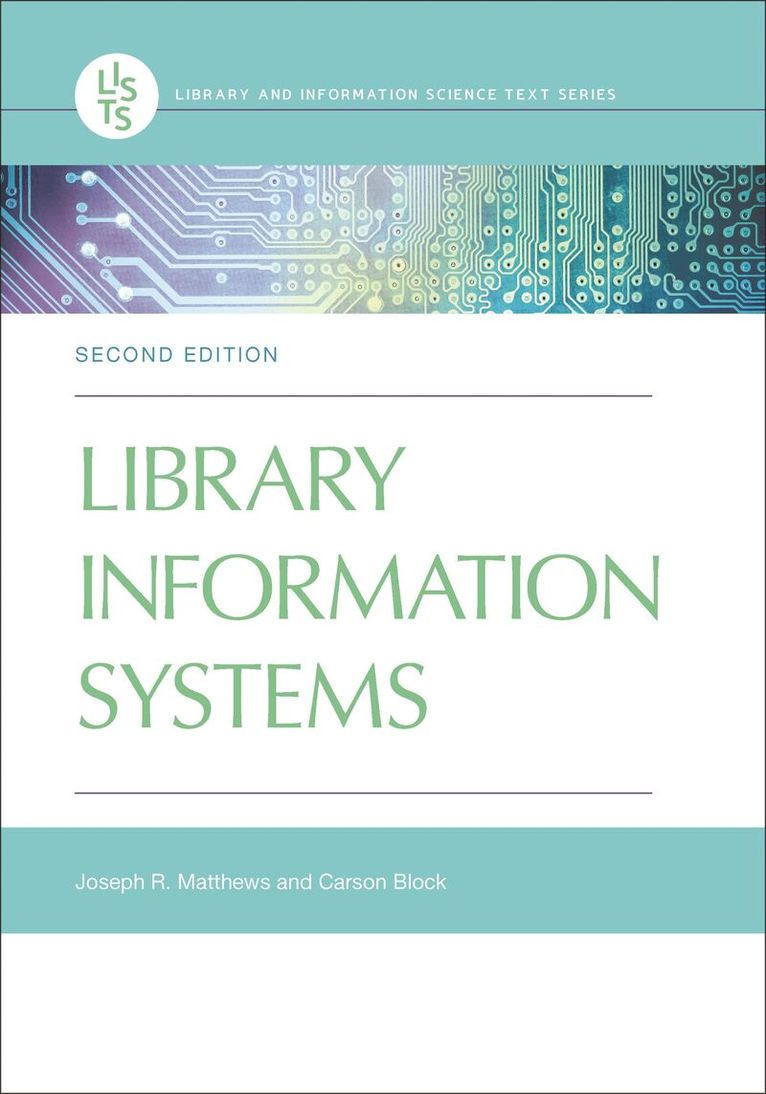
    Library Information Systems

    AvJoseph R. Matthews,Carson Block

    Häftad, Engelska, 2019

    Del i serien Library and Information Science Text Series

    896 kr

    Beställningsvara. Skickas inom 10-15 vardagar. Fri frakt över 249 kr.

    Fler format och utgåvor

    E-bok

    967 kr

    E-bok

    967 kr

    Beskrivning

    Information systems are central to libraries, and managing information systems is critical to serving library communities. Both a textbook for LIS courses and a handbook for practitioners, this volume thoroughly addresses modern libraries' challenges of integrating information technology.Written by Joseph R. Matthews and Carson Block, both experts on library information systems, this book describes the evolution of library information systems, their enabling technologies, and today's dynamic IT marketplace. It explains specific technologies and related topics, including standards and standards organizations, telecommunications and networks, integrated library systems, electronic resource management systems, repositories, authentication and link verification, electronic resources, and nextgen library systems.Readers will also learn the latest about information systems management, covering technology planning, basic technology axioms, the impact of technology on library services, system selection and implementation, system usability, and general technology management. The final section considers current trends and future developments in LIS, including those related to mobile devices and apps as well as the growth of digital libraries.

    Produktinformation

    • Utgivningsdatum:2019-11-11
    • Mått:172 x 252 x 20 mm
    • Vikt:640 g
    • Format:Häftad
    • Språk:Engelska
    • Serie:Library and Information Science Text Series
    • Antal sidor:348
    • Upplaga:2
    • Förlag:Bloomsbury Publishing Plc
    • ISBN:9781440851940

    Utforska kategorier

    • Referensverk och tvärvetenskap inom Samhälle och politik

    Mer om författaren

    Joseph R. Matthews has provided consulting assistance to numerous academic, public, and special libraries and local governments. He was previously an instructor at the School of Library Information Science (SLIS) at San Jose State University.Carson Block has been a library technologist for more than 25 years–as a library worker, IT director, and now a library technology consultant.

    Recensioner i media

    Library Information Systems is a quality text written by recognized experts in their field. The foundational understanding that it imparts is an excellent starting point for understanding the breadth and depth of the technologies that undergird the day-to-day library functions. Readers may find this book to be a good companion piece to more technically oriented texts, as it provides helpful context for how individual technological elements interact across workflows and infrastructure. Managerial perspectives and strategic planning discussions set this book apart as a useful addition to any systems librarian's collection, in particular those faced with a looming systems selection and migration project.

    Innehållsförteckning

    • Preface: A Word of CautionAcknowledgmentsIntroduction to the Revised Edition: A Word of HopePart I—The Broader Context1 The Evolution of Information TechnologyOrigins of Library Information SystemsHistorical PerspectivesDevelopments Impacting Library Information SystemsHardware: From Mainframes to Ubiquitous ComputingThe End of Moore's LawSoftware Ranging from Proprietary to Open SystemsTelecommunication DevelopmentsWhat's Old Is New AgainSummaryQuestions to ConsiderNotes2 The Library Information Systems MarketplaceSources of SoftwareComplexity of Commercial SoftwareSize of the Commercial Library Automation MarketplaceThe Integrated Library Systems MarketplaceSystem ArchitecturesMergers and AcquisitionsCurrent System ArchitecturesOperating SystemsDatabase EnvironmentsSummaryQuestions to ConsiderNotesPart II—The Technologies3 Standards and Standards OrganizationsStandardsOfficial Standards OrganizationsStandards Important to LibrariesConceptual ModelContent StandardsControlled VocabulariesFrameworkEncoding StandardsHypertext Markup Language (HTML)Extensible Markup Language (XML)Communication StandardsTechnology StandardsDe Facto StandardsThe Standards RealityRelated OrganizationsSummaryQuestions to ConsiderNotes4 Telecommunications and NetworksTelecommunicationsNetworksLocal Area NetworksLAN TechnologiesTwisted-Pair CableFiber-Optic CableWiFiNetwork DesignWireless LANsLocation-Based ServiceWide Area NetworksOptical Fiber ConnectionsInternet ProtocolInfrastructure ImplicationsSummaryQuestions to ConsiderNotes5 Proprietary Library SystemsIntegrated Library SystemsMarketplace DynamicsLibrary Services PlatformsMaturing LSP MarketplaceLSP ProductsSummaryQuestions to ConsiderNotes6Open Source SystemsOpen Source SoftwareFactors Influencing Open Source SoftwareFor-Profit Firms Support Open Source SoftwareReasons to Open SourceSize of Open Source MarketplaceOpen Source Library SystemsKuali Open Library Environment ProjectThe Future of Libraries Is Open (FOLIO)No Free LunchComparing Proprietary and Open Source ILSOpen Source DevoteesSummaryOpen Source ChallengeQuestions to ConsiderSuggested Web ResourcesNotes7 Other SilosElectronic Resource Management SystemStandards Pertaining to Electronic ResourcesElectronic Resource Management SystemsFunctionalityERMS BenefitsInstitutional RepositoryAuthenticationLink ResolversLink VerificationDiscovery SystemDiscovery System IndexesNon-Library Discovery ServiceDiscovery System ChallengeseBook PlatformLocal eBook PlatformOpen Access eBook PlatformseLending LicensesThe eBook ChallengesSummaryQuestions to ConsiderNotes8 Electronic Resource ManagementEvaluationCollecting DataLicensingUsabilityElectronic Reference MaterialsOther OptionsSummaryQuestions to ConsiderNotesPart III—Management Issues9 Planning for Information TechnologyStrategic PlanningTechnology PlanTechnology InventoryOutline of a Technology PlanDigital Strategic PlanStaying CurrentImpact of IT on StaffLean ThinkingSummaryQuestions to ConsiderSuggested Web ResourcesNotes10 The Impact of Technology on Library ServicesPossible BenefitsImpacts on Library CatalogsOnline Catalog ProblemsDiscovery SystemsDiscovery System ProblemsImpacts on eResourcesImpacts on Document DeliveryImpacts on Interlibrary LoanImpacts on AcquisitionsImpacts on SerialsImpacts on CatalogingImpacts on CirculationSummaryQuestions to ConsiderNotes11 System SelectionProcesses and ServicesTechnical Services FunctionsPublic ServicesAdministrative Planning and Decision-MakingSystem SelectionIdentify a Library's NeedsDocument the Library's NeedsEvaluate AlternativesIn-House SystemShared SystemCloud-Based ServiceEvaluating AlternativesTo RFP or . . .Evaluating ProposalsUsing ConsultantsWritten AgreementsExhibit - Service-Level AgreementSummaryQuestions to ConsiderSuggested ReadingsNotes12 System Migration and ImplementationMigration TeamPremigration DecisionsWhat Data to Migrate?Data CleanupShould Data Be Enhanced?How Much Testing Should Be Done?How to Best Phase in a MigrationImplementationLibrary PoliciesTypes of BarcodesRFIDData MigrationTrainingAdapting Procedures, Forms, and WorkflowTypical Implementation ScheduleSuccessful SystemsCommunication Is VitalSummaryQuestions to ConsiderNotes13 Managing Library Information SystemsSystem Manager CharacteristicsSpecific Job SkillsManaging in the CloudSystems IntegrationTechnology PlanningManagement of InfrastructureUpgradesBackupsThe Rule of Three (or 3-2-1)Managing Applications and LicensesEmergency/Recovery SupportSecurityAssistive TechnologySummaryQuestions to ConsiderSuggested Web ResourcesNotes14 Usability and User ExperienceWebsite DesignBrowser and Device NeutralityNavigationReadableUnderstandableFamiliarSearchableAccessibleUsability GuidelinesUsability TestingContent Management SystemIntranetsGoogle Analytics—A Two-Edged SwordSummaryQuestions to ConsiderSuggested Web ResourcesSuggested ReadingsNotes15 Basic Technology AxiomsAxiom 1: Standards Are Critical; Recommended Practices Are VitalAxiom 2: The Converted Data Are an Important Asset—If You Make Them Work HardAxiom 3: Conversion, Maintenance, and Training Are Always UnderestimatedAxiom 4: Use of Technology Will Grow to Fill the Available CapacityAxiom 5: Information Technology Is the Central Nervous System of StrategyAxiom 6: You Need Sociable Network BandwidthAxiom 7: Support Costs for Technology Sources and Services Are a Significant Part of a Library's Budget, Whether This Is Recognized or NotAxiom 8: APIs Are Playing an Increasingly Important Role as Libraries Move to Embrace Web-Based ServicesAxiom 9: We Live in a Network-Centric WorldAxiom 10: A Library's Information Technology Budget Should Be SizableSummaryQuestions to ConsiderNotesPart IV—Future Considerations16 Evolving Technology TrendsTechnology TrendsIFLA Trend ReportCognifyingFlowingThe Death of Moore's Law?AccessingSharingFilteringRemixingInteractingTrackingEmerging TechnologiesSummaryQuestions to ConsiderSuggested Web ResourcesNotes17 Mobile DevicesResponsive WebsiteAppsThe BasicsPopular AppsKeeping UpDevelopmentImplicationsBeaconsSummaryQuestions to ConsiderNotes18 Digital LibrariesDigital Asset Management SystemDAMS OptionsDigital Asset Management System ChallengesInstitutional RepositoriesDigital Media LabsSocial MediaSummaryQuestions to ConsiderNotesGlossaryIndex