• Fri frakt över 249 kr
  • •
  • Snabba leveranser
  • •
  • Billiga böcker
Kundservice

Du är på sajten för privatpersoner.

Företag, bibliotek eller offentlig verksamhet?

Du handlar på classic.bokus.com, där alla dina funktioner finns intakta.
Till classic.bokus.com
Bokus logotyp. Gå till startsidan.
  • Erbjudanden
  • Nyheter
  • Student
  • Topplistor
  • Barn & ungdom
  • Bokus Play
  • E-böcker
  • Pocketböcker
  • Spel & pussel

10% rabatt på allt med kod NYSTART10 →

Sidfot

Mina sidor

    Hjälp

    • Kundservice
    • Vanliga frågor och svar
    • Frakt och leverans
    • Retur vid ångerrätt
    • Reklamera vara
    • Betalning
    • Köpvillkor
    • Allmänna villkor
    • Information om webbplatsens tillgänglighet

    Om Bokus

    • Om oss
    • Pressrum
    • För studenter
    • För företag
    • För bibliotek och offentlig verksamhet
    • För leverantörer
    • Hållbarhet

    Populärt

    • Aktuella erbjudanden
    • Presentkort
    • Studentlitteratur
    • Nya böcker
    • Topplistor
    • Signerade böcker
    • Engelska böcker

    Inspiration

    • Boktips
    • BookTok
    • Populära bokserier
    • Barnbokskaraktärer
    • Populära författare
    Logotyp för Bokus
    Följ oss på Facebook (extern länk)Följ oss på Instagram (extern länk)Följ oss på YouTube (extern länk)Följ oss på TikTok (extern länk)
    bokus @ CookiesAnpassa cookiesIntegritetspolicyKöpvillkor
    Till Citymail hemsida (extern länk)Till Budbee hemsida (extern länk)Till Postnord hemsida (extern länk)Till Schenker hemsida (extern länk)Till Early Bird hemsida (extern länk)Till Walleys hemsida (extern länk)
    1. Filosofi och religion
    2. Filosofi
    3. Filosofiska discipliner

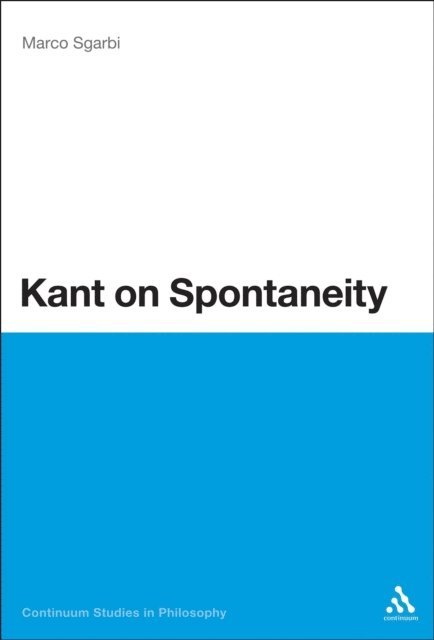
    Kant on Spontaneity

    AvMarco Sgarbi

    E-bok
    Engelska, 2012

    Del i serien Bloomsbury Studies in Philosophy

    543 kr

    Läs direkt i Bokus Reader – eller ladda ned till din enhet

    Fler format och utgåvor

    Inbunden

    2 090 kr

    E-bok

    545 kr

    Häftad

    507 kr

    Beskrivning

    The concept of spontaneity is central to Kant's philosophy, yet Kant himself never dealt with it explicitly. Instead it was presented as an insoluble problem concerning human reason. The ambiguity surrounding his approach to this problem is surprising when one considers that he was a philosopher who based his theoretical programme on the critique of the faculties of knowledge, feeling and desire. However, this ambiguity seems to have avoided up to now any possible critique. This highly original book presents the first full-length study of the problem of spontaneity in Kant. Marco Sgarbi demonstrates that spontaneity is a crucial concept in relation to every aspect of Kant's thought. He begins by reconstructing the history of the concept of spontaneity in the German Enlightenment prior to Kant and goes on to define knowing, thinking, acting and feeling as spontaneous activities of the mind that in turn determine Kant's logic, ethics and aesthetics. Ultimately Sgarbi shows that the notion of spontaneity is key to understanding both Kant's theoretical and practical philosophy.

    Produktinformation

    • Utgivningsdatum:2012-06-14
    • Språk:Engelska
    • Antal sidor:160
    • Filformat:EPUB
    • Kopieringsskydd:LCP
    • ISBN:9781441115287
    • Förlag:Continuum Publishing Corporation
    • Serie:Bloomsbury Studies in Philosophy

    Utforska kategorier

    • Filosofiska discipliner inom Filosofi och religion

    Mer om författaren

    Marco Sgarbi is Adjunct Professor in Philosophy at the University of Verona, Italy.

    Recensioner i media

    'I know of no one writing in English who has this kind of grasp of Kant in the full historical context. The result is an encyclopedic treatment of this central Kantian theme, a theme lying at the heart of the critical philosophy that, despite the massive Kantian literature, has apparently never been discussed in depth in any language. This is an impressive study.'

    Innehållsförteckning

    • Acknowledgments \ Sources and Abbreviations \ 1. Introduction: The Problem of Spontaneity in Kant \ 2. History: Spontaneity from Leibniz to Kant \ 3. Metaphysics: Spontaneity and the Problem of the Unconditioned \ 4. Logic: Spontaneity and the Problem of Knowledge \ 5. Ethics: Spontaneity and the Problem of Acting \ 6. Aesthetics and Biology: Spontaneity and the Problems of Feeling and Life \ 7. Anthropology: Spontaneity and the Problem of Human Nature \ 8. Conclusion \ Notes \ Bibliography \ Index