• Fri frakt över 249 kr
  • •
  • Snabba leveranser
  • •
  • Billiga böcker
Kundservice

Du är på sajten för privatpersoner.

Företag, bibliotek eller offentlig verksamhet?

Du handlar på classic.bokus.com, där alla dina funktioner finns intakta.
Till classic.bokus.com
Bokus logotyp. Gå till startsidan.
  • Erbjudanden
  • Nyheter
  • Student
  • Topplistor
  • Barn & ungdom
  • Bokus Play
  • E-böcker
  • Pocketböcker
  • Spel & pussel

10% rabatt på allt med kod: NYSTART10 →

Sidfot

Mina sidor

    Hjälp

    • Kundservice
    • Vanliga frågor och svar
    • Frakt och leverans
    • Retur vid ångerrätt
    • Reklamera vara
    • Betalning
    • Köpvillkor
    • Allmänna villkor
    • Information om webbplatsens tillgänglighet

    Om Bokus

    • Om oss
    • Pressrum
    • För studenter
    • För företag
    • För bibliotek och offentlig verksamhet
    • För leverantörer
    • Hållbarhet

    Populärt

    • Aktuella erbjudanden
    • Presentkort
    • Studentlitteratur
    • Nya böcker
    • Topplistor
    • Signerade böcker
    • Engelska böcker

    Inspiration

    • Boktips
    • BookTok
    • Populära bokserier
    • Barnbokskaraktärer
    • Populära författare
    Logotyp för Bokus
    Följ oss på Facebook (extern länk)Följ oss på Instagram (extern länk)Följ oss på YouTube (extern länk)Följ oss på TikTok (extern länk)
    bokus @ CookiesAnpassa cookiesIntegritetspolicyKöpvillkor
    Till Citymail hemsida (extern länk)Till Budbee hemsida (extern länk)Till Postnord hemsida (extern länk)Till Schenker hemsida (extern länk)Till Early Bird hemsida (extern länk)Till Walleys hemsida (extern länk)
    1. Filosofi och religion
    2. Filosofi
    3. Filosofiska discipliner

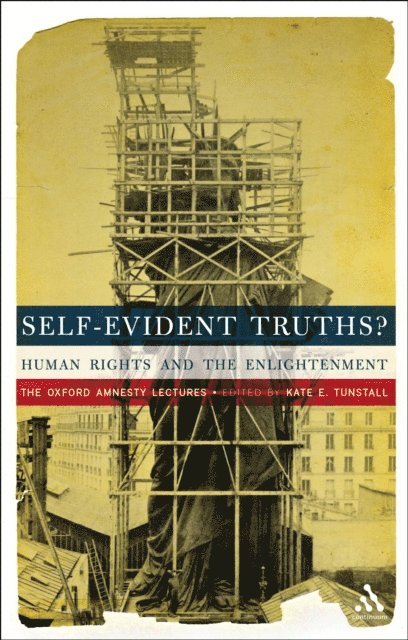
    Self-Evident Truths?

    Human Rights and the Enlightenment (the Oxford Amnesty Lectures)

    AvKate E. Tunstall

    E-bok
    PDF, Engelska, 2012

    545 kr

    Läs direkt i Bokus Reader – eller ladda ned till din enhet (PDF kräver ofta zoom och scroll på små skärmar).

    Beskrivning

    The keywords of the Enlightenment-freedom, tolerance, rights, equality-are today heard everywhere, and they are used to endorse a wide range of positions, some of which are in perfect contradiction. While Orwell's 1984 claims that there is one phrase in the English language that resists translation into Newspeak, namely the opening lines of that key Enlightenment text, the Declaration of Independence: 'We hold these truths to be self-evident, that all men are created equal...', we also find the Wall Street Journal saying of the Iraq War that the US was 'fighting for the very notion of the Enlightenment'. It seems we are no longer sure whether these truths are self-evident nor quite what they might mean today. Based on the critically acclaimed Oxford Amnesty Lectures series, this book brings together a number of major international figures to debate the history of freedom, tolerance, equality, and to explore the complex legacy of the Enlightenment for human rights. The lectures are published here with responses from other leading figures in the field.

    Produktinformation

    • Utgivningsdatum:2012-09-06
    • Språk:Engelska
    • Antal sidor:240
    • Filformat:PDF
    • Kopieringsskydd:LCP
    • ISBN:9781441180711
    • Förlag:Bloomsbury Publishing PLC (Digital)

    Utforska kategorier

    • Filosofiska discipliner inom Filosofi och religion

    Mer om författaren

    Kate E. Tunstall is University Lecturer in French at the University of Oxford and Fellow of Worcester College. She is Programme Director of Oxford's Besterman Centre for the Enlightenment, a Director of the Oxford Amnesty Lectures, and she co-authored and co-presented (with Caroline Warman) a series of BBC radio programmes on Diderot.

    Recensioner i media

    The decision by the editor to pair each contribution with a distinct response works extremely well, as the reader is able to witness a conversation between author and critic that is often very stimulating ... An intellectually stimulating and exciting volume.

    Innehållsförteckning

    • What Are the Oxford Amnesty Lectures?AcknowledgementsPrefaceKate E. Tunstall (University of Oxford)Part I: Human Rights Today: an Enlightenment Legacy?Chapter OneRethinking Human Rights and Enlightenment: A View from the Twenty-First CenturyJames Tully (University of Victoria)A Response to James TullyChristopher Brooke (University of Cambridge)Chapter Two"That the General Will is Indestructible": From a Citizen of Geneva to the Citizens of GazaKarma Nabulsi (University of Oxford)Singular and Exemplary: The Theory and Experience of Citizenship in Rousseau. A Response to Karma NabulsiOurida Mostefai (Boston College)Chapter ThreeCosmopolitanism after Kant: Claiming Rights Across Borders in a New CenturySeyla Benhabib (Princeton University)The Making of Norms versus the Making of a Rights-bearing Subject: A Response to Seyla BenhabibSaskia Sassen (Columbia University and London School of Economics)Part II: Revolutions and DeclarationsChapter FourPhilosophy, Religion, and the Controversy about Basic Human Rights in 1789Jonathan Israel (Institute for Advanced Study, Princeton)A Response to Jonathan IsraelDan Edelstein (Stanford University)Chapter FiveSlavery, Emancipation and Human RightsRobin Blackburn (Essex and the New School) Rights, Resistance and Emancipation: A Response to Robin BlackburnDavid Geggus (University of Florida) Part III: Particular Rights: the Pursuit of Happiness and Freedom of SpeechChapter SixMy Happiness, Right or Wrong?Adam Phillips (Writer and Child psychologist)On Being Happy Not to Pursue Happiness: A Response to Adam PhillipsPatrick Mackie (Writer and Independent scholar)Chapter SevenToleration and CalumnyJeremy Waldron (University of Oxford and New York School of Law)Rights Persuasion: A Response to Jeremy WaldronLiora Lazarus (University of Oxford)Afterword: The Self-Evidence of Human RightsSamuel Moyn (Columbia University)List of ContributorsIndex