Häftad, Engelska, 2009
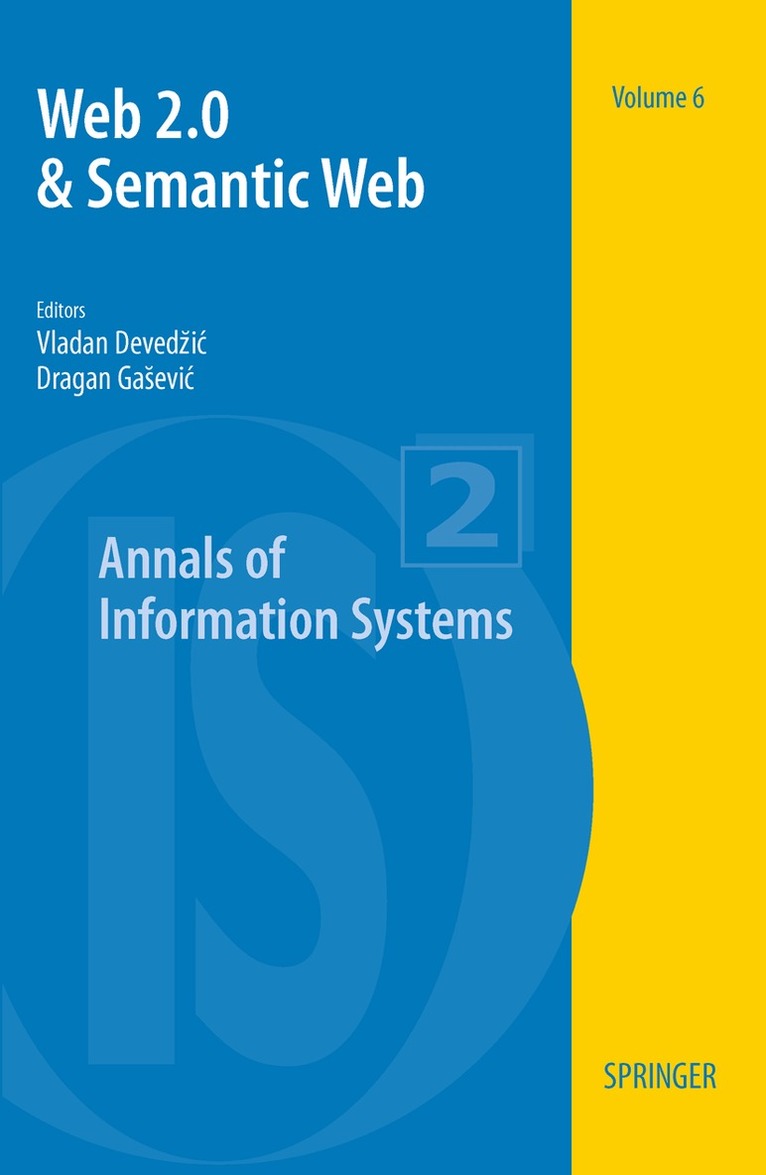
Web 2.0 & Semantic Web
Av Vladan Devedžic, Dragan Gaševic
1128 kr
Beställningsvara. Skickas inom 10-15 vardagar. Fri frakt över 249 kr.
Beskrivning
According to the W3C Semantic Web Activity [1]: The Semantic Web provides a common framework that allows data to be shared and reused across appli- tion, enterprise, and community boundaries. This statement clearly explains that the Semantic Web is about data sharing. Currently, the Web uses hyperlinks to connect Web pages. The Semantic Web goes beyond that and focuses on data and envisions the creation of the web of data. On the Semantic Web, anyone can say anything about any resource on the Web. This is fully based on the concept of semantic - notations, where each resource on the Web can have an assigned meaning. This is done through the use of ontologies as a formal and explicit representation of domain concepts and their relationships [2]. Ontologies are formally based on description logics. This enables agents and applications to reason over the data when searching the Web, which has not previously been possible. Web 2. 0 has gradually evolved from letting the Web users play a more active role. Unlike the initial version of the Web, where the users mainly “consumed” content, users are now offered easy-to-use services for content production and publication. Mashups, blogs, wikis, feeds, interface remixes, and social networking/tagging s- tems are examples of these well-known services. The success and wide adoption of Web 2. 0 was in its reliance on social interactions as an inevitable characteristic of the use and life of the Web. In particular, Web 2.
Produktinformation
- Utgivningsdatum: 2009-11-23
- Mått: 155 x 235 x 18 mm
- Vikt: 338 g
- Format: Häftad
- Språk: Engelska
- Serie: Annals of Information Systems
- Antal sidor: 206
- Upplaga: 2009
- Förlag: Springer-Verlag New York Inc.
- ISBN: 9781441912183
Betyg & recensioner
0 recensioner
Inga recensioner tillgängliga.