• Fri frakt över 249 kr
  • •
  • Snabba leveranser
  • •
  • Billiga böcker
Kundservice

Du är på sajten för privatpersoner.

Företag, bibliotek eller offentlig verksamhet?

Du handlar på classic.bokus.com, där alla dina funktioner finns intakta.
Till classic.bokus.com
Bokus logotyp. Gå till startsidan.
  • Erbjudanden
  • Student
  • Topplistor
  • Barn & ungdom
  • Bokus Play
  • E-böcker
  • Ljudböcker
  • Pocketböcker
  • Spel & pussel

Upp till 25% på utvalda nyheter →

Sidfot

Mina sidor

    Hjälp

    • Kundservice
    • Vanliga frågor och svar
    • Frakt och leverans
    • Retur vid ångerrätt
    • Reklamera vara
    • Betalning
    • Köpvillkor
    • Allmänna villkor
    • Information om webbplatsens tillgänglighet

    Om Bokus

    • Om oss
    • Pressrum
    • För studenter
    • För företag
    • För bibliotek och offentlig verksamhet
    • För leverantörer
    • Hållbarhet

    Populärt

    • Aktuella erbjudanden
    • Presentkort
    • Studentlitteratur
    • Nya böcker
    • Topplistor
    • Signerade böcker
    • Engelska böcker

    Inspiration

    • Boktips
    • BookTok
    • Populära bokserier
    • Barnbokskaraktärer
    • Populära författare
    Logotyp för Bokus
    Följ oss på Facebook (extern länk)Följ oss på Instagram (extern länk)Följ oss på YouTube (extern länk)Följ oss på TikTok (extern länk)
    bokus @ CookiesAnpassa cookiesIntegritetspolicyKöpvillkor
    Till Citymail hemsida (extern länk)Till Budbee hemsida (extern länk)Till Postnord hemsida (extern länk)Till Schenker hemsida (extern länk)Till Early Bird hemsida (extern länk)Till Walleys hemsida (extern länk)
    1. Samhälle och politik
    2. Sociologi och antropologi
    3. Sociologi

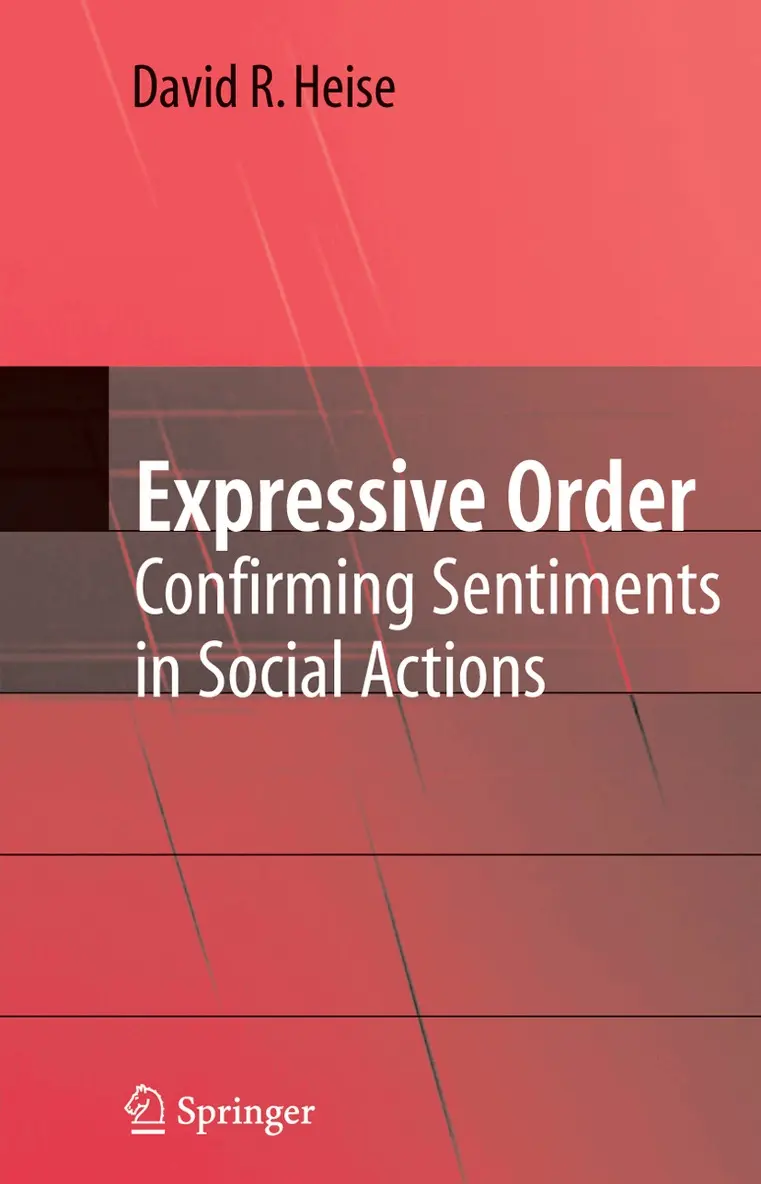
    Expressive Order

    Confirming Sentiments in Social Actions

    AvDavid R. Heise

    Häftad, Engelska, 2010

    547 kr

    Beställningsvara. Skickas inom 10-15 vardagar. Fri frakt över 249 kr.

    Fler format och utgåvor

    Inbunden

    547 kr

    E-bok

    710 kr

    Beskrivning

    Expressive Order introduces affect control theory to lay readers of sociology, and additionally guides sociology specialists into the theory's deep structure.Briefly, affect control theory proposes that individuals shape their social interactions so that emerging impressions reinforce sentiments about salient identities, behaviors, and settings. Emotions signal how the process of confirming sentiments is going for each individual. The theory explains behaviors, emotions, social labeling, and personality attributions in a wide variety of social contexts – including intimate relations, work-world interactions, courtrooms, and international relations.Part 1 of the book provides a plain-language exposition of the theory, along with numerous interpretive analyses of everyday situations. This is engaging and provocative reading for anyone interested in social relations, including undergraduates in and out of the social sciences.Part 2 presents the mathematical derivations that define sentiment-confirming behavior, labeling, attribution, and emotion. The mathematical solutions, conjoined with understandings about social institutions, are the basis of the theory's explanations. The derivations clarify the theory's assumptions and reasoning, as only mathematics can.Part 3 of Expressive Order describes the research program associated with the theory and the computer simulation software that is used in research. This part of the book offers a jump start for individuals wishing to use affect control theory in their own research.

    Produktinformation

    • Utgivningsdatum:2010-10-29
    • Mått:155 x 235 x 11 mm
    • Vikt:283 g
    • Format:Häftad
    • Språk:Engelska
    • Antal sidor:164
    • Förlag:Springer-Verlag New York Inc.
    • ISBN:9781441942562

    Utforska kategorier

    • Sociologi inom Samhälle och politik

    Innehållsförteckning

    • Preface.- Part I Affect Control Theory, Plainly Told.- Introduction .- Affect control theory.- Utility of the Theory .- Overview of the Book.- Further Readings.- Sentiments.- Evaluation, Potency, and Activity (EPA).-Measuring EPA .- Universality of EPA.- Further Readings.- Culture.- Consensus.- Individuality Versus Norms.- Measurement Implications.- Cultural Stability.- Instability or Unreliability? .- Variations Across Cultures.- Further Readings .- Sub-Cultures.- Gender.- A Pseudo-Sub-Culture.- Gendered Traits.- Gay Christians .- Deviance Sub-Cultures.- Non-Normalized Deviants .- Occupations.- Further Readings.- Defining Situations.- Identities.- Institutions.- Cues to Institutions.- Selves.- Multiple Identities.- Identity Modifiers.- Further Readings.- Interpreting Actions.- Action Frames.- Institutional Coherence.- Affective Processing .- Impression Formation.- Stability.-  Behavior Effects.- Diminishment.- Consistencies.- Congruencies.- Balance.- States of Being .- Cross-Cultural Variations.- Versus Sentiments—Deflection.- Identifying Behaviors .- Further Readings .- Building Actions.-Selecting a Behavior.- Social Interaction.- Groups .- Avoiding Diminishment .- Social Roles .- Medicine.- Law .- Work Roles .- Macroactions .- Informal Roles.- Deviance.-  Interactions With Deviants.-  Interactions Among Deviants.- Further Readings .- Emotions .-  Emotions as Signals.- Impressions and Emotions .- Characteristic and Structural Emotions .- Solidarity .- Emotions and Motivation .- Stress .- Self-Sentiments and Stress .- Emotions and Stress .- Emotions of Deviants.- Further Readings.- Changing Sentiments.- Re-identification .- Identity Filtering.- Labeling Deviants .- Attribution .- Inferences From Emotionality.- Identity Fluctuation.- Sentiment Change.- New Sentiments .- Enculturation.- Turning Points.- Further Readings.- Selves.- Salient Identities.- Commitment and Alienation.- Deviance Forays .-  Deviants .- Self-Repugnance .-  Patterns of Deviance .- Self-Fluctuation.- Cultural Shifts in Self .- Further Readings.- Part II Mathematics of Affect Control Theory .- Event Likelihood.- Optimal Behavior.- Incorporating Settings.- Self-Directed Action .- Optimal Identity.- Re-identifying Actors.-  Re-identifying Object Persons .- Modifiers .- Emotions.- Characteristic Emotion.- Attributes.- Emotions and Re-identification .- Inferences From Mood.- Elaborations.- Self and Identities.- Minimizing Inauthenticity.- Illustrative Analyses.- Optimal Behavior.- Optimal Re-identifications.- Emotions and Re-identification.- Programming the Model.- Organization of Analyses.- Emotionality Constraints .-  Impression-Formation Equations.- Selection .- Algorithms.- Part III Researching Affect Control Theory.- Growth of Affect Control Theory.- Chronology .- Branches.- Measurement of Affective Dimensions.- Impression Formation.- Theory and Mathematics.- Self.- Computer Programming.- Experiments.- Emotions.- Sub-Cultures, Gender, Ideology.- Life Course.- Social Structure, Social Change.- Politics .- Deviance .- Language and Arts.- Business .- Simulations.- Conducting Simulations.- Define Interactants Form.- Define Situation Form.- Define Events Form.- Analyze Events Form.- View Report Form .- Other Capabilities .-  Errors.- Different Versions of Interact .- Further Readings .-  Basic Concepts in Affect Control Theory.- References .- Index