• Fri frakt över 249 kr
  • •
  • Snabba leveranser
  • •
  • Billiga böcker
Kundservice

Du är på sajten för privatpersoner.

Företag, bibliotek eller offentlig verksamhet?

Du handlar på classic.bokus.com, där alla dina funktioner finns intakta.
Till classic.bokus.com
Bokus logotyp. Gå till startsidan.
  • Erbjudanden
  • Nyheter
  • Student
  • Topplistor
  • Barn & ungdom
  • Bokus Play
  • E-böcker
  • Pocketböcker
  • Spel & pussel

10% rabatt på allt med kod NYSTART10 →

Sidfot

Mina sidor

    Hjälp

    • Kundservice
    • Vanliga frågor och svar
    • Frakt och leverans
    • Retur vid ångerrätt
    • Reklamera vara
    • Betalning
    • Köpvillkor
    • Allmänna villkor
    • Information om webbplatsens tillgänglighet

    Om Bokus

    • Om oss
    • Pressrum
    • För studenter
    • För företag
    • För bibliotek och offentlig verksamhet
    • För leverantörer
    • Hållbarhet

    Populärt

    • Aktuella erbjudanden
    • Presentkort
    • Studentlitteratur
    • Nya böcker
    • Topplistor
    • Signerade böcker
    • Engelska böcker

    Inspiration

    • Boktips
    • BookTok
    • Populära bokserier
    • Barnbokskaraktärer
    • Populära författare
    Logotyp för Bokus
    Följ oss på Facebook (extern länk)Följ oss på Instagram (extern länk)Följ oss på YouTube (extern länk)Följ oss på TikTok (extern länk)
    bokus @ CookiesAnpassa cookiesIntegritetspolicyKöpvillkor
    Till Citymail hemsida (extern länk)Till Budbee hemsida (extern länk)Till Postnord hemsida (extern länk)Till Schenker hemsida (extern länk)Till Early Bird hemsida (extern länk)Till Walleys hemsida (extern länk)
    1. Naturvetenskap och teknik
    2. Teknik och industri
    3. Elektronik och kommunikationer

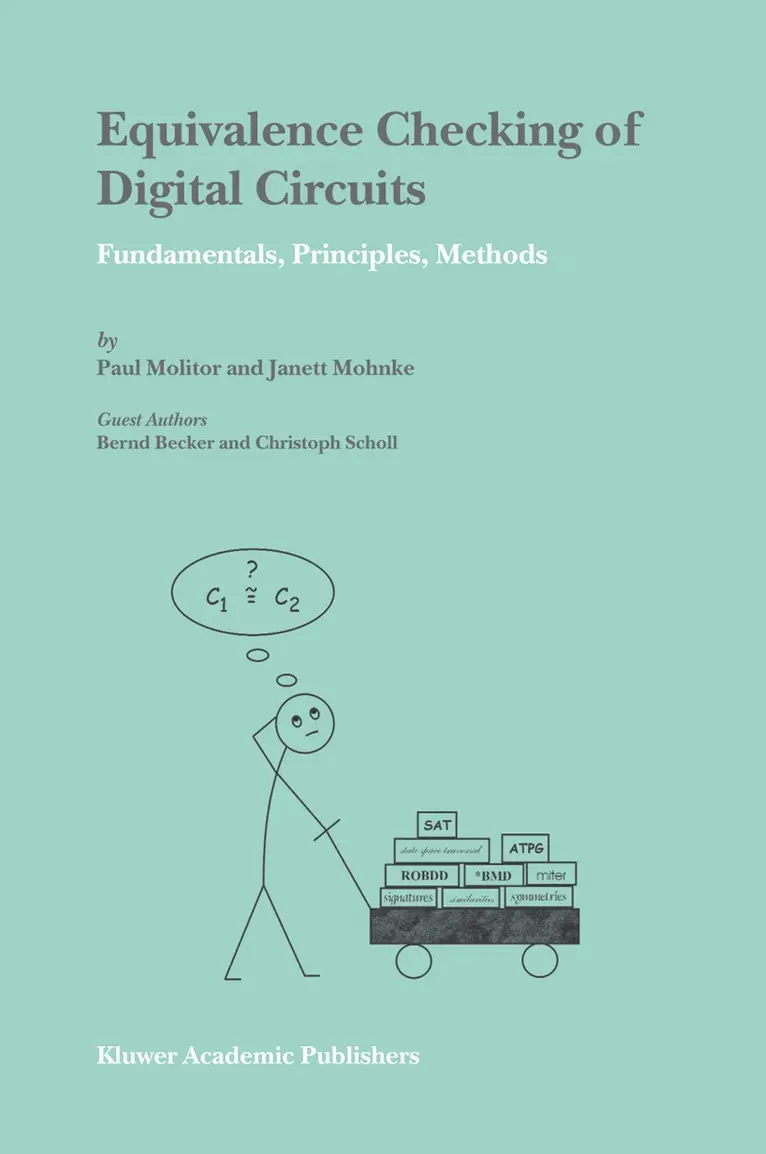
    Equivalence Checking of Digital Circuits

    Fundamentals, Principles, Methods

    AvPaul Molitor,Janett Mohnke

    Häftad, Engelska, 2010

    1 625 kr

    Beställningsvara. Skickas inom 10-15 vardagar. Fri frakt över 249 kr.

    Fler format och utgåvor

    Inbunden

    1 625 kr

    Beskrivning

    Hardware veri?cation is the process of checking whether a design conforms to its speci?cations of functionality and timing. In today’s design processes it becomes more and more important. Very large scale integrated (VLSI) circuits and the resulting digital systems have conquered a place in almost all areas of our life, even in security sensitive applications. Complex digital systems control airplanes, have been used in banks and on intensive-care units. Hence, the demand for error-free designs is more important than ever. In addition, economic reasons underline this demand as well. The design and production process of present day VLSI-circuits is highly time- and cost-intensive. Mo- over, it is nearly impossible to repair integrated circuits. Thus, it is desirable to detect design errors early in the design process and not just after producing the prototype chip. All these facts are re?ected by developing and prod- tion statistics of present day companies. For example, In?neon Technologies [118] assumed that about 60% to 80% of the overall design time was spent for veri?cation in 2000. Other sources cite the 3-to-1 head count ratio between veri?cation engineers and logic designers. This shows that verifying logical correctness of the design of hardware systems is a major gate to the problem of time-to-market (cf. [113]). With the chip complexity constantly increasing, the dif?culty as well as the - portance of functional veri?cation of new product designs has been increased. It is not only more important to get error-free designs.

    Produktinformation

    • Utgivningsdatum:2010-12-07
    • Mått:155 x 235 x 16 mm
    • Vikt:429 g
    • Format:Häftad
    • Språk:Engelska
    • Antal sidor:263
    • Förlag:Springer-Verlag New York Inc.
    • ISBN:9781441954237

    Utforska kategorier

    • Elektronik och kommunikationer inom Naturvetenskap och teknik
    • Energiteknik inom Naturvetenskap och teknik
    • Artificiell intelligens inom Data och IT

    Innehållsförteckning

    • Fundamentals.- Preliminaries.- Representation of Boolean and Pseudo Boolean Functions.- Equivalence Checking of Combinational Circuits.- Use of Canonical Data Structures.- SAT and ATPG Based Equivalence Checking.- Exploiting Similarities.- Checking Equivalence for Partial Implementations.- Permutation Independent Boolean Comparison.- Equivalence Checking of Sequential Circuits.- Formal Basics.- The Latch Correspondence Problem.