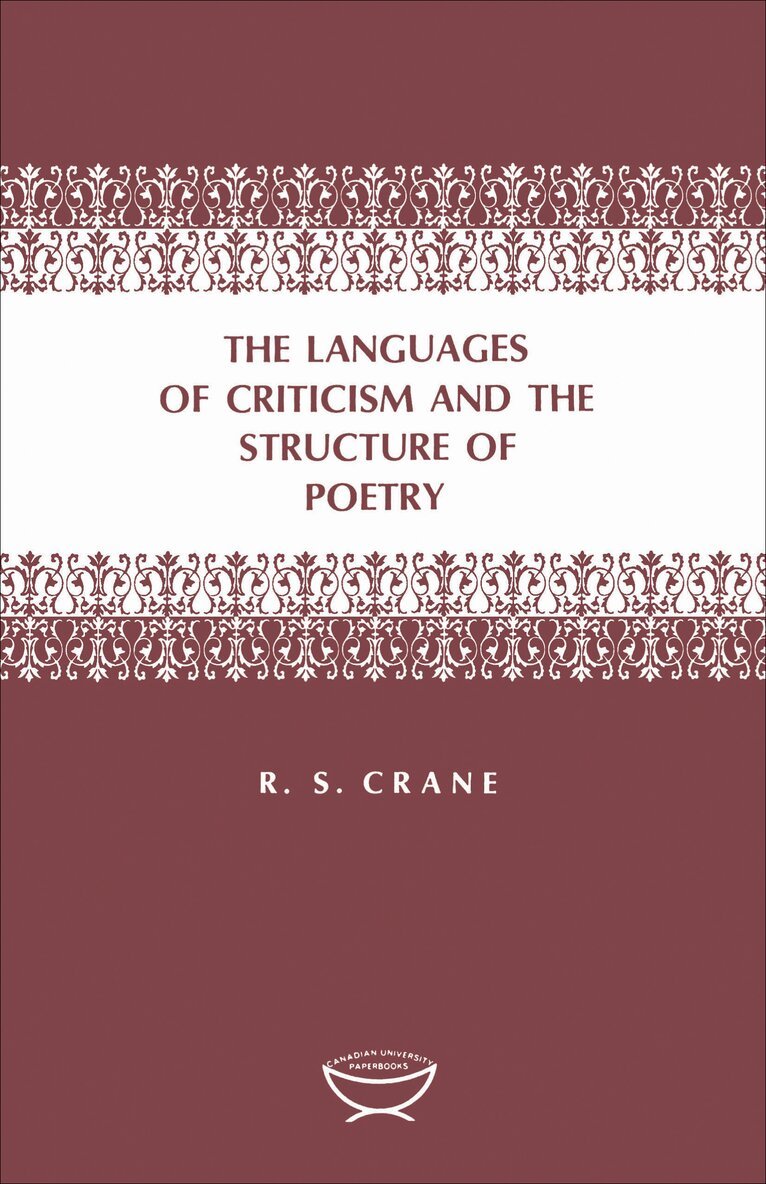
Languages of Criticism and the Structure of Poetry
460 kr
Läs direkt i Bokus Reader – eller ladda ned till din enhet
Du är på sajten för privatpersoner.
460 kr
Läs direkt i Bokus Reader – eller ladda ned till din enhet
R.S. Crane (1886-1967) was a literary critic, historian, bibliographer, and professor. He is credited with the founding of the Chicago School of Literary Criticism.
"...this book aims at being a comprehensive account of the attitude of one of the most influential of modern critics to the critics of the past, with suggestions for the directions in which contemporary critics may most profitably explore...an unusually stimulating book." - The Times Literary Supplement "The Alexander Lectures given by Professor Crane in 1952 form one of the most significant volumes in a distinguished series...here we have a reasoned statement, in manageable compass, of the doctrines which roused so much controversy when they appeared in Critics and Criticism, but without the polemical tone or the sense of the partisanship of a 'school' which confused the response to that book. Mr. Crane here remarks that schools are a sign of competing dogmatisms rather than of co-operative learning, and it is impossible for any reader of this book to regard its author as an Aristotelian determinist out to do a hatchet job on the new critics." - Northrop Frye (University of Toronto Quarterly) "Mr. Crane divides modern critics into two schools: those who take an analytic, systematic interest in the language and meanings of poetry as these are differentiated from the language and meanings of prose; those who apply to poetry the insights of psychoanalysis and anthropology. Most of both sorts are New. Gazing at them from calm, distant, commonsensical eyes, Mr. Crane describes with reflective detachment, his critics' midnight marches, routs, sieges, voyages, their all-but-mortal combats." - Randall Jarrell (Saturday Review)
Du är på sajten för privatpersoner.
460 kr
Läs direkt i Bokus Reader – eller ladda ned till din enhet
R.S. Crane (1886-1967) was a literary critic, historian, bibliographer, and professor. He is credited with the founding of the Chicago School of Literary Criticism.
"...this book aims at being a comprehensive account of the attitude of one of the most influential of modern critics to the critics of the past, with suggestions for the directions in which contemporary critics may most profitably explore...an unusually stimulating book." - The Times Literary Supplement "The Alexander Lectures given by Professor Crane in 1952 form one of the most significant volumes in a distinguished series...here we have a reasoned statement, in manageable compass, of the doctrines which roused so much controversy when they appeared in Critics and Criticism, but without the polemical tone or the sense of the partisanship of a 'school' which confused the response to that book. Mr. Crane here remarks that schools are a sign of competing dogmatisms rather than of co-operative learning, and it is impossible for any reader of this book to regard its author as an Aristotelian determinist out to do a hatchet job on the new critics." - Northrop Frye (University of Toronto Quarterly) "Mr. Crane divides modern critics into two schools: those who take an analytic, systematic interest in the language and meanings of poetry as these are differentiated from the language and meanings of prose; those who apply to poetry the insights of psychoanalysis and anthropology. Most of both sorts are New. Gazing at them from calm, distant, commonsensical eyes, Mr. Crane describes with reflective detachment, his critics' midnight marches, routs, sieges, voyages, their all-but-mortal combats." - Randall Jarrell (Saturday Review)