• Fri frakt över 249 kr
  • •
  • Snabba leveranser
  • •
  • Billiga böcker
Kundservice

Du är på sajten för privatpersoner.

Företag, bibliotek eller offentlig verksamhet?

Du handlar på classic.bokus.com, där alla dina funktioner finns intakta.
Till classic.bokus.com
Bokus logotyp. Gå till startsidan.
  • Erbjudanden
  • Student
  • Topplistor
  • Barn & ungdom
  • Bokus Play
  • E-böcker
  • Ljudböcker
  • Pocketböcker
  • Spel och pussel

Skapa nya rutiner – hälsoböcker upp till 50% →

Sidfot

Mina sidor

    Hjälp

    • Kundservice
    • Vanliga frågor och svar
    • Frakt och leverans
    • Retur vid ångerrätt
    • Reklamera vara
    • Betalning
    • Köpvillkor
    • Allmänna villkor
    • Information om webbplatsens tillgänglighet

    Om Bokus

    • Om oss
    • Pressrum
    • För studenter
    • För företag
    • För bibliotek och offentlig verksamhet
    • För leverantörer
    • Hållbarhet

    Populärt

    • Aktuella erbjudanden
    • Presentkort
    • Studentlitteratur
    • Nya böcker
    • Topplistor
    • Signerade böcker
    • Engelska böcker

    Inspiration

    • Boktips
    • BookTok
    • Barnbokskaraktärer
    • Populära författare
    Logotyp för Bokus
    Följ oss på Facebook (extern länk)Följ oss på Instagram (extern länk)Följ oss på YouTube (extern länk)Följ oss på TikTok (extern länk)
    bokus @ CookiesAnpassa cookiesIntegritetspolicyKöpvillkor
    Till Citymail hemsida (extern länk)Till Budbee hemsida (extern länk)Till Postnord hemsida (extern länk)Till Schenker hemsida (extern länk)Till Early Bird hemsida (extern länk)Till Walleys hemsida (extern länk)
    1. Kultur
    2. Fotoböcker
    3. Fotoutrustning och fototeknik

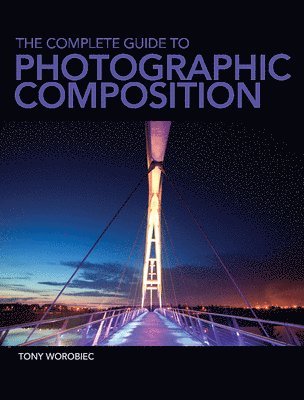
    The Complete Guide to Photographic Composition

    AvTony Worobiec

    Häftad, Engelska, 2013

    224 kr

    Beställningsvara. Skickas inom 5-8 vardagar. Fri frakt över 249 kr.

    Beskrivning

    Composition is absolutely fundamental to great photography. It is also an extremely complex concept. But with the help of award-winning photographer Tony Worobiec, who has training and background in the visual arts, you will learn the theory, skills and techniques needed to achieve beautiful compositions, alongside Tony's inspiring and striking photographs.Progressing from a simple introduction to composition and conventional compositional techniques to post camera techniques, such as cropping for effect, as well as a discussion of more challenging concepts and alternative approaches to composition, such as using disharmony, eidetic images and the Gestalt Theory to create a heightened visual statement in your photography. Whether you are an enthusiastic beginner or experienced photographer, The Complete Guide to Photographic Composition is essential reading for all creative photographers.

    Produktinformation

    • Utgivningsdatum:2013-09-27
    • Mått:11 x 277 x 211 mm
    • Vikt:706 g
    • Format:Häftad
    • Språk:Engelska
    • Antal sidor:160
    • Förlag:David & Charles
    • ISBN:9781446302637

    Utforska kategorier

    • Fotoutrustning och fototeknik inom Kultur

    Mer om författaren

    Tony Worobiec has won awards for photography in the UK and internationally and he has had work exhibited in London's Barbican Gallery and Bradford's National Museum of Photography. He is a founder member and current chairman of the Arena group of photographers and is a Fellow of the Royal Photographic Society and a former member of that society's Distinctions Panel for Visual Arts. Tony's work has appeared in many photographic magazines both in the UK and the USA. Tony lives in Dorset.

    Innehållsförteckning

    • Section 1. Conventional compositional techniques A. What is composition? An introduction 1. What is Composition? 2. Consider how the rules of photography have been drawn from art 3. The Golden Section and the "rule of the thirds" 4. The Golden Spiral 5. The Golden Triangle B. Exploring the viewpoint 1. Understand the each scenario offers different viewpoints 2. Consider the vantage point C. How to organise interacting shapes and forms 1. Organising shapes 2. Balancing Elements 3. The dominant and the subordinate element 4. The Fulcrum. 5. Composing from a corner 6. Organising elements at opposite ends 7. The Multifaceted design 8. Positive and negative shapes D. How line can help structure a composition 1. Line in Composition 2. Perspective and the lead-in line 3. The power of the diagonal line 4. The aesthetic appeal of the "flowing" line 5. The visual "full-stop" E. Foreground/ background 1. Examine strategies for linking the foreground and background 2. The foreground mimicking the background 3. A suitable background 4. Create a sense of scale F. The numbers game 1. Selecting a single focal point / area of greatest tonal contrast 2. Working with pairs 3. When highlighting multiples, use an odd number 4. Crop at the edge to suggest more 5. Matching numbers G. The Value of Colour 1. The Psychology of Colour 2. Creating impact using complimentary colours 3. The aesthetic values of harmonies 4. Advancing and receding colours 5. Monochromatic colour 6. A splash of colour 7. Harmonies H. Consider the edge 1. Using natural frames to direct the eye 2. Ensure that elements face into the picture 3. Print in the edges/vignetting I. Patterns in composition 1. Consider the cohesive qualities of pattern 2. The broken or interrupted pattern 3. Exploiting Texture J. Facing Inwards K. Exploring Texture Section 2. Achieving style through composition A. Improving the structure of the image 1. The Central Meridian 2. Nearly Central 3. Understand how the choice of Format affects composition 4. Manipulating Tonal Values using HDR 5. Knowing when to crop 6. Manipulating scale and proportion 7. Create a visual "palindrome" 8. The mirrored or reflected image 9. Proportion B. Less is more 1. In shades of Grey; using a very restricted palette 2. Tonal recession and aerial perspective 3. High Key/ Low Key 4. Understanding the virtue of the empty space 5. Minimalism 6. The visual appeal of the silhouette 7. In splendid isolation C. Using photographic techniques to improve composition 1. Explore the background 2. The illuminated focal point 3. Increasing emphasis by reducing the depth of field 4. Composition and the "critical moment" D. How art influences photography 1. Explore abstract elements 2. The arabesque line 3. Rhythms in the composition 4. The Graphic image 5. Viewing the same place 6. The Resonating image 7. Text and composition Section 3. A fresh look at composition A. Alternative techniques 1. A shape within a shape/ circle in a square 2. The created composition e.g. the kaleidoscope 3. The negative of a positive 4. Counter-change 5. Creating Translucent layers 6. Sequences and related images 7. Seeing order out of chaos 8. Stalactites" and "stalagmites" 9. The role for serendipity 10. The "constructed" image B. Composing for disharmony 1. The Imperfect Composition 2. The Sloping Horizon 3. Celebrate the ugly 4. The distressed image 5. Anti Composition 6. The edge of the frame 7. The divided image 8. So how do we compose? 9. Just break the "rules" 10. Conclusion; Eidetic images and the Gestalt Theory