• Fri frakt över 249 kr
  • •
  • Snabba leveranser
  • •
  • Billiga böcker
Kundservice

Du är på sajten för privatpersoner.

Företag, bibliotek eller offentlig verksamhet?

Du handlar på classic.bokus.com, där alla dina funktioner finns intakta.
Till classic.bokus.com
Bokus logotyp. Gå till startsidan.
  • Erbjudanden
  • Nyheter
  • Student
  • Topplistor
  • Barn & ungdom
  • Bokus Play
  • E-böcker
  • Pocketböcker
  • Spel & pussel

10% rabatt på allt med kod NYSTART10 →

Sidfot

Mina sidor

    Hjälp

    • Kundservice
    • Vanliga frågor och svar
    • Frakt och leverans
    • Retur vid ångerrätt
    • Reklamera vara
    • Betalning
    • Köpvillkor
    • Allmänna villkor
    • Information om webbplatsens tillgänglighet

    Om Bokus

    • Om oss
    • Pressrum
    • För studenter
    • För företag
    • För bibliotek och offentlig verksamhet
    • För leverantörer
    • Hållbarhet

    Populärt

    • Aktuella erbjudanden
    • Presentkort
    • Studentlitteratur
    • Nya böcker
    • Topplistor
    • Signerade böcker
    • Engelska böcker

    Inspiration

    • Boktips
    • BookTok
    • Populära bokserier
    • Barnbokskaraktärer
    • Populära författare
    Logotyp för Bokus
    Följ oss på Facebook (extern länk)Följ oss på Instagram (extern länk)Följ oss på YouTube (extern länk)Följ oss på TikTok (extern länk)
    bokus @ CookiesAnpassa cookiesIntegritetspolicyKöpvillkor
    Till Citymail hemsida (extern länk)Till Budbee hemsida (extern länk)Till Postnord hemsida (extern länk)Till Schenker hemsida (extern länk)Till Early Bird hemsida (extern länk)Till Walleys hemsida (extern länk)
    1. Data och IT
    2. Systemvetenskap och AI

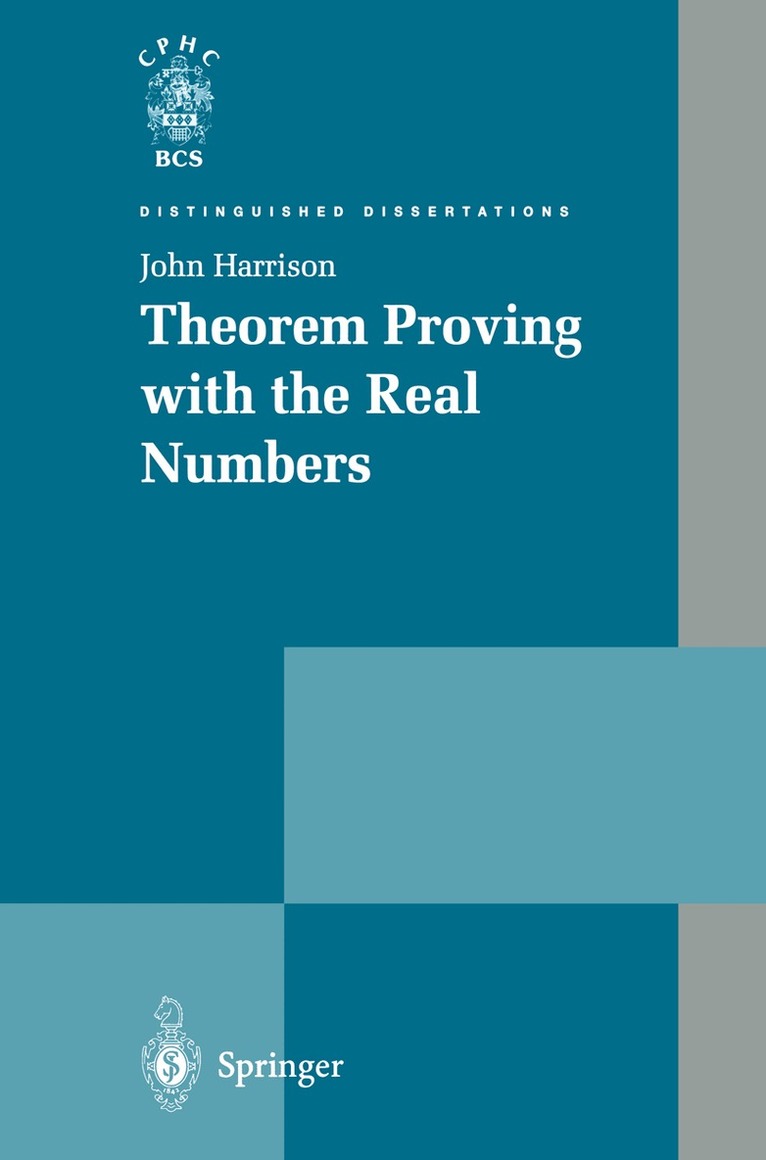
    Theorem Proving with the Real Numbers

    AvJohn Harrison

    Häftad, Engelska, 2011

    Del i serien Distinguished Dissertations

    1 117 kr

    Beställningsvara. Skickas inom 10-15 vardagar. Fri frakt över 249 kr.

    Fler format och utgåvor

    E-bok

    1 455 kr

    Beskrivning

    This book discusses the use of the real numbers in theorem proving. Typ­ ically, theorem provers only support a few 'discrete' datatypes such as the natural numbers. However the availability of the real numbers opens up many interesting and important application areas, such as the verification of float­ ing point hardware and hybrid systems. It also allows the formalization of many more branches of classical mathematics, which is particularly relevant for attempts to inject more rigour into computer algebra systems. Our work is conducted in a version of the HOL theorem prover. We de­ scribe the rigorous definitional construction of the real numbers, using a new version of Cantor's method, and the formalization of a significant portion of real analysis. We also describe an advanced derived decision procedure for the 'Tarski subset' of real algebra as well as some more modest but practically useful tools for automating explicit calculations and routine linear arithmetic reasoning. Finally, we consider in more detail two interesting application areas. We discuss the desirability of combining the rigour of theorem provers with the power and convenience of computer algebra systems, and explain a method we have used in practice to achieve this. We then move on to the verification of floating point hardware. After a careful discussion of possible correctness specifications, we report on two case studies, one involving a transcendental function.

    Produktinformation

    • Utgivningsdatum:2011-11-20
    • Mått:155 x 235 x 12 mm
    • Vikt:312 g
    • Format:Häftad
    • Språk:Engelska
    • Serie:Distinguished Dissertations
    • Antal sidor:186
    • Förlag:Springer London Ltd
    • ISBN:9781447115939

    Utforska kategorier

    • Systemvetenskap och AI inom Data och IT
    • Artificiell intelligens inom Data och IT
    • Programmeringsböcker inom Data och IT

    Innehållsförteckning

    • 1. Introduction.- 1.1 Symbolic computation.- 1.2 Verification.- 1.3 Higher order logic.- 1.4 Theorem proving vs. model checking.- 1.5 Automated vs. interactive theorem proving.- 1.6 The real numbers.- 1.7 Concluding remarks.- 2 Constructing the Real Numbers.- 2.1 Properties of the real numbers.- 2.2 Uniqueness of the real numbers.- 2.3 Constructing the real numbers.- 2.4 Positional expansions.- 2.5 Cantor’s method.- 2.6 Dedekind’s method.- 2.7 What choice?.- 2.8 Lemmas about nearly-multiplicative functions.- 2.9 Details of the construction.- 2.10 Adding negative numbers.- 2.11 Handling equivalence classes.- 2.12 Summary and related work.- 3. Formalized Analysis.- 3.1 The rigorization and formalization of analysis.- 3.2 Some general theories.- 3.3 Sequences and series.- 3.4 Limits, continuity and differentiation.- 3.5 Power series and the transcendental functions.- 3.6 Integration.- 3.7 Summary and related work.- 4. Explicit Calculations.- 4.1 The need for calculation.- 4.2 Calculation with natural numbers.- 4.3 Calculation with integers.- 4.4 Calculation with rationals.- 4.5 Calculation with reals.- 4.6 Summary and related work.- 5. A Decision Procedure for Real Algebra.- 5.1 History and theory.- 5.2 Real closed fields.- 5.3 Abstract description of the algorithm.- 5.4 The HOL Implementation.- 5.5 Optimizing the linear case.- 5.6 Results.- 5.7 Summary and related work.- 6. Computer Algebra Systems.- 6.1 Theorem provers vs. computer algebra systems.- 6.2 Finding and checking.- 6.3 Combining systems.- 6.4 Applications.- 6.5 Summary and related work.- 7. Floating Point Verification.- 7.1 Motivation.- 7.2 Floating point error analysis.- 7.3 Specifying floating point operations.- 7.4 Idealized integer and floating point operations.- 7.5 A square root algorithm.- 7.6 ACORDIC natural logarithm algorithm.- 7.7 Summary and related work.- 8. Conclusions.- 8.1 Mathematical contributions.- 8.2 The formalization of mathematics.- 8.3 The LCF approach to theorem proving.- 8.4 Computer algebra systems.- 8.5 Verification applications.- 8.6 Concluding remarks.- A. Logical foundations of HOL.- B. Recent developments.