• Fri frakt över 249 kr
  • •
  • Snabba leveranser
  • •
  • Billiga böcker
Kundservice

Du är på sajten för privatpersoner.

Företag, bibliotek eller offentlig verksamhet?

Du handlar på classic.bokus.com, där alla dina funktioner finns intakta.
Till classic.bokus.com
Bokus logotyp. Gå till startsidan.
  • Erbjudanden
  • Nyheter
  • Student
  • Topplistor
  • Barn & ungdom
  • Bokus Play
  • E-böcker
  • Pocketböcker
  • Spel & pussel

10% rabatt på allt med kod: NYSTART10 →

Sidfot

Mina sidor

    Hjälp

    • Kundservice
    • Vanliga frågor och svar
    • Frakt och leverans
    • Retur vid ångerrätt
    • Reklamera vara
    • Betalning
    • Köpvillkor
    • Allmänna villkor
    • Information om webbplatsens tillgänglighet

    Om Bokus

    • Om oss
    • Pressrum
    • För studenter
    • För företag
    • För bibliotek och offentlig verksamhet
    • För leverantörer
    • Hållbarhet

    Populärt

    • Aktuella erbjudanden
    • Presentkort
    • Studentlitteratur
    • Nya böcker
    • Topplistor
    • Signerade böcker
    • Engelska böcker

    Inspiration

    • Boktips
    • BookTok
    • Populära bokserier
    • Barnbokskaraktärer
    • Populära författare
    Logotyp för Bokus
    Följ oss på Facebook (extern länk)Följ oss på Instagram (extern länk)Följ oss på YouTube (extern länk)Följ oss på TikTok (extern länk)
    bokus @ CookiesAnpassa cookiesIntegritetspolicyKöpvillkor
    Till Citymail hemsida (extern länk)Till Budbee hemsida (extern länk)Till Postnord hemsida (extern länk)Till Schenker hemsida (extern länk)Till Early Bird hemsida (extern länk)Till Walleys hemsida (extern länk)
    1. Data och IT
    2. Systemvetenskap och AI

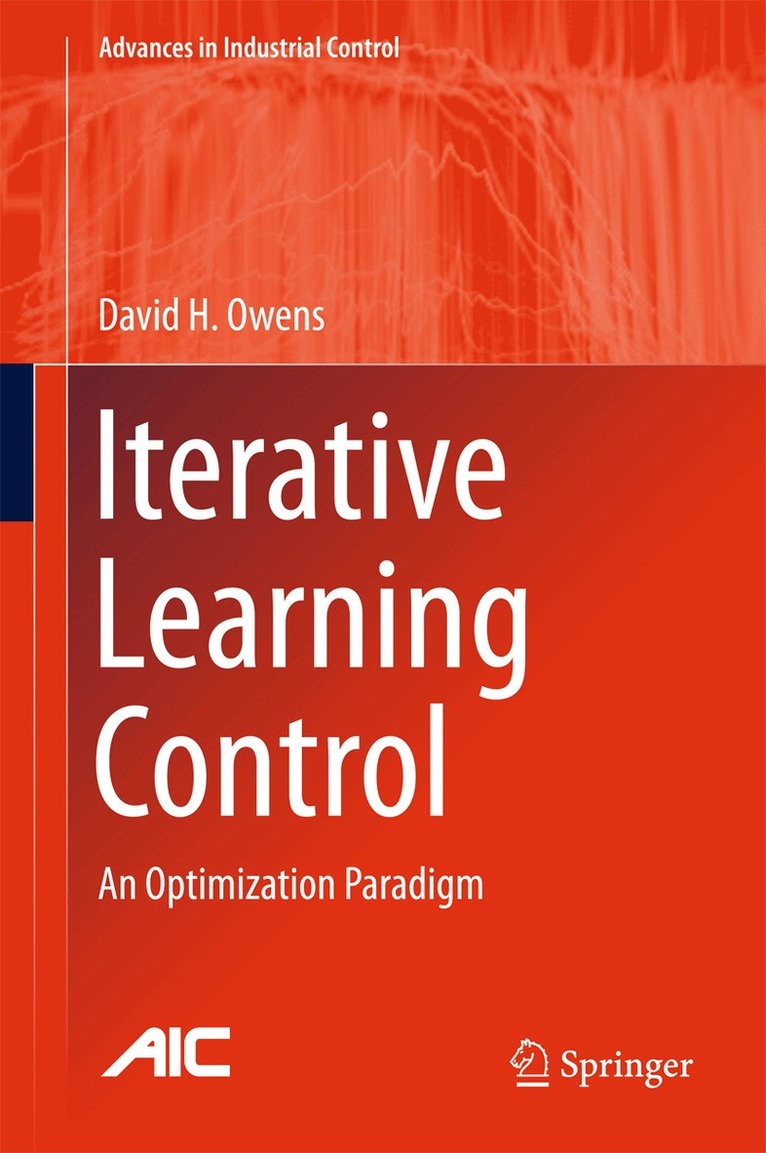
    Iterative Learning Control

    An Optimization Paradigm

    AvDavid H. Owens

    Inbunden, Engelska, 2015

    Del i serien Advances in Industrial Control

    1 563 kr

    Beställningsvara. Skickas inom 10-15 vardagar. Fri frakt över 249 kr.

    Fler format och utgåvor

    E-bok

    1 570 kr

    Häftad

    1 318 kr

    Beskrivning

    This book develops a coherent and quite general theoretical approach to algorithm design for iterative learning control based on the use of operator representations and quadratic optimization concepts including the related ideas of inverse model control and gradient-based design.Using detailed examples taken from linear, discrete and continuous-time systems, the author gives the reader access to theories based on either signal or parameter optimization. Although the two approaches are shown to be related in a formal mathematical sense, the text presents them separately as their relevant algorithm design issues are distinct and give rise to different performance capabilities. Together with algorithm design, the text demonstrates the underlying robustness of the paradigm and also includes new control laws that are capable of incorporating input and output constraints, enable the algorithm to reconfigure systematically in order to meet the requirements of different reference and auxiliary signals and also to support new properties such as spectral annihilation.Iterative Learning Control will interest academics and graduate students working in control who will find it a useful reference to the current status of a powerful and increasingly popular method of control. The depth of background theory and links to practical systems will be of use to engineers responsible for precision repetitive processes.

    Produktinformation

    • Utgivningsdatum:2015-11-10
    • Mått:155 x 235 x 32 mm
    • Vikt:887 g
    • Format:Inbunden
    • Språk:Engelska
    • Serie:Advances in Industrial Control
    • Antal sidor:456
    • Upplaga:15001
    • Förlag:Springer London Ltd
    • ISBN:9781447167709

    Utforska kategorier

    • Systemvetenskap och AI inom Data och IT
    • Artificiell intelligens inom Data och IT
    • Programmeringsböcker inom Data och IT

    Mer om författaren

    Professor Owens has 40 years of experience of Control Engineering theory and applications in areas including nuclear power, robotics and mechanical test. He has extensive teaching experience at both undergraduate and postgraduate levels in three UK universities. His research has included multivariable frequency domain theory and design, the theory of multivariable root loci, contributions to robust control theory, theoretical methods for controller design based  on plant step data and involvement in aspects of adaptive control, model reduction and optimization-based design. His area of research that specifically underpins the text is his experience of modelling and analysis of systems with repetitive dynamics. Originally arising in control of underground coal cutters, my theory of “multipass processes” (developed in 1976 with follow-on applications introduced by J.B. Edwards) laid the foundation for analysis and design in this area and others including metal rolling and automatedagriculture. This work led to substantial contributions (with collaborator E. Rogers and others) in the area of repetitive control systems (as part of 2D systems theory) but more specifically, since 1996, in the area of iterative learning control when I introduced the use of optimization to the ILC community in the form of “norm optimal iterative learning control”. Since that time he has continued to teach and research in areas related to this topic adding considerable detail and depth to the approach and introducing the ideas of parameter optimal iterative learning to simplify the implementations. This led to his development of a wide range of new algorithms, supporting analysis and applications to mechanical test. This work is also being applied to the development of data analysis tools for control in gantry robots and stroke rehabilitation equipment by collaborators at Southampton University. Work with S. Daley has also seen applications in automative test at Jaguar and related industrial sites. David Owens was elected a Fellow of the Royal Academy of Engineering for his contributions to knowledge in these and other areas.

    Recensioner i media

    “This book presents a comprehensive study of ILC from the optimization paradigm, more specifically, the NOILC optimization paradigm. The organization is clear, and the necessary fundamentals are self-contained. The mathematical analysis is rigorous, and the algorithms are detail complete. This book is suitable for academic researchers … . It can be used a textbook for graduate students who are interested in ILC. It also gives rich motivations for researchers to study ILC from the optimization perspective.” (Li Xia, IEEE Control Systems Magazine, Vol. 37 (2), April, 2017)“This is a seminal text since it is very likely to generate interest and enthusiasm in the whole topic, and it provided a comprehensive overview of the mathematical methods that can be applied. It is very suitable for researchers in advanced control but it will also be useful to engineers involved with multi pass or repetitive processes where learning can provide a substantial improvement.” (ACTC applied control technology consortium, actc-control.com, March, 2016)

    Innehållsförteckning

    • Iterative Learning Control: Background and Review. Mathematical and Linear Modelling Methodologies.- Norm Optimal Iterative Learning Control: An Optimal Control Perspective.- Predicting the Effects of Non-minimum-phase Zeros.- Predictive Norm Optimal Iterative Learning Control.- Other Applications of Norm Optimal Iterative Learning Control.- Successive Projection Algorithms.- Parameter Optimal Iterative Learning Control.- Robustness of Parameter Optimal Iterative Learning Control.- Multi-parameter Optimal Iterative Learning Control.- No Normal 0 false false false EN-GB X-NONE X-NONE/* Style Definitions */ table.MsoNormalTable {mso-style-name:"Table Normal"; mso-tstyle-rowband-size:0; mso-tstyle-colband-size:0; mso-style-noshow:yes; mso-style-priority:99; mso-style-parent:""; mso-padding-alt:0cm 5.4pt 0cm 5.4pt; mso-para-margin-top:0cm; mso-para-margin-right:0cm; mso-para-margin-bottom:10.0pt; mso-para-margin-left:0cm; line-height:115%; mso-pagination:widow-orphan; font-size:11.0pt; font-family:"Calibri","sans-serif"; mso-ascii-font-family:Calibri; mso-ascii-theme-font:minor-latin; mso-hansi-font-family:Calibri; mso-hansi-theme-font:minor-latin; mso-fareast-language:EN-US;} nlinear Iterative Learning Control and Optimization.