• Fri frakt över 249 kr
  • •
  • Snabba leveranser
  • •
  • Billiga böcker
Kundservice

Du är på sajten för privatpersoner.

Företag, bibliotek eller offentlig verksamhet?

Du handlar på classic.bokus.com, där alla dina funktioner finns intakta.
Till classic.bokus.com
Bokus logotyp. Gå till startsidan.
  • Erbjudanden
  • Nyheter
  • Student
  • Topplistor
  • Barn & ungdom
  • Bokus Play
  • E-böcker
  • Pocketböcker
  • Spel & pussel

10% rabatt på allt med kod NYSTART10 →

Sidfot

Mina sidor

    Hjälp

    • Kundservice
    • Vanliga frågor och svar
    • Frakt och leverans
    • Retur vid ångerrätt
    • Reklamera vara
    • Betalning
    • Köpvillkor
    • Allmänna villkor
    • Information om webbplatsens tillgänglighet

    Om Bokus

    • Om oss
    • Pressrum
    • För studenter
    • För företag
    • För bibliotek och offentlig verksamhet
    • För leverantörer
    • Hållbarhet

    Populärt

    • Aktuella erbjudanden
    • Presentkort
    • Studentlitteratur
    • Nya böcker
    • Topplistor
    • Signerade böcker
    • Engelska böcker

    Inspiration

    • Boktips
    • BookTok
    • Populära bokserier
    • Barnbokskaraktärer
    • Populära författare
    Logotyp för Bokus
    Följ oss på Facebook (extern länk)Följ oss på Instagram (extern länk)Följ oss på YouTube (extern länk)Följ oss på TikTok (extern länk)
    bokus @ CookiesAnpassa cookiesIntegritetspolicyKöpvillkor
    Till Citymail hemsida (extern länk)Till Budbee hemsida (extern länk)Till Postnord hemsida (extern länk)Till Schenker hemsida (extern länk)Till Early Bird hemsida (extern länk)Till Walleys hemsida (extern länk)
    1. Data och IT
    2. Databaser

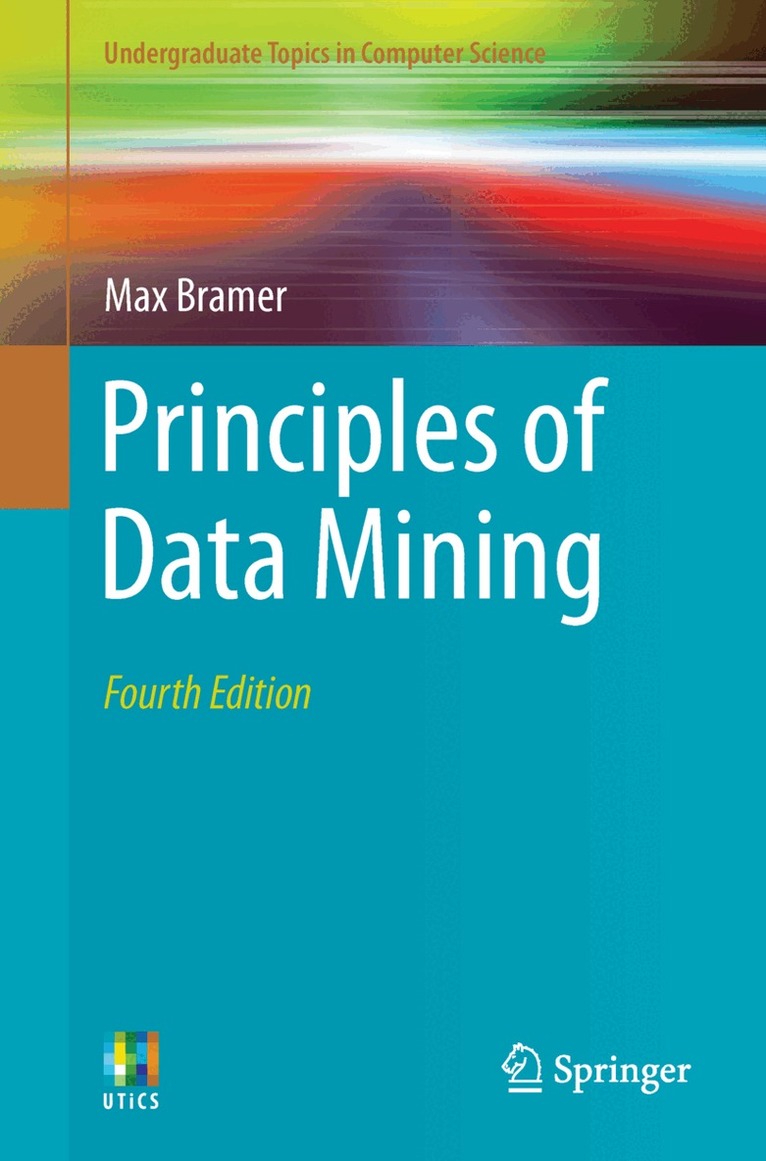
    Principles of Data Mining

    AvMax Bramer

    Häftad, Engelska, 2020

    Del i serien Undergraduate Topics in Computer Science

    340 kr

    Beställningsvara. Skickas inom 5-8 vardagar. Fri frakt över 249 kr.

    Fler format och utgåvor

    E-bok

    439 kr

    E-bok

    732 kr

    E-bok

    650 kr

    E-bok

    439 kr

    Beskrivning

    This book explains and explores the principal techniques of Data Mining, the automatic extraction of implicit and potentially useful information from data, which is increasingly used in commercial, scientific and other application areas. It focuses on classification, association rule mining and clustering.Each topic is clearly explained, with a focus on algorithms not mathematical formalism, and is illustrated by detailed worked examples. The book is written for readers without a strong background in mathematics or statistics and any formulae used are explained in detail.It can be used as a textbook to support courses at undergraduate or postgraduate levels in a wide range of subjects including Computer Science, Business Studies, Marketing, Artificial Intelligence, Bioinformatics and Forensic Science.As an aid to self-study, it aims to help general readers develop the necessary understanding of what is inside the 'black box' so they can use commercial data mining packages discriminatingly, as well as enabling advanced readers or academic researchers to understand or contribute to future technical advances in the field.Each chapter has practical exercises to enable readers to check their progress. A full glossary of technical terms used is included.Principles of Data Mining includes descriptions of algorithms for classifying streaming data, both stationary data, where the underlying model is fixed, and data that is time-dependent, where the underlying model changes from time to time - a phenomenon known as concept drift. The expanded fourth edition gives a detailed description of a feed-forward neural network with backpropagation and shows how it can be used for classification.

    Produktinformation

    • Utgivningsdatum:2020-05-21
    • Mått:155 x 235 x 47 mm
    • Vikt:886 g
    • Format:Häftad
    • Språk:Engelska
    • Serie:Undergraduate Topics in Computer Science
    • Antal sidor:571
    • Upplaga:4
    • Förlag:Springer London Ltd
    • ISBN:9781447174929

    Utforska kategorier

    • Databaser inom Data och IT
    • Artificiell intelligens inom Data och IT
    • Programmeringsböcker inom Data och IT

    Mer om författaren

    Max Bramer is Emeritus Professor of Information Technology at the University of Portsmouth, England, Vice-President of the International Federation for Information Processing (IFIP) and Chair of the British Computer Society Specialist Group on Artificial Intelligence. He has been actively involved since the 1980s in the field that has since come to be called by names such as Data Mining, Knowledge Discovery in Databases, Big Data and Predictive Analytics. He has carried out many projects in the field, particularly in relation to automatic classification of data, and has published extensively in the technical literature. He has taught the subject to both undergraduate and postgraduate students for many years.Some of Max Bramer’s other Springer publications include:Research and Development in Intelligent SystemsArtificial Intelligence in Theory and PracticeArtificial Intelligence: an International PerspectiveLogic Programming with PrologWeb Programming with PHP and MySQL

    Innehållsförteckning

    • Introduction to Data Mining.- Data for Data Mining.- Introduction to Classification: Naïve Bayes and Nearest Neighbour.- Using Decision Trees for Classification.- Decision Tree Induction: Using Entropy for Attribute Selection.- Decision Tree Induction: Using Frequency Tables for Attribute Selection.- Estimating the Predictive Accuracy of a Classifier.- Continuous Attributes.- Avoiding Overfitting of Decision Trees.- More About Entropy.- Inducing Modular Rules for Classification.- Measuring the Performance of a Classifier.- Dealing with Large Volumes of Data.- Ensemble Classification.- Comparing Classifiers.- Associate Rule Mining I.- Associate Rule Mining II.- Associate Rule Mining III.- Clustering.- Mining.- Classifying Streaming Data.- Classifying Streaming Data II: Time-dependent Data.- An Introduction to Neural Networks.- Appendix A – Essential Mathematics.- Appendix B – Datasets.- Appendix C – Sources of Further Information.- Appendix D – Glossary and Notation.- Appendix E – Solutions to Self-assessment Exercises.- Index.