• Fri frakt över 249 kr
  • •
  • Snabba leveranser
  • •
  • Billiga böcker
Kundservice

Du är på sajten för privatpersoner.

Företag, bibliotek eller offentlig verksamhet?

Du handlar på classic.bokus.com, där alla dina funktioner finns intakta.
Till classic.bokus.com
Bokus logotyp. Gå till startsidan.
  • Erbjudanden
  • Nyheter
  • Student
  • Topplistor
  • Barn & ungdom
  • Bokus Play
  • E-böcker
  • Pocketböcker
  • Spel & pussel

10% rabatt på allt med kod NYSTART10 →

Sidfot

Mina sidor

    Hjälp

    • Kundservice
    • Vanliga frågor och svar
    • Frakt och leverans
    • Retur vid ångerrätt
    • Reklamera vara
    • Betalning
    • Köpvillkor
    • Allmänna villkor
    • Information om webbplatsens tillgänglighet

    Om Bokus

    • Om oss
    • Pressrum
    • För studenter
    • För företag
    • För bibliotek och offentlig verksamhet
    • För leverantörer
    • Hållbarhet

    Populärt

    • Aktuella erbjudanden
    • Presentkort
    • Studentlitteratur
    • Nya böcker
    • Topplistor
    • Signerade böcker
    • Engelska böcker

    Inspiration

    • Boktips
    • BookTok
    • Populära bokserier
    • Barnbokskaraktärer
    • Populära författare
    Logotyp för Bokus
    Följ oss på Facebook (extern länk)Följ oss på Instagram (extern länk)Följ oss på YouTube (extern länk)Följ oss på TikTok (extern länk)
    bokus @ CookiesAnpassa cookiesIntegritetspolicyKöpvillkor
    Till Citymail hemsida (extern länk)Till Budbee hemsida (extern länk)Till Postnord hemsida (extern länk)Till Schenker hemsida (extern länk)Till Early Bird hemsida (extern länk)Till Walleys hemsida (extern länk)
    1. Data och IT
    2. Systemvetenskap och AI

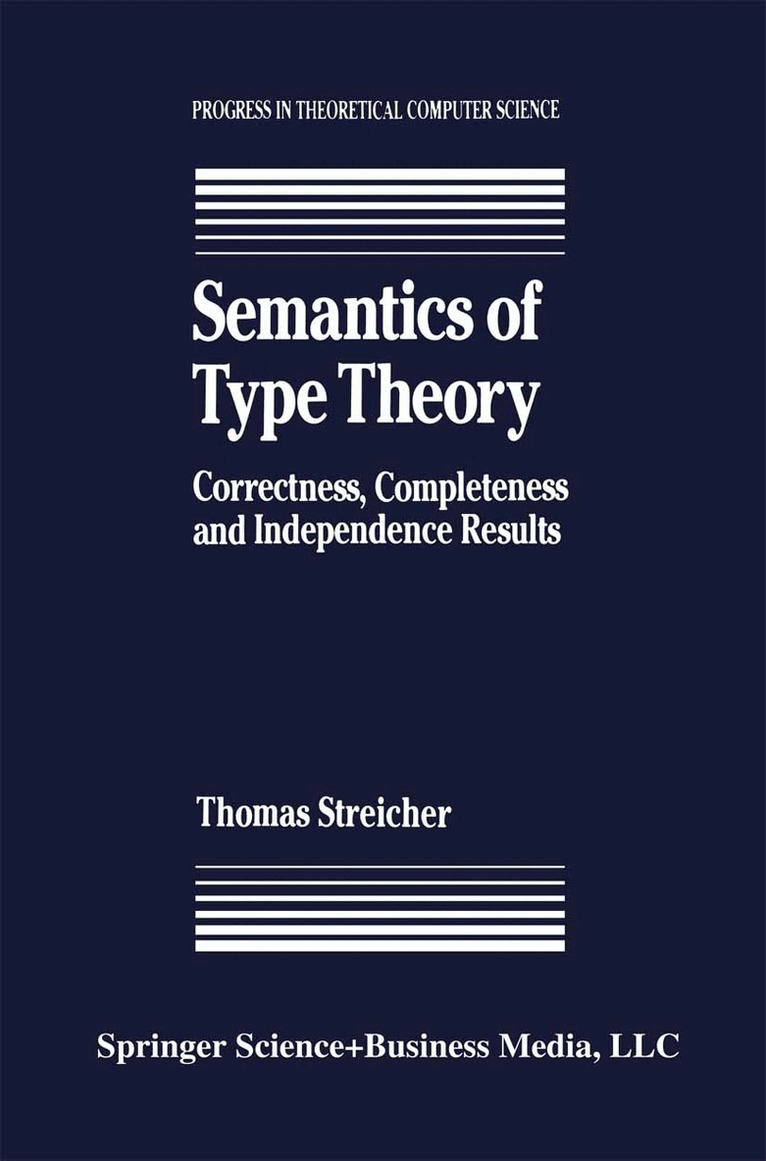
    Semantics of Type Theory

    Correctness, Completeness and Independence Results

    AvT. Streicher

    Häftad, Engelska, 2012

    Del i serien Progress in Theoretical Computer Science

    924 kr

    Beställningsvara. Skickas inom 10-15 vardagar. Fri frakt över 249 kr.

    Fler format och utgåvor

    E-bok

    1 176 kr

    Beskrivning

    Typing plays an important role in software development. Types can be consid­ ered as weak specifications of programs and checking that a program is of a certain type provides a verification that a program satisfies such a weak speci­ fication. By translating a problem specification into a proposition in constructive logic, one can go one step further: the effectiveness and unifonnity of a con­ structive proof allows us to extract a program from a proof of this proposition. Thus by the "proposition-as-types" paradigm one obtains types whose elements are considered as proofs. Each of these proofs contains a program correct w.r.t. the given problem specification. This opens the way for a coherent approach to the derivation of provably correct programs. These features have led to a "typeful" programming style where the classi­ cal typing concepts such as records or (static) arrays are enhanced by polymor­ phic and dependent types in such a way that the types themselves get a complex mathematical structure. Systems such as Coquand and Huet's Calculus of Con­ structions are calculi for computing within extended type systems and provide a basis for a deduction oriented mathematical foundation of programming. On the other hand, the computational power and the expressive (impred­ icativity !) of these systems makes it difficult to define appropriate semantics.

    Produktinformation

    • Utgivningsdatum:2012-10-29
    • Mått:155 x 235 x 18 mm
    • Vikt:482 g
    • Format:Häftad
    • Språk:Engelska
    • Serie:Progress in Theoretical Computer Science
    • Antal sidor:299
    • Förlag:Springer-Verlag New York Inc.
    • ISBN:9781461267577

    Utforska kategorier

    • Systemvetenskap och AI inom Data och IT
    • Beräkning och matematisk analys inom Naturvetenskap och teknik

    Innehållsförteckning

    • 1 Contextual Categories and Categorical Semantics of Dependent Types.- 2 Models for the Calculus of Constructions and Its Extensions.- 3 Correctness of the Interpretation of the Calculus of Constructions in Doctrines of Constructions.- 4 The Term Model of the Calculus of Constructions and Its Metamathematical Applications.- 5 Related Work, Extensions and Directions of Future Investigations.- Appendix Independence Proofs by Realizability Models.- References.