• Fri frakt över 249 kr
  • •
  • Snabba leveranser
  • •
  • Billiga böcker
Kundservice

Du är på sajten för privatpersoner.

Företag, bibliotek eller offentlig verksamhet?

Du handlar på classic.bokus.com, där alla dina funktioner finns intakta.
Till classic.bokus.com
Bokus logotyp. Gå till startsidan.
  • Erbjudanden
  • Student
  • Topplistor
  • Barn & ungdom
  • Bokus Play
  • E-böcker
  • Ljudböcker
  • Pocketböcker
  • Spel och pussel

Pocketfynda! Hundratals böcker för 49 kr/st →

Sidfot

Mina sidor

    Hjälp

    • Kundservice
    • Vanliga frågor och svar
    • Frakt och leverans
    • Retur vid ångerrätt
    • Reklamera vara
    • Betalning
    • Köpvillkor
    • Allmänna villkor
    • Information om webbplatsens tillgänglighet

    Om Bokus

    • Om oss
    • Pressrum
    • För studenter
    • För företag
    • För bibliotek och offentlig verksamhet
    • För leverantörer
    • Hållbarhet

    Populärt

    • Aktuella erbjudanden
    • Presentkort
    • Studentlitteratur
    • Nya böcker
    • Topplistor
    • Signerade böcker
    • Engelska böcker

    Inspiration

    • Boktips
    • BookTok
    • Barnbokskaraktärer
    • Populära författare
    Logotyp för Bokus
    Följ oss på Facebook (extern länk)Följ oss på Instagram (extern länk)Följ oss på YouTube (extern länk)Följ oss på TikTok (extern länk)
    bokus @ CookiesAnpassa cookiesIntegritetspolicyKöpvillkor
    Till Citymail hemsida (extern länk)Till Budbee hemsida (extern länk)Till Postnord hemsida (extern länk)Till Schenker hemsida (extern länk)Till Early Bird hemsida (extern länk)Till Walleys hemsida (extern länk)
    1. Data och IT
    2. Systemvetenskap och AI

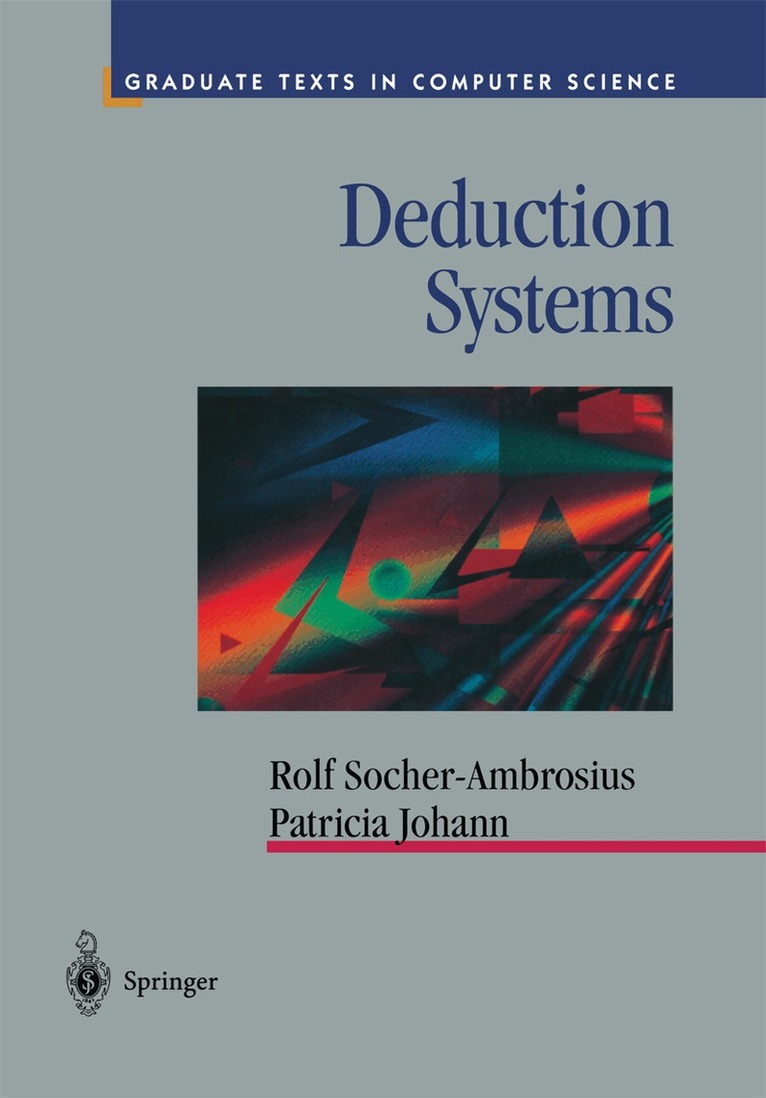
    Deduction Systems

    AvRolf Socher-Ambrosius,Patricia Johann

    Häftad, Engelska, 2011

    Del i serien Texts in Computer Science

    559 kr

    Beställningsvara. Skickas inom 10-15 vardagar. Fri frakt över 249 kr.

    Beskrivning

    The idea of mechanizing deductive reasoning can be traced all the way back to Leibniz, who proposed the development of a rational calculus for this purpose. But it was not until the appearance of Frege's 1879 Begriffsschrift-"not only the direct ancestor of contemporary systems of mathematical logic, but also the ancestor of all formal languages, including computer programming languages" ([Dav83])-that the fundamental concepts of modern mathematical logic were developed. Whitehead and Russell showed in their Principia Mathematica that the entirety of classical mathematics can be developed within the framework of a formal calculus, and in 1930, Skolem, Herbrand, and Godel demonstrated that the first-order predicate calculus (which is such a calculus) is complete, i. e. , that every valid formula in the language of the predicate calculus is derivable from its axioms. Skolem, Herbrand, and GOdel further proved that in order to mechanize reasoning within the predicate calculus, it suffices to Herbrand consider only interpretations of formulae over their associated universes. We will see that the upshot of this discovery is that the validity of a formula in the predicate calculus can be deduced from the structure of its constituents, so that a machine might perform the logical inferences required to determine its validity. With the advent of computers in the 1950s there developed an interest in automatic theorem proving.

    Produktinformation

    • Utgivningsdatum:2011-09-18
    • Mått:170 x 244 x 13 mm
    • Vikt:395 g
    • Format:Häftad
    • Språk:Engelska
    • Serie:Texts in Computer Science
    • Antal sidor:206
    • Förlag:Springer-Verlag New York Inc.
    • ISBN:9781461274797

    Utforska kategorier

    • Systemvetenskap och AI inom Data och IT

    Innehållsförteckning

    • 1 Introduction.- 2 Mathematical Preliminaries.- 2.1 Sets and Relations.- 2.2 Functions and Countability.- 2.3 Posets and Zorn’s Lemma.- 2.4 Trees.- 2.5 Mathematical Induction.- 3 Syntax of First-order Languages.- 3.1 First-order Languages.- 3.2 Induction over Terms and Formulae.- 3.3 Free and Bound Variables.- 3.4 Substitutions.- 4 Semantics of First-order Languages.- 4.1 Structures and Interpretations.- 4.2 The Substitution Lemma.- 5 The Gentzen Calculus G.- 5.1 The Calculus G.- 5.2 Completeness of G.- 6 Normal Forms and Herbrand’s Theorem.- 6.1 Normal Forms.- 6.2 Gentzen’s Sharpened Hauptsatz.- 6.3 Skolemization and Herbrand’s Theorem.- 7 Resolution and Unification.- 7.1 Ground Resolution.- 7.2 Unification.- 7.3 Improving Unification Algorithms.- 7.4 Resolution and Subsumption.- 7.5 Fair Derivation Strategies.- 8 Improving Deduction Efficiency.- 8.1 Delaying Unification.- 8.2 Unit Resolution.- 8.3 Input Resolution.- 8.4 Linear Resolution.- 8.5 Hyperresolution.- 8.6 Semantic Resolution and the Set-of-Support Strategy.- 8.7 Selection and Ordering Concepts.- 8.8 A Notion of Redundancy.- 9 Resolution in Sorted Logic.- 9.1 Introduction.- 9.2 Syntax and Semantics of Elementary Sorted Logic.- 9.3 Relativization.- 9.4 Sorted Logic with Term Declarations.- 9.5 Unification and Resolution in Sorted Signatures.- 9.6 Complexity of Sorted Unification.- References.